
IB DP Physics · Theme E · Nuclear and quantum physics

Fusion and stars.

E.5 · Where starlight comes from, how stars live and die, and how we measure them
Standard level and higher level

SL + HL · 6 hours E.4 Fission ↗

The journey

Four parts.

Part 01

Fusion

The energy released, and the temperature and density it needs

Part 02

The life of a star

Equilibrium, and how mass decides what happens

Part 03

The HR diagram

Its regions, and lines of constant radius

Part 04

Measuring stars

Distance by parallax, and radius from luminosity and temperature

E.5 FUSION AND STARS · SL + HL

Part 01

Fusion.

Light nuclei joining together: the energy source of the stars

E.5 FUSION AND STARS · SL + HL

Joining light nuclei

What fusion is.

DEUTERIUM AND TRITIUMPRESS → TO PLAY
  • Two light nuclei join to make a heavier one
  • The product is more tightly bound: mass is lost and energy released
  • Per kilogram of fuel, several times more than fission
E.5 FUSION AND STARS · SL + HL

Binding energy per nucleon

Why fusion releases energy.

  • The curve is steep for light nuclei
  • \({}^{2}\mathrm{H}\): 1.1 MeV per nucleon. \({}^{4}\mathrm{He}\): 7.1 MeV per nucleon
  • Fusion releases energy up to iron, at the peak
Beyond iron, fusing nuclei would take in energy.
MEASURED VALUESHORIZONTAL SCALE STRETCHED BELOW 60
E.5 FUSION AND STARS · SL + HL

Worked example

Energy released in fusion.

\({}^{2}\mathrm{H}\) + \({}^{3}\mathrm{H}\) → \({}^{4}\mathrm{He}\) + n · masses / u \({}^{2}\mathrm{H}\) 2.014102 · \({}^{3}\mathrm{H}\) 3.016049 \({}^{4}\mathrm{He}\) 4.002602 · n 1.008665 Before: \(2.014102 + 3.016049 = 5.030151\) After: \(4.002602 + 1.008665 = 5.011267\) \(\Delta m = 5.011267 - 5.030151 = -0.018884 \,\mathrm{u}\) \(E_\mathrm{released} = -(-0.018884) \times 931.5 = \class{res}{17.6 \,\mathrm{MeV}}\)
In the Sun, overall: 4 \({}^{1}\mathrm{H}\) → \({}^{4}\mathrm{He}\) \({}^{1}\mathrm{H}\) 1.007825 u \(\Delta m = 4.002602 - 4 \times 1.007825\) \(\Delta m = -0.028698 \,\mathrm{u}\) \(E_\mathrm{released} = -(-0.028698) \times 931.5 = \class{res}{26.7 \,\mathrm{MeV}}\)
E.5 FUSION AND STARS · SL + HL

Temperature and density

The conditions for fusion.

  • Nuclei are positive: they repel
  • The strong force acts only within about \(10^{-15}\) m
  • High temperature: enough kinetic energy to get that close
  • High density: enough collisions each second
TWO PROTONS APPROACHING
E.5 FUSION AND STARS · SL + HL

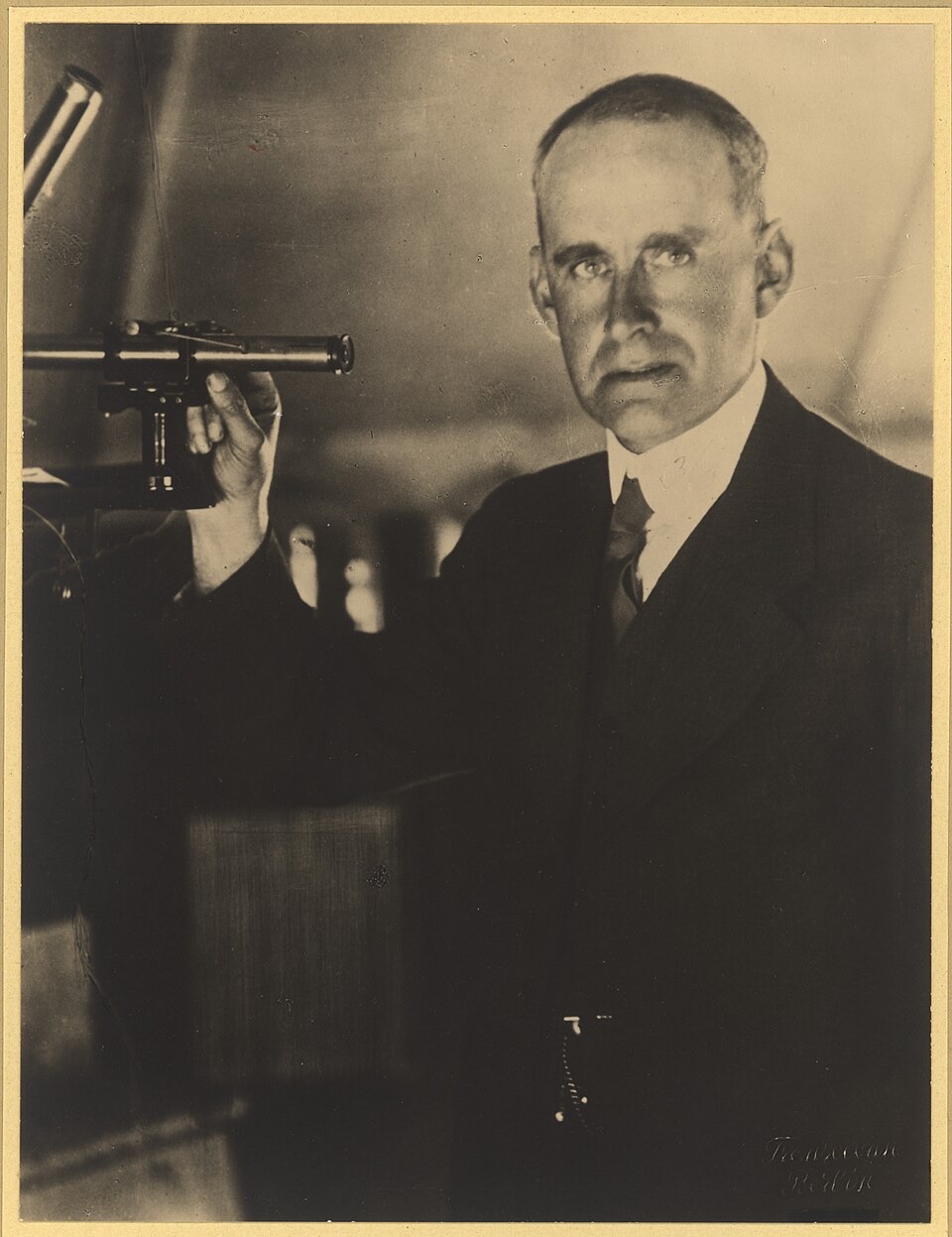
The story · England, the 1920s

Background story · not assessed

What keeps the Sun shining.

Photograph of Arthur Eddington
Arthur Eddington
  • The Sun has shone for thousands of millions of years. No chemical fuel, and no slow shrinking under gravity, could last so long
  • Four hydrogen nuclei have slightly more mass than one helium nucleus
  • Eddington proposed that the Sun is powered by fusing hydrogen into helium, and built the physics of stars on the idea in his book of 1926
  • Fusion had not yet been seen in any laboratory
A star explained from a table of atomic masses and \(E = mc^{2}\).
Photograph: Smithsonian Institution, no known restrictions.

E.5 FUSION AND STARS · SL + HL

Worked example

How long can the Sun shine.

\(L_{\odot} = 3.85 \times 10^{26} \,\mathrm{W}\) Signed rate of change of the Sun’s mass \(\dfrac{\Delta m}{\Delta t} = -\dfrac{L}{c^{2}}\) \(= -\dfrac{3.85 \times 10^{26}}{(3.00 \times 10^{8})^{2}}\) \(= \class{res}{-4.3 \times 10^{9} \,\mathrm{kg} \,\mathrm{s}^{-1}}\)
Mass \(2.0 \times 10^{30}\) kg · 10% of it fuses 0.71% of that mass becomes energy \(E = 0.10 \times 2.0 \times 10^{30} \times 0.0071 \times c^{2}\) \(E = 1.3 \times 10^{44} \,\mathrm{J}\) \(t = \dfrac{E}{L} = \dfrac{1.3 \times 10^{44}}{3.85 \times 10^{26}} = 3.3 \times 10^{17} \,\mathrm{s}\) \(t = \class{res}{1.0 \times 10^{10} \,\text{years}}\)
E.5 FUSION AND STARS · SL + HL

Quick check

Fusion.

01What is nuclear fusion?

Light nuclei joining to make a heavier one

02Why do nuclei have to be moving fast to fuse?

To overcome their electric repulsion

03Why is a high density needed?

For a high rate of collisions

04A mass defect of 0.0050 u. Energy released?

\(0.0050 \times 931.5 = 4.7 \,\mathrm{MeV}\)

05Up to which element does fusion release energy?

Iron

06\({}^{2}\mathrm{H}\) + \({}^{2}\mathrm{H}\) → \({}^{3}\mathrm{He}\) + ?

A neutron
PRESS → TO REVEAL EACH ANSWER

Part 02

The life of a star.

A long balance between gravity and pressure, and what happens when it ends

E.5 FUSION AND STARS · SL + HL

Why a star keeps its size

A star in equilibrium.

  • Gravity pulls every part of the star inwards
  • Radiation pressure and gas pressure push outwards
  • Fusion in the core supplies the energy that keeps the pressure up
Balanced: a stable star.
INWARDS AND OUTWARDS
E.5 FUSION AND STARS · SL + HL

One number sets the story

Mass decides.

  • More mass: stronger gravity, so a hotter, denser core
  • Fusion runs far faster: much greater luminosity
  • So the fuel is used up sooner
  • And the star ends differently
Mass (Sun = 1)Luminosity (Sun = 1)Time on the main sequence
0.5about 0.1\(\sim 10^{11}\) years
11\(\sim 10^{10}\) years
10about 3000\(\sim 3 \times 10^{7}\) years
E.5 FUSION AND STARS · SL + HL

Up to about eight solar masses

The life of a star like the Sun.

FOUR STAGESSIZES NOT TO SCALE
When the core runs out of hydrogen, fusion there stops, the core contracts and heats, and the outer layers swell and cool.
E.5 FUSION AND STARS · SL + HL

More than about eight solar masses

The life of a massive star.

FOUR STAGESSIZES NOT TO SCALE
The core is hot enough to fuse heavier and heavier nuclei, until it is iron. Then fusion can supply no more energy.
E.5 FUSION AND STARS · SL + HL

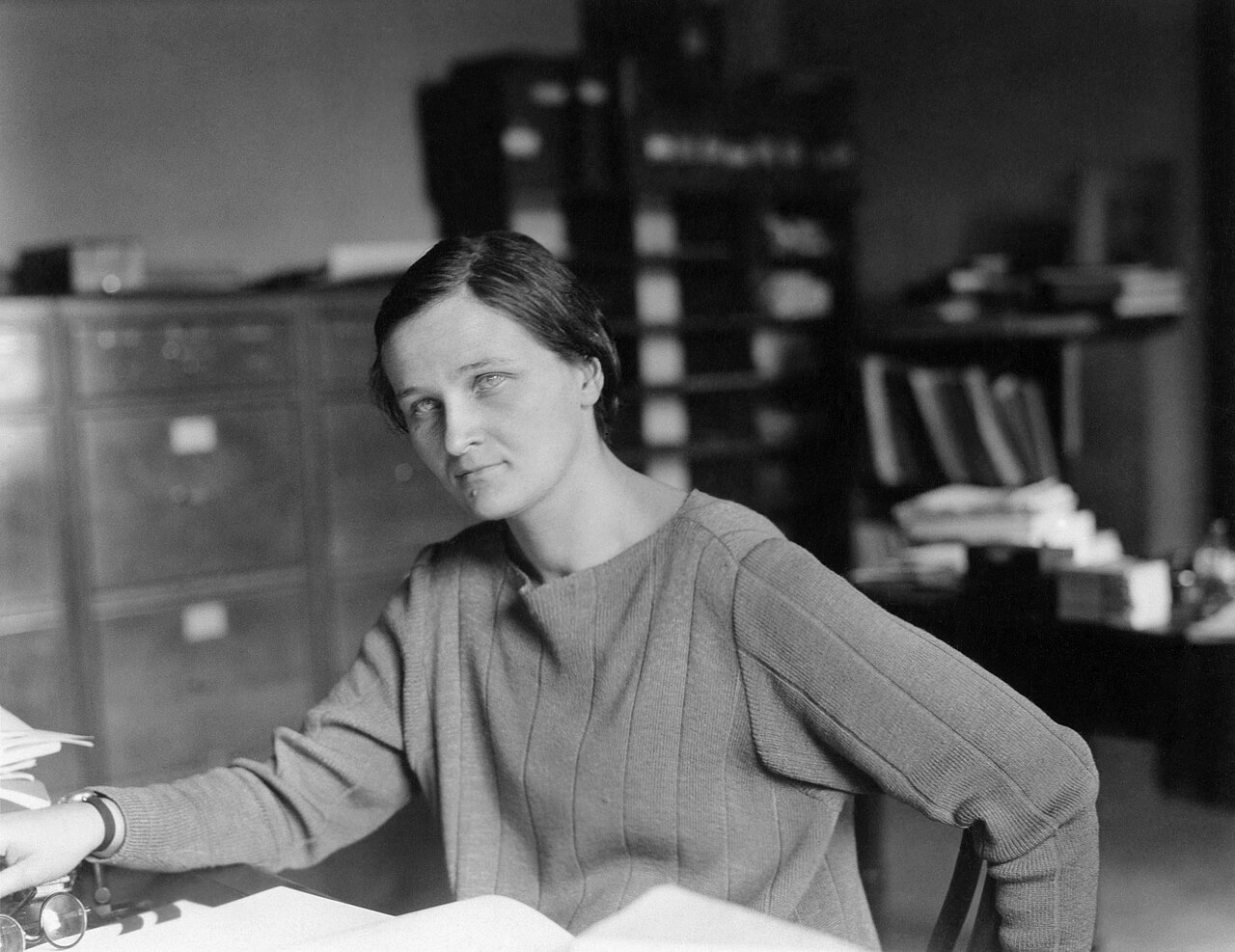
The story · Harvard, 1925

Background story · not assessed

What the stars are made of.

Black and white photograph of Cecilia Payne seated at a desk with papers, in front of filing cabinets and shelves
Cecilia Payne at the Harvard College Observatory
  • She came from England to Harvard in 1923. Her thesis of 1925 used the lines in stellar spectra to work out what stars are made of
  • Her answer: mainly hydrogen and helium. The leading astronomer of the day called it “spurious” and urged her not to claim it
  • In 1929 he reached the same result himself. Her thesis was later called the most brilliant ever written in astronomy

Photograph: Smithsonian Institution, Science Service, public domain.

E.5 FUSION AND STARS · SL + HL

Quick check

The life of a star.

01Which two things balance in a stable star?

Gravity inwards; radiation (and gas) pressure outwards

02What decides how a star’s life goes?

Its mass

03Which lives longer: a star of 0.5 or of 10 solar masses?

The 0.5 solar mass star

04What does the Sun become after the red giant stage?

A planetary nebula, then a white dwarf

05Why does fusion stop at iron in a massive star?

Iron is at the peak of the binding energy curve

06What can a supernova leave behind?

A neutron star or a black hole
PRESS → TO REVEAL EACH ANSWER

Part 03

The HR diagram.

One graph on which every star has a place

E.5 FUSION AND STARS · SL + HL

Luminosity against temperature

The Hertzsprung–Russell diagram.

  • Luminosity upwards, in units of the Sun’s
  • Temperature across, decreasing to the right
  • Both scales are logarithmic
  • Stars fall into a few regions, not everywhere
EACH DOT IS A STARILLUSTRATIVE
E.5 FUSION AND STARS · SL + HL

Who lives where

The regions of the HR diagram.

RegionWhere on the diagramWhat the stars are like
Main sequenceA band from upper left to lower rightFusing hydrogen in the core. About 90% of stars
Red giantsAbove the main sequence, on the rightCool but luminous, so very large
SupergiantsAcross the topThe most luminous and the largest
White dwarfsLower leftHot but faint, so very small
Instability stripA narrow band crossing above the main sequenceStars that pulsate, varying in brightness
E.5 FUSION AND STARS · SL + HL

Size on the HR diagram

Lines of constant radius.

\(L = \sigma A T^{4} = 4 \pi R^{2} \sigma T^{4}\)
  • For one radius, \(L \propto T^{4}\): a straight line on these axes
  • Sloping down to the right
  • Larger stars: lines further up and right
THREE RADII
E.5 FUSION AND STARS · SL + HL

A life as a path

The Sun’s path on the HR diagram.

  • Now: on the main sequence, hardly moving
  • Red giant: up and to the right. Cooler, larger, more luminous
  • Outer layers lost: across to the left as the hot core is uncovered
  • White dwarf: down to the lower left, then cooling
A SKETCH OF THE PATH
E.5 FUSION AND STARS · SL + HL

Quick check

The HR diagram.

01What is plotted on each axis?

Luminosity up; temperature across

02Which way does temperature increase?

To the left

03Where are white dwarfs?

Lower left: hot and faint

04A star is cool but very luminous. What does that say about its size?

It is very large

05Where on the main sequence are the most massive stars?

Upper left

06Two stars lie on the same line of constant radius. What do they share?

The same radius
PRESS → TO REVEAL EACH ANSWER

Part 04

Measuring stars.

How far away, how bright, how hot and how big, from a point of light

E.5 FUSION AND STARS · SL + HL

Distance by geometry

Stellar parallax.

\(d \,\text{(parsec)} = \dfrac{1}{p \,\text{(arc-second)}}\)
  • A nearby star shifts against distant ones as the Earth orbits
  • \(p\): half the total shift in six months
  • Further away: a smaller angle
NOT TO SCALE
E.5 FUSION AND STARS · SL + HL

AU, light years and parsecs

Units of distance.

UnitValue
Astronomical unit, AU: the Earth–Sun distance\(1.50 \times 10^{11} \,\mathrm{m}\)
Light year, ly: the distance light travels in a year\(9.46 \times 10^{15} \,\mathrm{m}\)
Parsec, pc: parallax of one arc-second3.26 ly
The nearest star: \(p = 0.769\) arc-second \(d = \dfrac{1}{p} = \dfrac{1}{0.769} = \class{res}{1.30 \,\mathrm{pc}}\) \(d = 1.30 \times 3.26 = \class{res}{4.24 \,\mathrm{ly}}\) \(d = 4.24 \times 9.46 \times 10^{15} = \class{res}{4.0 \times 10^{16} \,\mathrm{m}}\) \(d = \dfrac{4.0 \times 10^{16}}{1.50 \times 10^{11}} = \class{res}{2.7 \times 10^{5} \,\mathrm{AU}}\)
E.5 FUSION AND STARS · SL + HL

Worked example

The radius of a star.

Sirius: \(L = 9.8 \times 10^{27} \,\mathrm{W}\) · \(T = 9940 \,\mathrm{K}\) \(L = 4 \pi R^{2} \sigma T^{4}\) \(R = \sqrt{\dfrac{L}{4 \pi \sigma T^{4}}}\) \(R = \sqrt{\dfrac{9.8 \times 10^{27}}{4 \pi \times 5.67 \times 10^{-8} \times 9940^{4}}}\) \(R = \class{res}{1.2 \times 10^{9} \,\mathrm{m}}\)
The same, as a ratio to the Sun (5800 K) \(\dfrac{R}{R_{\odot}} = \sqrt{\dfrac{L}{L_{\odot}}} \left(\dfrac{T_{\odot}}{T}\right)^{2}\) \(= \sqrt{25.4} \times \left(\dfrac{5800}{9940}\right)^{2}\) \(= \class{res}{1.7}\)
E.5 FUSION AND STARS · SL + HL

Putting it together

Everything from a point of light.

Step 1 · Parallax

Distance

\(d = \frac{1}{p}\)

Step 2 · Brightness

Luminosity

\(L = 4 \pi d^{2} b\)
from B.1

Step 3 · Spectrum

Temperature and composition

Wien’s law for the peak; the lines for the elements

Step 4 · Stefan–Boltzmann

Radius

\(R = \sqrt{\frac{L}{4 \pi \sigma T^{4}}}\)

With \(L\) and \(T\) the star has a place on the HR diagram, and from that its stage of life.
E.5 FUSION AND STARS · SL + HL

Quick check

Measuring stars.

01A star has a parallax of 0.20 arc-second. Distance?

5.0 pc

02Convert 10 pc to light years.

32.6 ly

03Why does parallax fail for very distant stars?

The angle is too small to measure

04A star has the Sun’s temperature and 100 times its luminosity. Radius?

10 solar radii

05What two things does a star’s spectrum give?

Surface temperature and composition

06Which law gives the temperature from the peak wavelength?

Wien’s displacement law
PRESS → TO REVEAL EACH ANSWER

Summary

Fusion and stars on one slide.

Fusion

Light nuclei join

\(E_\mathrm{released} = -\Delta m \, c^{2}\)
Needs high temperature and high density

A stable star

Gravity = pressure

Inward gravity against outward radiation pressure

Mass decides

Heavier: brighter, shorter

White dwarf, or supernova and neutron star or black hole

HR diagram

\(L\) up, \(T\) falling to the right

Main sequence, red giants, supergiants, white dwarfs, instability strip

Distance

\(d = \frac{1}{p}\)

Parsecs and arc-seconds
1 pc = 3.26 ly

Radius

\(L = 4 \pi R^{2} \sigma T^{4}\)

Lines of constant radius slope down to the right

E.5 FUSION AND STARS · SL + HL

Summary

Key words.

FusionLight nuclei joining to make a heavier one
Radiation pressureThe outward push of light on matter
Main sequenceStars fusing hydrogen in their cores
Red giantCool, luminous and very large
White dwarfHot, faint and very small: a dead core
SupernovaThe explosion of a massive star
HR diagramLuminosity against surface temperature
ParallaxApparent shift of a nearby star as the Earth orbits
ParsecDistance for a parallax of one arc-second
E.5 FUSION AND STARS · SL + HL