IB DP Physics · Theme E · Nuclear and quantum physics

Fission.

E.4 · Splitting heavy nuclei: the energy released, chain reactions, reactors and waste
Standard level and higher level

SL + HL · 4 hours E.3 Radioactive decay ↗

The journey

Three parts.

Part 01

Fission and its energy

What happens, why energy is released, and how much

Part 02

Chain reactions and reactors

Moderator, control rods, heat exchanger and shielding

Part 03

The products of fission

What is left behind, and how it is managed

E.3 gave the tools: mass defect, binding energy per nucleon and \(E = mc^{2}\).
E.4 FISSION · SL + HL

Part 01

Fission and its energy.

A heavy nucleus splits in two, and a little mass disappears

E.4 FISSION · SL + HL

Splitting a heavy nucleus

What fission is.

NEUTRON-INDUCED FISSIONPRESS → TO PLAY
  • A heavy nucleus splits into two lighter nuclei and a few neutrons
  • Neutron-induced: it first absorbs a neutron
  • Spontaneous: it splits by itself, a rare kind of radioactive decay
  • Either way, energy is released
E.4 FISSION · SL + HL

The story · Berlin and Sweden, December 1938

Background story · not assessed

The nucleus that split.

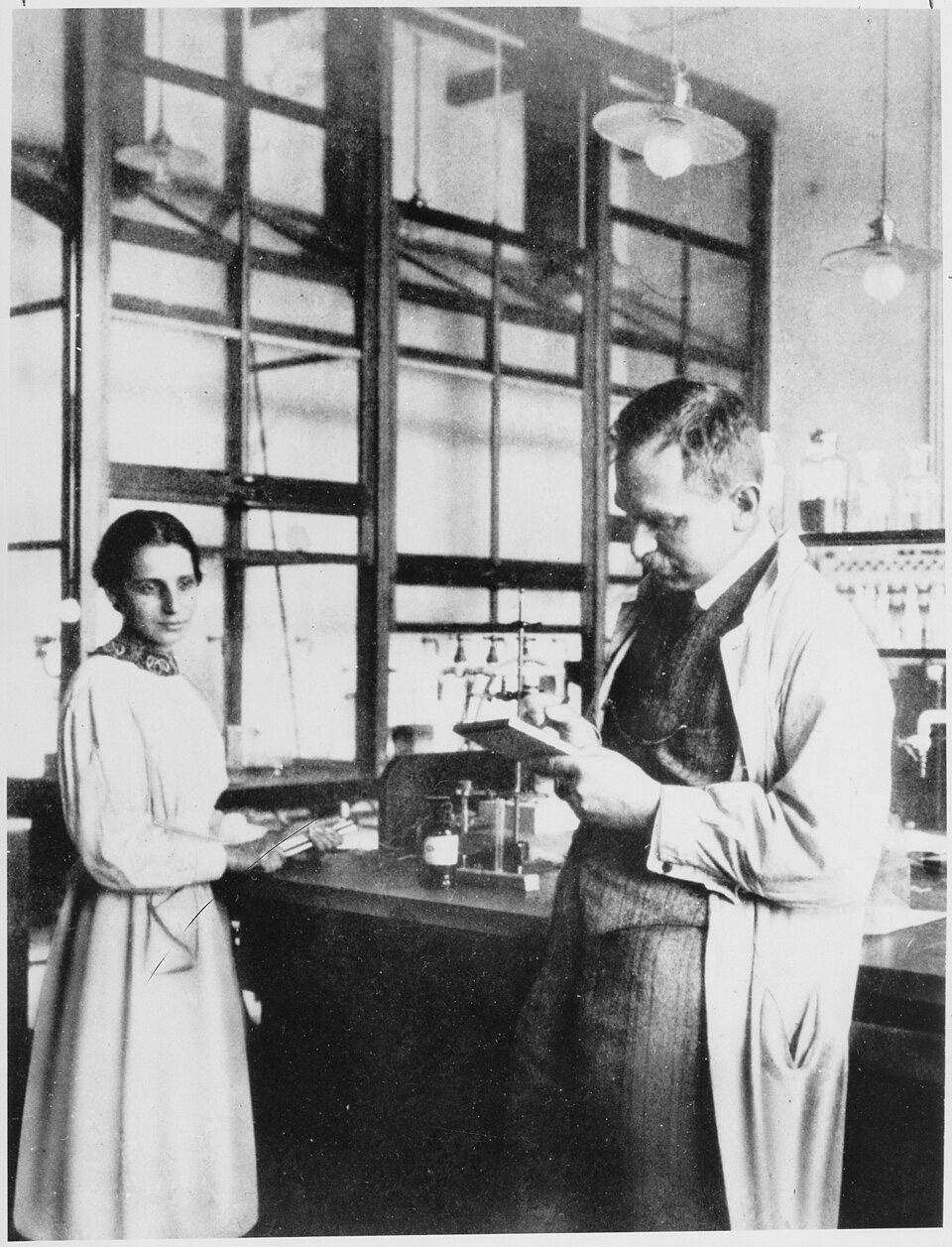
Black and white photograph of Lise Meitner and Otto Hahn standing at a laboratory bench in front of tall windows
Lise Meitner and Otto Hahn in their laboratory, 1913
  • In Berlin, Otto Hahn and Fritz Strassmann fired neutrons at uranium and found barium: an element half its size
  • Their colleague of thirty years, Lise Meitner, had fled Germany that July
  • At Christmas in Sweden, she and her nephew Otto Frisch worked it out: the nucleus had split, releasing about 200 MeV
  • Frisch named it fission, after the division of a living cell
The Nobel Prize for the discovery went to Hahn alone.

Photograph: unknown photographer, 1913, public domain.

E.4 FISSION · SL + HL

Binding energy per nucleon

Why energy is released.

  • Uranium: about 7.6 MeV per nucleon
  • The fragments: about 8.4 MeV per nucleon
  • More tightly bound means less mass
The difference in binding energy is released.
MOVING UP THE CURVE
E.4 FISSION · SL + HL

Worked example · first method

Energy released, from binding energies.

Binding energy per nucleon / MeV \({}^{235}\mathrm{U}\): 7.59 · \({}^{141}\mathrm{Ba}\): 8.33 · \({}^{92}\mathrm{Kr}\): 8.51 Before: \(235 \times 7.59 = 1784 \,\mathrm{MeV}\) After: \(141 \times 8.33 + 92 \times 8.51\) \(= 1175 + 783 = 1958 \,\mathrm{MeV}\)
Energy released = binding energy after − before \(= 1958 - 1784\) \(= \class{res}{174 \,\mathrm{MeV}}\)
Free neutrons have no binding energy: leave them out.
E.4 FISSION · SL + HL

Worked example · second method

Energy released, from masses.

Masses / u \({}^{235}\mathrm{U}\) 235.043930 · n 1.008665 \({}^{141}\mathrm{Ba}\) 140.914411 · \({}^{92}\mathrm{Kr}\) 91.926156 Before: \(235.043930 + 1.008665 = 236.052595\) After: \(140.914411 + 91.926156 + 3 \times 1.008665\) \(= 235.866562\)
\(\Delta m = 235.866562 - 236.052595\) \(\Delta m = -0.186033 \,\mathrm{u}\) \(E_\mathrm{released} = -\Delta m\,c^{2}\) \(E_\mathrm{released} = -(-0.186033) \times 931.5 = \class{res}{173 \,\mathrm{MeV}}\)
E.4 FISSION · SL + HL

Worked example

A kilogram of uranium-235.

173 MeV per fission · molar mass 235 g mol⁻¹ \(N = \dfrac{m}{M} N_\mathrm{A} = \dfrac{1000}{235} \times 6.02 \times 10^{23}\) \(N = 2.56 \times 10^{24}\) nuclei \(E = N \times 173 \times 1.60 \times 10^{-13}\) \(E = \class{res}{7.1 \times 10^{13} \,\mathrm{J}}\)
  • Coal gives about \(3 \times 10^{7}\) J per kilogram
  • So 1 kg of uranium-235 matches over two thousand tonnes of coal
  • Most of the energy is the kinetic energy of the fragments
E.4 FISSION · SL + HL

Quick check

Fission and its energy.

01What is the difference between spontaneous and induced fission?

Induced fission first absorbs a neutron

02n + \({}^{235}\mathrm{U}\) → \({}^{144}\mathrm{Ba}\) + \({}^{89}\mathrm{Kr}\) + ? neutrons

3 neutrons

03Which is more tightly bound per nucleon: uranium or its fragments?

The fragments

04A mass defect of 0.20 u. Energy released?

\(0.20 \times 931.5 = 186 \,\mathrm{MeV}\)

05In what form is most of the energy released?

Kinetic energy of the fragments

06Why can a slow neutron enter a nucleus easily?

It has no charge: no repulsion
PRESS → TO REVEAL EACH ANSWER

Part 02

Chain reactions and reactors.

Keeping the reaction going, and keeping it steady

E.4 FISSION · SL + HL

Neutrons making more neutrons

Chain reactions.

EACH FISSION CAUSES TWO MORENOT TO SCALE
0 Neutron Uranium-235 Pair: has just split
  • Each fission needs one neutron and releases two or three
  • Those neutrons can cause further fissions: a chain reaction
  • If more than one goes on to cause a fission, the rate grows
E.4 FISSION · SL + HL

One neutron, on average

Controlling a chain reaction.

Fewer than one goes on

The reaction dies away

Sub-critical: shutting down

Exactly one goes on

A steady rate

Critical: a reactor running at constant power

More than one goes on

The rate grows

Supercritical: raising the power, or, unchecked, an explosion

A reactor needs two things: enough slow neutrons to keep the chain going, and a way to absorb the surplus.
E.4 FISSION · SL + HL

Slowing the neutrons

The moderator.

  • Fission neutrons are fast: about 1 MeV
  • Slow, thermal neutrons are far more likely to cause fission in \({}^{235}\mathrm{U}\)
  • The moderator slows them by collisions with light nuclei
  • Water or graphite
A NEUTRON IN THE MODERATOR
E.4 FISSION · SL + HL

Absorbing the surplus

Control rods.

  • Rods of a material that absorbs neutrons strongly, such as boron or cadmium
  • Lowered further in: more neutrons absorbed, fewer fissions, less power
  • Raised: more fissions, more power

Moderator

Slows neutrons

So that they can cause fission

Control rods

Absorb neutrons

So that only one per fission goes on

E.4 FISSION · SL + HL

From fission to electricity

A nuclear power plant.

  • Fuel rods: fission heats them
  • Heat exchanger: hot coolant from the core boils water in a separate loop
  • Steam turns a turbine and generator
  • Shielding: steel and concrete absorb neutrons and gamma rays
A PRESSURIZED-WATER REACTORSCHEMATIC
E.4 FISSION · SL + HL

The story · Chicago, 2 December 1942

Background story · not assessed

A reactor in a squash court.

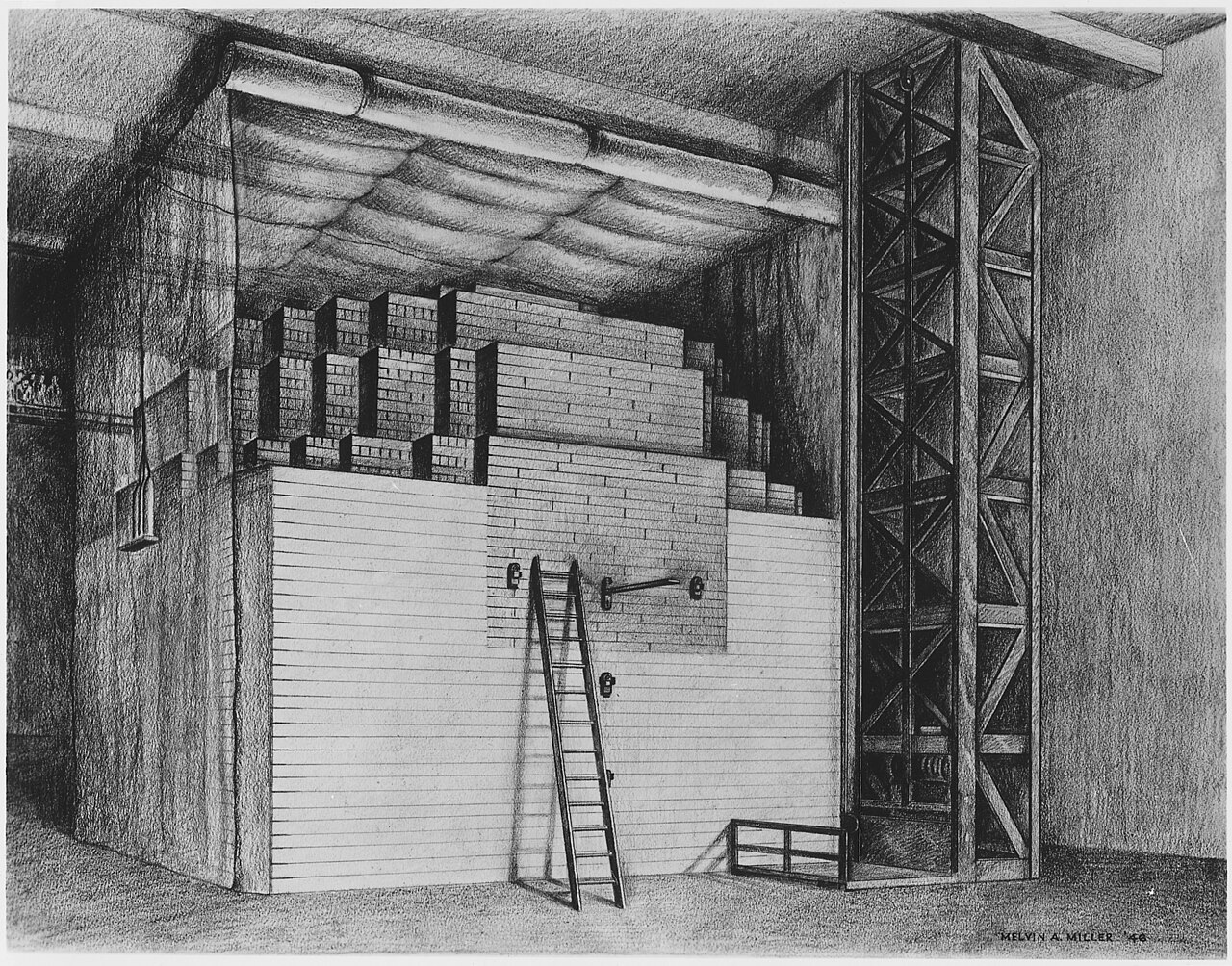
Drawing of a large stack of dark blocks, as tall as a room, built inside a timber frame with a ladder leaning against it
Chicago Pile-1, drawn by Melvin A. Miller
  • Under the stands of a university sports field, Enrico Fermi’s team stacked 45 000 blocks of graphite with uranium between them
  • Graphite was the moderator. Strips of wood covered in cadmium were the control rods
  • At 15:25 the chain reaction became self-sustaining, at about half a watt
  • No shielding and no cooling: it was never meant to run at power
The message sent in code: “The Italian navigator has landed in the New World.”

Drawing: Melvin A. Miller, Argonne National Laboratory, public domain.

E.4 FISSION · SL + HL

Worked example

The fuel used in a day.

1000 MW of electrical power · efficiency 33% 173 MeV = \(2.77 \times 10^{-11}\) J per fission \(P_\mathrm{in} = \dfrac{P_\mathrm{out}}{\eta} = \dfrac{1.0 \times 10^{9}}{0.33} = 3.0 \times 10^{9} \,\mathrm{W}\) Fissions per second \(= \dfrac{3.0 \times 10^{9}}{2.77 \times 10^{-11}}\) \(= 1.1 \times 10^{20} \,\mathrm{s}^{-1}\)
In one day: 86 400 s \(N = 1.1 \times 10^{20} \times 86\,400 = 9.5 \times 10^{24}\) \(m = N \times 235 \,\mathrm{u}\) \(m = 9.5 \times 10^{24} \times 235 \times 1.661 \times 10^{-27}\) \(m = \class{res}{3.7 \,\mathrm{kg}}\) of \({}^{235}\mathrm{U}\)
E.4 FISSION · SL + HL

Quick check

Chain reactions and reactors.

01What carries a chain reaction from one fission to the next?

Neutrons

02How many neutrons per fission must go on, for steady power?

Exactly one, on average

03What does the moderator do?

Slows the neutrons by collisions

04What do the control rods do?

Absorb neutrons

05Why is there a heat exchanger?

To keep radioactive coolant out of the turbine

06The control rods are lowered further. What happens to the power?

It falls
PRESS → TO REVEAL EACH ANSWER

Part 03

The products of fission.

What comes out of a reactor, and what has to be done with it

E.4 FISSION · SL + HL

What is in spent fuel

The products of fission.

  • The fragments have too many neutrons for their size
  • So they are radioactive: beta-minus emitters, with gamma rays
  • Half-lives from seconds to millions of years
  • Neutrons also turn \({}^{238}\mathrm{U}\) into plutonium and other heavy nuclei
In spent fuelHalf-life
Iodine-1318 days
Strontium-9029 years
Cesium-13730 years
Plutonium-23924 000 years
E.4 FISSION · SL + HL

What is done with it

Managing nuclear waste.

  • First years: under water in cooling ponds, which absorb radiation and remove heat
  • Then: sealed in steel and concrete casks, or reprocessed and set in glass
  • Finally: burial deep in stable rock
ACTIVITY OF SPENT FUELA SKETCH
E.4 FISSION · SL + HL

The story · Olkiluoto, Finland

Background story · not assessed

A cave built to be forgotten.

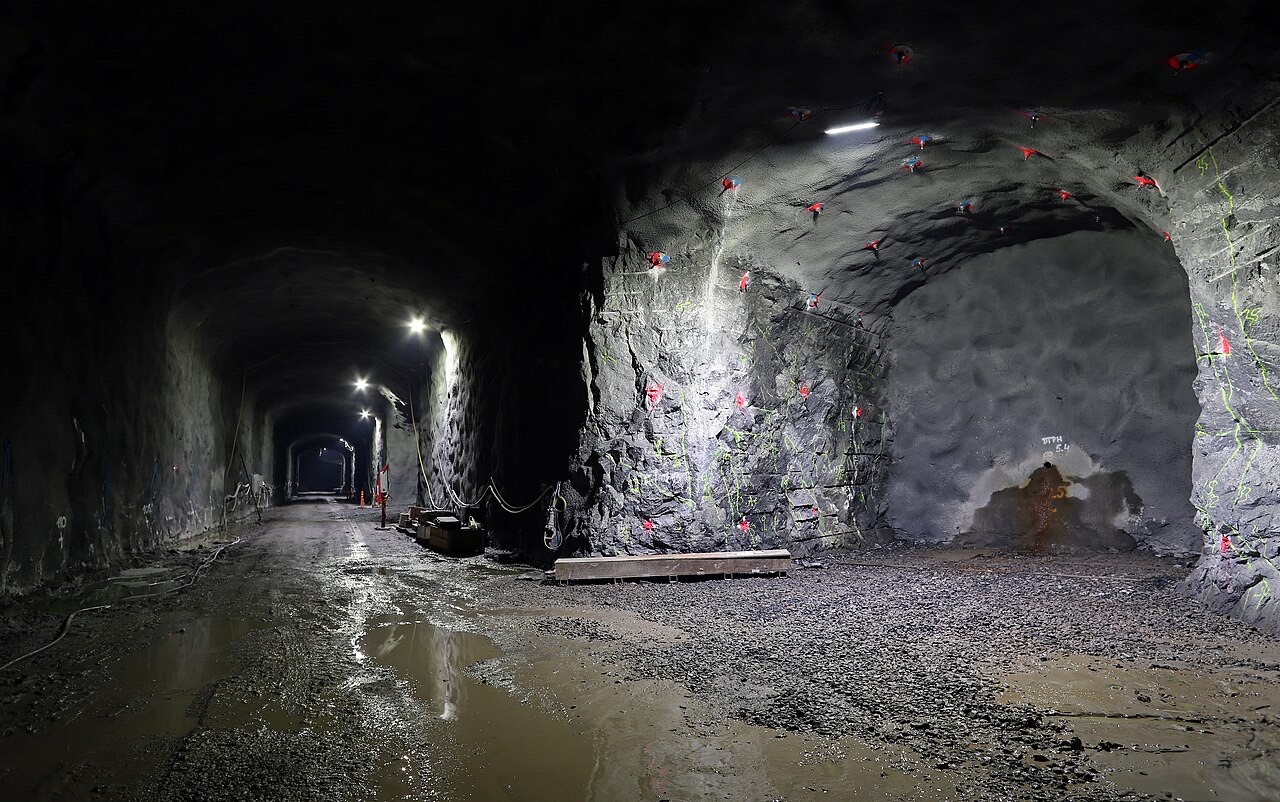
A wide tunnel cut through bare rock, lit by lamps, with a side chamber opening on the right and a wet gravel floor
A tunnel in the Onkalo repository. The name means “small cave”
  • Excavation into granite bedrock began in 2004; the tunnels reach about 450 m down
  • Spent fuel goes into cast-iron inserts inside copper canisters, each in its own hole, packed round with clay
  • The first permanent store for spent fuel in the world. Its capsules are meant to last 100 000 years

Photograph: kallerna, CC BY-SA 4.0.

E.4 FISSION · SL + HL

Worked example

How long it must be stored.

Cesium-137: half-life 30 years What fraction remains after 300 years? Number of half-lives \(= \dfrac{300}{30} = 10\) Fraction remaining \(= \left(\dfrac{1}{2}\right)^{10}\) \(= \class{res}{\dfrac{1}{1024}}\)
  • About a thousandth after three centuries
  • Plutonium-239 over the same time: \(\dfrac{300}{24\,000}\) of a half-life. Hardly any has gone
Ten half-lives: a factor of a thousand.
E.4 FISSION · SL + HL

Quick check

The products of fission.

01Why are fission fragments radioactive?

Too many neutrons for their size

02Which decay do they mostly undergo?

Beta-minus

03Why is spent fuel first stored under water?

To absorb radiation and remove heat

04Strontium-90 has a half-life of 29 years. Fraction left after 87 years?

\(\frac{1}{8}\)

05Why is plutonium a long-term problem?

Its half-life is 24 000 years

06Where is high-level waste finally stored?

Deep underground, in stable rock
PRESS → TO REVEAL EACH ANSWER

Summary

Fission on one slide.

Fission

A heavy nucleus splits

Spontaneous, or induced by a neutron
Two fragments and a few neutrons

Energy

\(E_\mathrm{released} = -\Delta m \, c^{2}\)

Or the rise in total binding energy
About 200 MeV per fission

Chain reaction

Neutrons cause more fissions

Steady when one per fission goes on

Moderator · control rods

Slow · absorb

Slow neutrons cause fission; surplus neutrons are removed

Heat exchanger · shielding

Transfer · protect

Steam for the turbine from a separate loop

Products

Radioactive, some for millennia

Cooling ponds, casks, deep burial

E.4 FISSION · SL + HL

Summary

Key words.

FissionThe splitting of a heavy nucleus
Induced fissionTriggered by absorbing a neutron
Chain reactionNeutrons from one fission cause others
Critical massThe least mass that sustains a chain reaction
Thermal neutronA slow neutron, in equilibrium with the moderator
ModeratorSlows neutrons by collisions
Control rodAbsorbs neutrons
Heat exchangerPasses thermal energy to a separate loop
Fission productsThe radioactive fragments
E.4 FISSION · SL + HL