IB DP Physics · Theme E · Nuclear and quantum physics

Quantum physics.

E.2 · Photoelectric effect, matter waves, Compton scattering
Higher level only: there is no standard level content in E.2

Additional HL · 8 hours E.1 Structure of the atom ↗

The journey

Three experiments.

Part 01

The photoelectric effect

Light behaves as particles

Part 02

Electron diffraction

Particles behave as waves

Part 03

Compton scattering

Photons carry momentum

Together: light and matter both show wave–particle duality.
E.2 QUANTUM PHYSICS · HL ONLY

Part 01

The photoelectric effect.

How can light be used to create an electric current?

E.2 QUANTUM PHYSICS · HL ONLY

From E.1

Photons: a reminder.

  • Light arrives as photons
  • Energy of each depends on frequency only
  • Intensity: how many arrive each second
\(E = hf = \dfrac{hc}{\lambda}\)
RadiationWavelengthPhoton energy
Red light700 nm1.77 eV
Violet light400 nm3.10 eV
Ultraviolet250 nm4.96 eV
E.2 QUANTUM PHYSICS · HL ONLY

The effect

Light knocks electrons out of a metal.

  • Shine light on a clean metal
  • Electrons may be emitted
  • They are called photoelectrons
But only if the frequency is high enough.
PHOTOELECTRIC EMISSIONNOT TO SCALE
E.2 QUANTUM PHYSICS · HL ONLY

The evidence

Four things the experiments show.

01 · Threshold

No emission below a certain frequency

The threshold frequency \(f_{0}\), different for each metal

02 · No delay

Emission starts at once

Even when the light is very dim

03 · Intensity

Brighter light: more electrons

But their maximum kinetic energy does not change

04 · Frequency

Higher frequency: faster electrons

Maximum kinetic energy rises with \(f\)

E.2 QUANTUM PHYSICS · HL ONLY

Classical wave theory against the evidence

Why the wave theory fails.

A wave would…What happens
FrequencyWork at any frequency, if bright enoughNothing below \(f_{0}\), however bright
TimeNeed time to build up energy in dim lightEmission is immediate
IntensityGive each electron more energy when brighterSame maximum energy: only more electrons
EnergyNot depend on frequencyMaximum energy rises with frequency
E.2 QUANTUM PHYSICS · HL ONLY

The story · Bern, 1905

Background story · not assessed

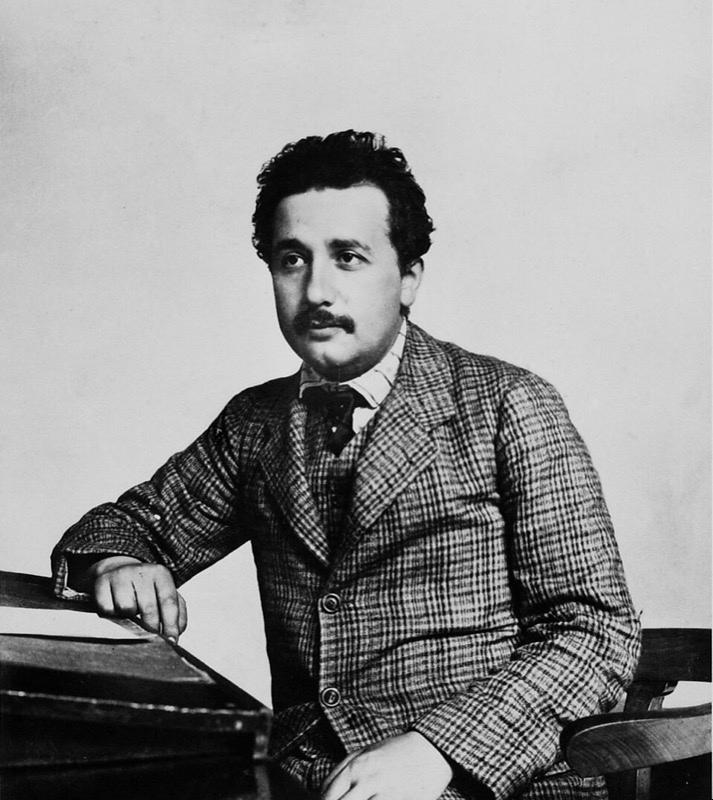
A patent clerk’s revolutionary idea.

A young Albert Einstein in a checked suit, sitting beside a desk
Albert Einstein at the patent office in Bern, about 1905
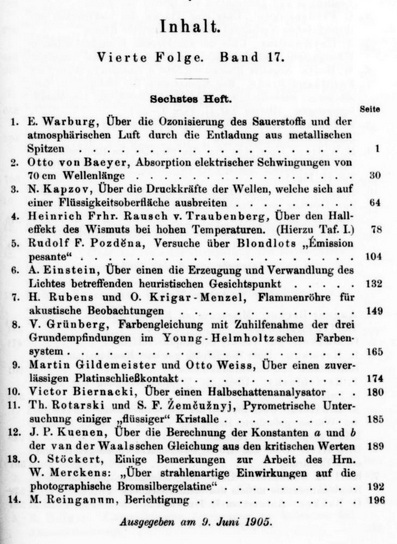
A printed contents page in German listing the papers in a journal
The journal’s contents, June 1905. His paper is sixth on the list
  • Einstein, aged 26, checks patents for a living and does physics in his spare time
  • His paper says light itself comes in packets of energy \(hf\): light quanta
  • Almost nobody believes it. Light was known to be a wave
  • 1921: the Nobel Prize, for this and not for relativity
He called it the one revolutionary thing he had done.

Photo: Lucien Chavan, public domain. Contents page: Nerd271, CC0.

E.2 QUANTUM PHYSICS · HL ONLY

Einstein (1905)

One photon, one electron.

  • Light is a stream of photons, each of energy \(hf\)
  • One photon gives all its energy to one electron
  • Work function \(\Phi\): the least energy needed to leave the metal
  • What is left over is kinetic energy
WHERE THE PHOTON’S ENERGY GOES
E.2 QUANTUM PHYSICS · HL ONLY

Einstein’s equation

The photoelectric equation.

\(E_{\mathrm{max}} = hf - \Phi\)
  • \(E_{\mathrm{max}}\): maximum kinetic energy of the photoelectrons
  • \(\Phi\): work function of the metal
  • At the threshold \(E_{\mathrm{max}} = 0\), so \(hf_{0} = \Phi\)
Threshold for zinc · \(\Phi = 4.30 \,\mathrm{eV}\) \(f_{0} = \dfrac{\Phi}{h} = \dfrac{4.30 \times 1.60 \times 10^{-19}}{6.63 \times 10^{-34}}\)   \(= \class{res}{1.04 \times 10^{15} \,\mathrm{Hz}}\) \(\lambda _{0} = \dfrac{c}{f_{0}} = \class{res}{2.88 \times 10^{-7} \,\mathrm{m}}\) 288 nm: ultraviolet
E.2 QUANTUM PHYSICS · HL ONLY

Einstein’s equation as a graph

One straight line, three readings.

  • \(E_{\mathrm{max}} = hf - \Phi\) has the form \(y = mx + c\)
  • Gradient = \(h\), the same for every metal
  • Intercept on the \(f\) axis = \(f_{0}\)
  • Intercept on the energy axis = \(-\Phi\)
Another metal: a parallel line.
MAXIMUM KINETIC ENERGY AGAINST FREQUENCY
E.2 QUANTUM PHYSICS · HL ONLY

The story · Chicago, 1912–1915

Background story · not assessed

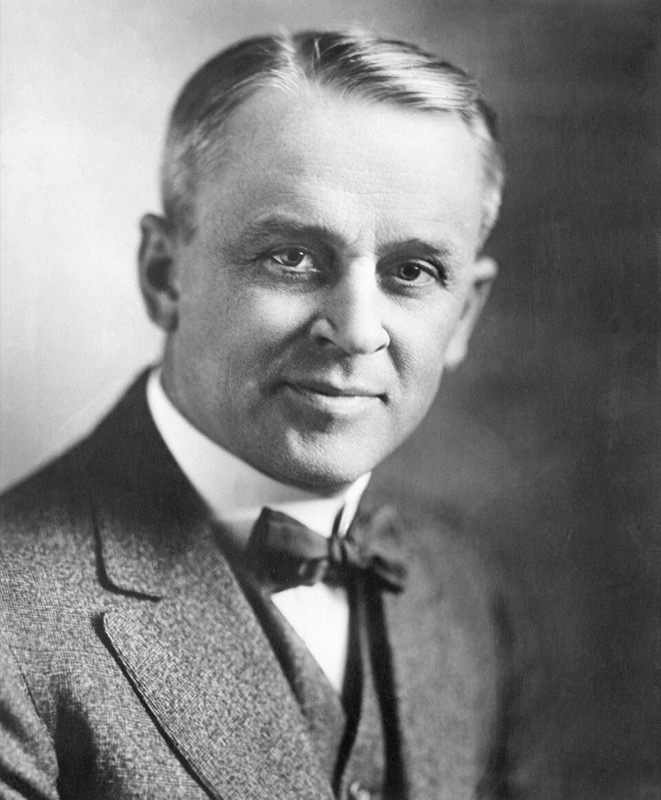
Millikan sets out to prove Einstein wrong.

Portrait of Robert Millikan in a suit and bow tie
Robert Millikan, pictured in 1923, the year of his Nobel Prize
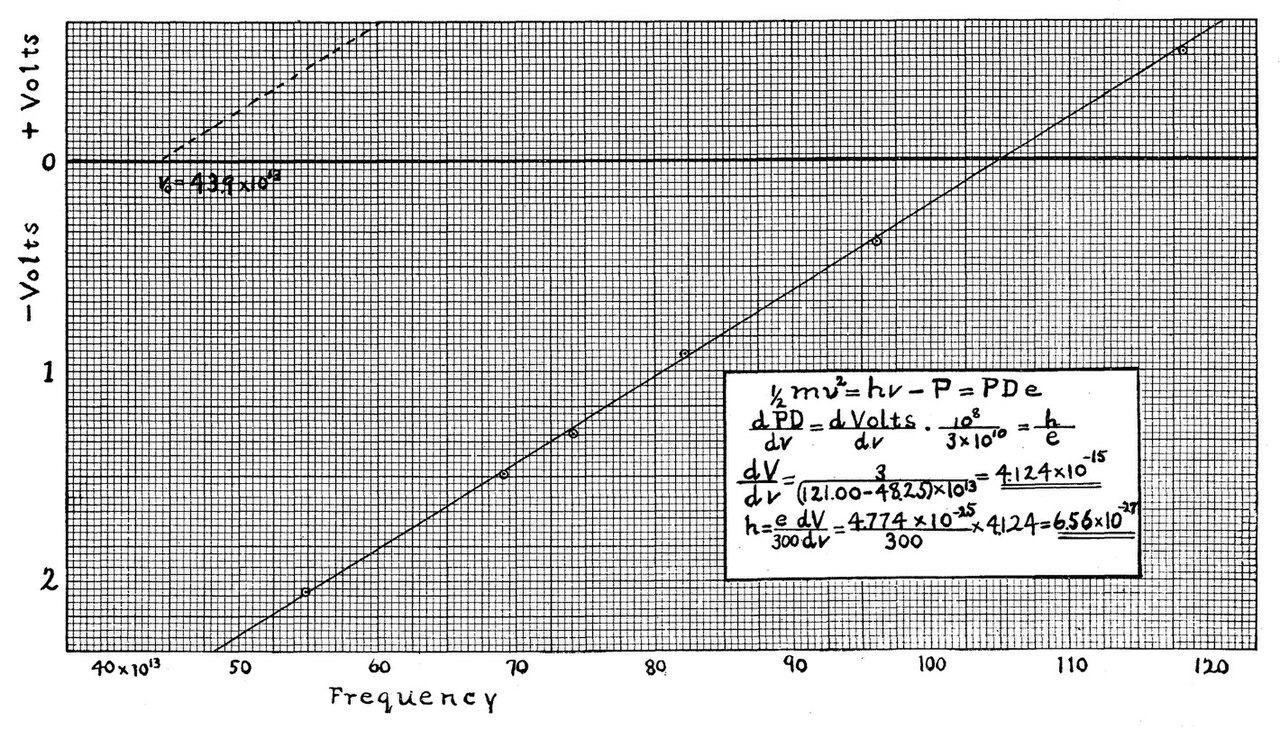
A hand-plotted graph on squared paper: points lying on a straight line rising from left to right
His graph, published in 1916: stopping potential against frequency, with the gradient used to find \(h\)
  • Millikan was sure light was a wave. He set out to show that Einstein’s equation failed
  • He shaved his metal surfaces clean inside the vacuum, so that nothing spoiled the readings
  • Every point fell on Einstein’s straight line, and its gradient gave an accurate value of \(h\)

Portrait: Nobel Foundation, public domain. Graph: R. A. Millikan, Physical Review, 1916, public domain.

E.2 QUANTUM PHYSICS · HL ONLY

Measuring the maximum kinetic energy

Stopping the fastest electrons.

  • Make the collector negative
  • Raise the p.d. until the current is zero
  • That p.d. is the stopping potential \(V_{\mathrm{s}}\)
\(eV_{\mathrm{s}} = E_{\mathrm{max}}\)
PHOTOCELLNOT TO SCALE
E.2 QUANTUM PHYSICS · HL ONLY

Worked example

250 nm ultraviolet on zinc.

\(\Phi = 4.30 \,\mathrm{eV}\) · \(hc = 1.24 \times 10^{-6} \,\mathrm{eV} \,\mathrm{m}\) Photon: \(E = \dfrac{hc}{\lambda} = \dfrac{1.24 \times 10^{-6}}{250 \times 10^{-9}} = \class{res}{4.96 \,\mathrm{eV}}\) \(E_{\mathrm{max}} = hf - \Phi = 4.96 - 4.30 = \class{res}{0.66 \,\mathrm{eV}}\)   \(= 0.66 \times 1.60 \times 10^{-19} = \class{res}{1.1 \times 10^{-19} \,\mathrm{J}}\) Stopping potential \(V_{\mathrm{s}} = \dfrac{E_{\mathrm{max}}}{e} = \class{res}{0.66 \,\mathrm{V}}\)
  • Double the intensity: still 0.66 eV, twice the current
  • Use 300 nm instead: 4.13 eV per photon, no emission
E.2 QUANTUM PHYSICS · HL ONLY

Quick check

The photoelectric effect.

01What is the threshold frequency?

Lowest frequency that gives emission

02What is the work function?

Least energy needed to free an electron

03Photons of 5.0 eV, metal with \(\Phi = 2.3 \,\mathrm{eV}\). \(E_{\mathrm{max}}\)?

\(5.0 - 2.3 = 2.7 \,\mathrm{eV}\)

04Intensity doubles, same frequency. What changes?

More electrons. Same \(E_{\mathrm{max}}\)

05Why can waves not explain the threshold?

Any frequency should work if bright enough

06What is the gradient of \(E_{\mathrm{max}}\) against \(f\)?

The Planck constant, \(h\)
PRESS → TO REVEAL EACH ANSWER

Part 02

Matter waves.

How can particles diffract?

E.2 QUANTUM PHYSICS · HL ONLY

The story · Paris, 1924

Background story · not assessed

A prince’s thesis.

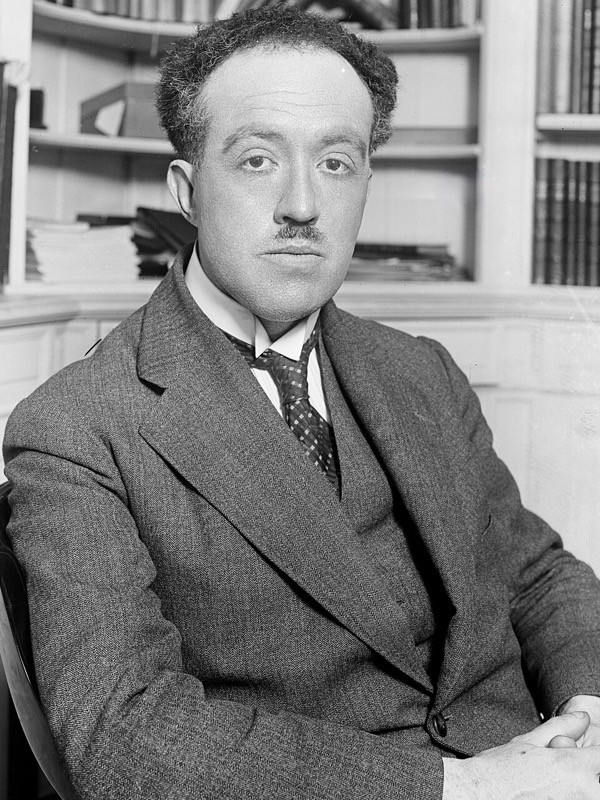
Louis de Broglie in a suit, sitting in front of bookshelves
Louis de Broglie, pictured in 1929, the year of his Nobel Prize
  • Louis de Broglie, a French prince, studied history before he turned to physics
  • 1924: his doctoral thesis proposes that electrons have a wavelength
  • His examiners were unsure. One sent a copy to Einstein, who backed it
  • There was no experimental evidence yet. It came three years later
The prediction came first. The evidence came afterwards.

Photo: Agence Rol, public domain.

E.2 QUANTUM PHYSICS · HL ONLY

de Broglie (1924)

If waves can be particles…?

  • Light, a wave, also behaves as particles
  • de Broglie: particles should also behave as waves
  • Every moving particle has a wavelength
\(\lambda = \dfrac{h}{p}\)
\(p = mv\), the momentum. More momentum → shorter wavelength.
THE DE BROGLIE WAVELENGTH
E.2 QUANTUM PHYSICS · HL ONLY

Worked examples

An electron and a tennis ball.

Electron accelerated through 150 V \(E_{\mathrm{k}} = eV = 1.60 \times 10^{-19} \times 150\)   \(= 2.40 \times 10^{-17} \,\mathrm{J}\) \(p = \sqrt{2mE_{\mathrm{k}}}\)   \(= \sqrt{2 \times 9.11 \times 10^{-31} \times 2.40 \times 10^{-17}}\)   \(= 6.61 \times 10^{-24} \,\mathrm{kg} \,\mathrm{m} \,\mathrm{s}^{-1}\) \(\lambda = \dfrac{h}{p} = \class{res}{1.0 \times 10^{-10} \,\mathrm{m}}\) About the spacing of atoms in a crystal
Tennis ball · 0.058 kg at \(50 \,\mathrm{m} \,\mathrm{s}^{-1}\) \(p = mv = 0.058 \times 50 = 2.9 \,\mathrm{kg} \,\mathrm{m} \,\mathrm{s}^{-1}\) \(\lambda = \dfrac{h}{p} = \dfrac{6.63 \times 10^{-34}}{2.9}\)   \(= \class{res}{2.3 \times 10^{-34} \,\mathrm{m}}\) Far smaller than a nucleus
E.2 QUANTUM PHYSICS · HL ONLY

The story · New York and Aberdeen, 1927

Background story · not assessed

An accident, and a father and son.

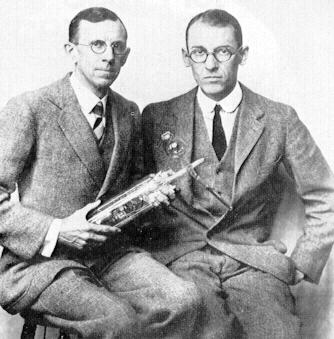
Two men in suits sitting side by side, one holding a glass vacuum tube
Clinton Davisson (left) and Lester Germer with their electron tube, 1927
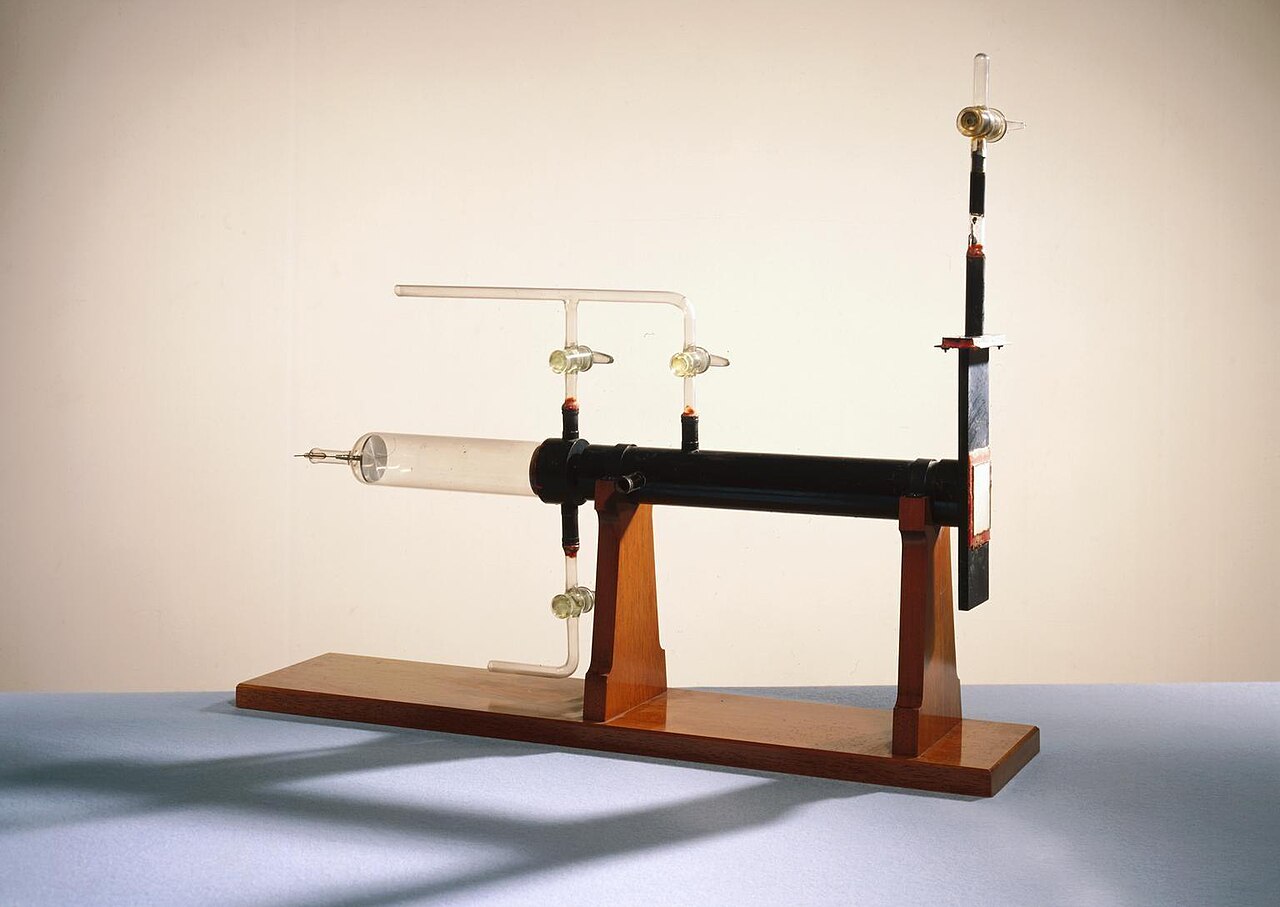
A long glass and metal tube mounted on a wooden stand
The diffraction camera G. P. Thomson built in Aberdeen
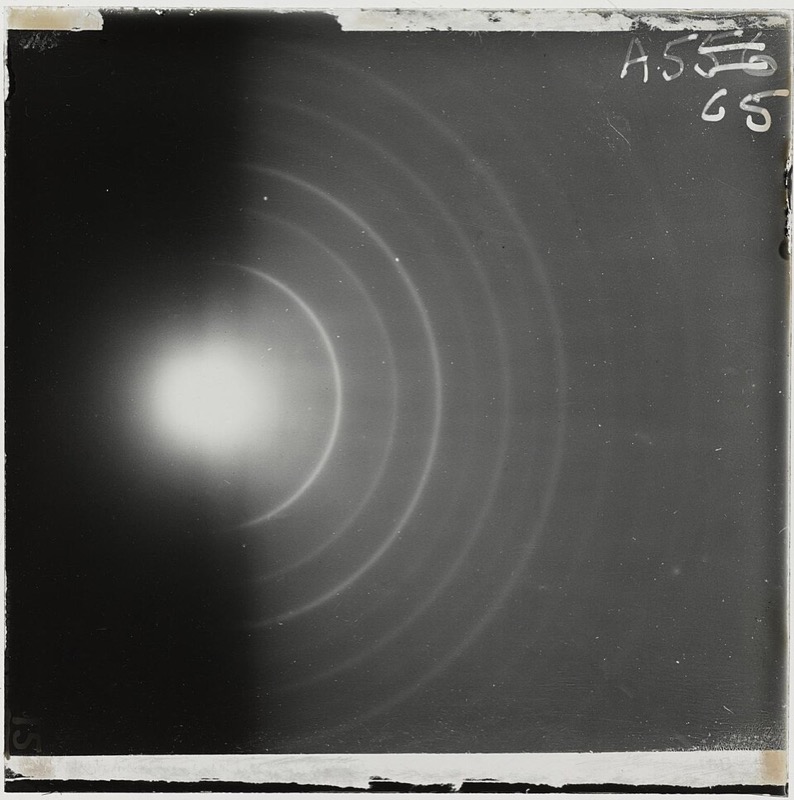
A dark photographic plate with a bright central spot surrounded by faint rings
One of Thomson’s electron diffraction photographs
  • Davisson and Germer fired electrons at nickel. A 1925 accident left it as a few large crystals: the electrons now came off in sharp peaks
  • In Aberdeen, G. P. Thomson sent electrons through thin metal films and photographed rings
  • His father, J. J. Thomson, showed the electron is a particle. The son showed it is a wave. Davisson and Thomson shared the 1937 Nobel Prize

Photo: unknown photographer, public domain. Camera and diffraction photograph: Science Museum Group and Science Museum Group, CC BY 4.0.

E.2 QUANTUM PHYSICS · HL ONLY

The test · Davisson & Germer, G. P. Thomson (1927)

Electron diffraction.

  • Fire electrons through thin graphite
  • The screen shows rings, not one spot
  • Rings are a diffraction pattern
  • Only waves diffract
ELECTRON DIFFRACTION TUBENOT TO SCALE
E.2 QUANTUM PHYSICS · HL ONLY

Evidence → conclusion

Testing \(\lambda = h/p\).

OBSERVATIONCONCLUSION
Electrons form rings on the screen
→
Electrons diffract: they have a wave nature
Higher accelerating p.d. → smaller rings
→
More momentum → shorter wavelength
Ring size gives a wavelength
→
It equals \(h/p\)
Diffraction of particles is the evidence for the wave nature of matter.
E.2 QUANTUM PHYSICS · HL ONLY

Diffraction of particles

Where the first minimum falls.

  • Particles scattered by an obstacle of width \(D\)
  • Counted at each angle \(\theta\)
  • Fewest arrive at the first minimum
\(\sin \theta \approx \dfrac{\lambda}{D}\)with \(\lambda = h/p\)
Measure \(\theta\) → find \(D\). This is how nuclei are measured.
SCATTERED PARTICLES AGAINST ANGLESKETCH
E.2 QUANTUM PHYSICS · HL ONLY

Putting it together

Wave–particle duality.

Behaves as a waveBehaves as a particle
LightDiffraction, interferencePhotoelectric effect, Compton scattering
ElectronsDiffraction by crystalsEach arrives at one point, with charge and mass
Neither picture alone is complete. Which one shows up depends on the experiment.
E.2 QUANTUM PHYSICS · HL ONLY

Quick check

Matter waves.

01State the de Broglie relation.

\(\lambda = h/p\)

02An electron’s speed doubles. Its wavelength?

Halves

03What is the evidence that electrons have a wave nature?

They diffract: rings from a thin crystal

04The accelerating p.d. is raised. What happens to the rings?

They get smaller: shorter wavelength

05Why does a tennis ball not diffract?

Its wavelength is far smaller than any gap

06Where is the first minimum for an obstacle of width \(D\)?

\(\sin \theta \approx \lambda /D\)
PRESS → TO REVEAL EACH ANSWER

Part 03

Compton scattering.

A photon collides with an electron

E.2 QUANTUM PHYSICS · HL ONLY

The story · St Louis, 1922

Background story · not assessed

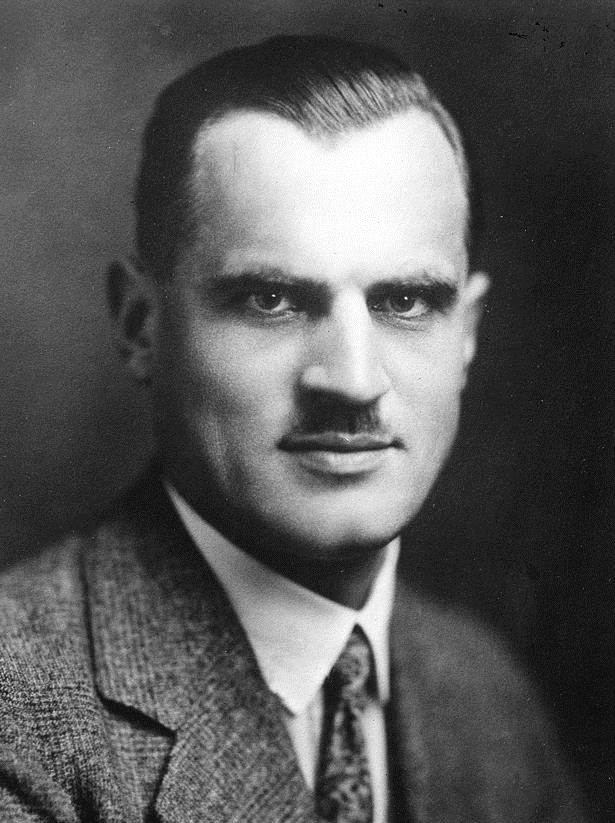
Compton plays billiards with light.

Portrait of Arthur Compton, a man with a mustache in a tweed suit
Arthur Compton, pictured in 1927, the year of his Nobel Prize
  • Compton, aged 30, scatters X-rays off graphite at Washington University
  • The scattered X-rays have a longer wavelength. No wave theory allowed that
  • He treats it as a collision between one photon and one electron. The numbers fit
  • 1927: the Nobel Prize, shared with C. T. R. Wilson, whose cloud chamber showed the recoiling electrons
After this, most physicists accepted the photon.

Photo: unknown photographer, public domain.

E.2 QUANTUM PHYSICS · HL ONLY

Compton (1923)

X-rays that change wavelength.

  • X-rays are scattered by electrons
  • The scattered X-rays have a longer wavelength
  • The bigger the angle, the bigger the change
  • The electron recoils
A collision between two particles.
ONE PHOTON, ONE ELECTRONNOT TO SCALE
~ Photon− Electron
E.2 QUANTUM PHYSICS · HL ONLY

The Compton formula

The shift in wavelength.

\(\lambda _{\mathrm{f}} - \lambda _{\mathrm{i}} = \dfrac{h}{m_{\mathrm{e}}c}(1 - \cos \theta )\)
  • \(\theta\): angle the photon is turned through
  • \(h/m_{\mathrm{e}}c = \class{res}{2.43 \times 10^{-12} \,\mathrm{m}}\)
  • The shift depends only on the angle
Angle \(\theta\)\(1 - \cos \theta\)Shift \(\Delta \lambda\)
0°00
90°12.43 pm
180°24.85 pm
E.2 QUANTUM PHYSICS · HL ONLY

Worked example

An X-ray scattered through 60°.

Incoming wavelength 71.0 pm \(\Delta \lambda = \dfrac{h}{m_{\mathrm{e}}c}(1 - \cos \theta )\)   \(= 2.43 \times (1 - \cos 60^{\circ}) = \class{res}{1.2 \,\mathrm{pm}}\) \(\lambda _{\mathrm{f}} = \lambda _{\mathrm{i}} + \Delta \lambda = 71.0 + 1.2 = \class{res}{72.2 \,\mathrm{pm}}\) Before: \(\dfrac{hc}{\lambda _{\mathrm{i}}} = \dfrac{1.24 \times 10^{-6}}{71.0 \times 10^{-12}} = 17.46 \,\mathrm{keV}\) After: \(\dfrac{hc}{\lambda _{\mathrm{f}}} = \dfrac{1.24 \times 10^{-6}}{72.2 \times 10^{-12}} = 17.17 \,\mathrm{keV}\)
  • The photon has lost about 0.29 keV
  • The electron has gained it as kinetic energy
E.2 QUANTUM PHYSICS · HL ONLY

Nature of science

Like two balls colliding?

THE SAMEDIFFERENT
Energy is conserved
≠
The photon has no mass
Momentum is conserved
≠
It never slows: always at \(c\)
The target recoils, the projectile is deflected
≠
Losing energy means a longer wavelength
A photon has momentum, \(p = h/\lambda\). Only a particle model predicts the shift.
E.2 QUANTUM PHYSICS · HL ONLY

Summary

Three experiments, one picture.

Photoelectric effect

Light as particles

Threshold frequency, no delay
\(E_{\mathrm{max}} = hf - \Phi\)

Electron diffraction

Matter as waves

Rings from a crystal
\(\lambda = h/p\)

Compton scattering

Photons have momentum

Wavelength shift with angle
\(\Delta \lambda = (h/m_{\mathrm{e}}c)(1 - \cos \theta )\)

Light and matter both show wave–particle duality.
E.2 QUANTUM PHYSICS · HL ONLY

Quick check

Compton scattering.

01What happens to the wavelength of a scattered photon?

It increases

02Why does it increase?

The photon gives energy to the electron: lower \(f\)

03At which angle is the shift greatest?

180°: 4.85 pm

04Which two quantities are conserved?

Energy and momentum

05Shift for scattering through 90°?

2.43 pm

06What would the wave theory predict?

No change in wavelength
PRESS → TO REVEAL EACH ANSWER

Summary

Key words.

Photoelectric effectLight frees electrons from a metal
Threshold frequency\(f_{0}\): lowest that gives emission\(hf_{0} = \Phi\)
Work function\(\Phi\): least energy to leave the metal
Photoelectric equation\(E_{\mathrm{max}} = hf - \Phi\)
Stopping potential\(eV_{\mathrm{s}} = E_{\mathrm{max}}\)
de Broglie wavelength\(\lambda = h/p\)
Electron diffractionEvidence that matter has a wave nature
Compton scatteringPhoton hits electronLonger wavelength
Wave–particle dualityLight and matter show both behaviors
E.2 QUANTUM PHYSICS · HL ONLY