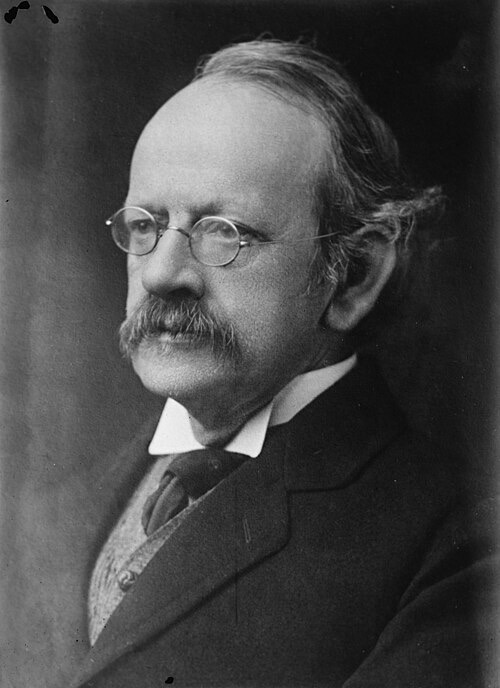
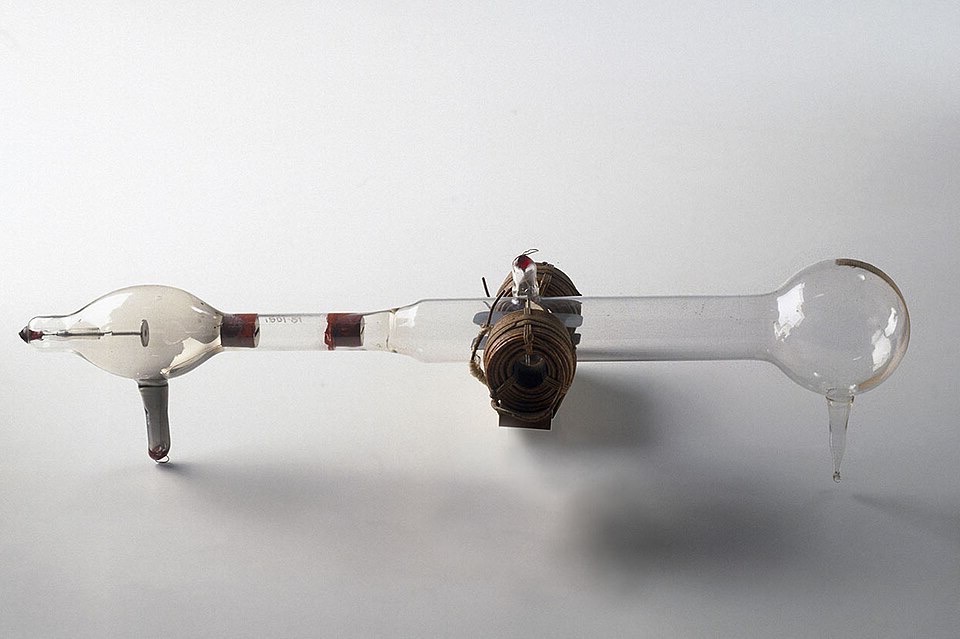
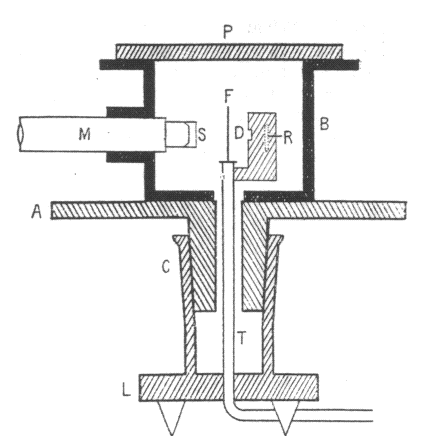
- Glowing rays crossed the tube. Nobody knew what they were
- Magnets and electric fields bent the rays: they were negative particles
- Every metal he tried gave the same particles
- So they must be inside every atom: the electron
IB DP Physics · Theme E · Nuclear and quantum physics
E.1 · The nucleus, energy levels, spectra
Standard level and higher level
© 2026 PanPhy Labs. All rights reserved.
The journey
Part 01 · SL + HL
Geiger–Marsden–Rutherford, nuclear notation
Part 02 · SL + HL
Energy levels, photons, \(E = hf\)
Part 03 · HL only
Nuclear radius, closest approach, Bohr’s hydrogen
Part 01 · SL + HL
New evidence → new model
Changing models
Tiny spheres that cannot be divided
After the electron was discovered
From alpha scattering
Electrons in energy levels
The story · Cambridge, 1897
Background story · not assessed


Portrait: Bain News Service, Library of Congress, public domain. Tube: Science Museum London, CC BY-SA 2.0.
Thomson (1904)
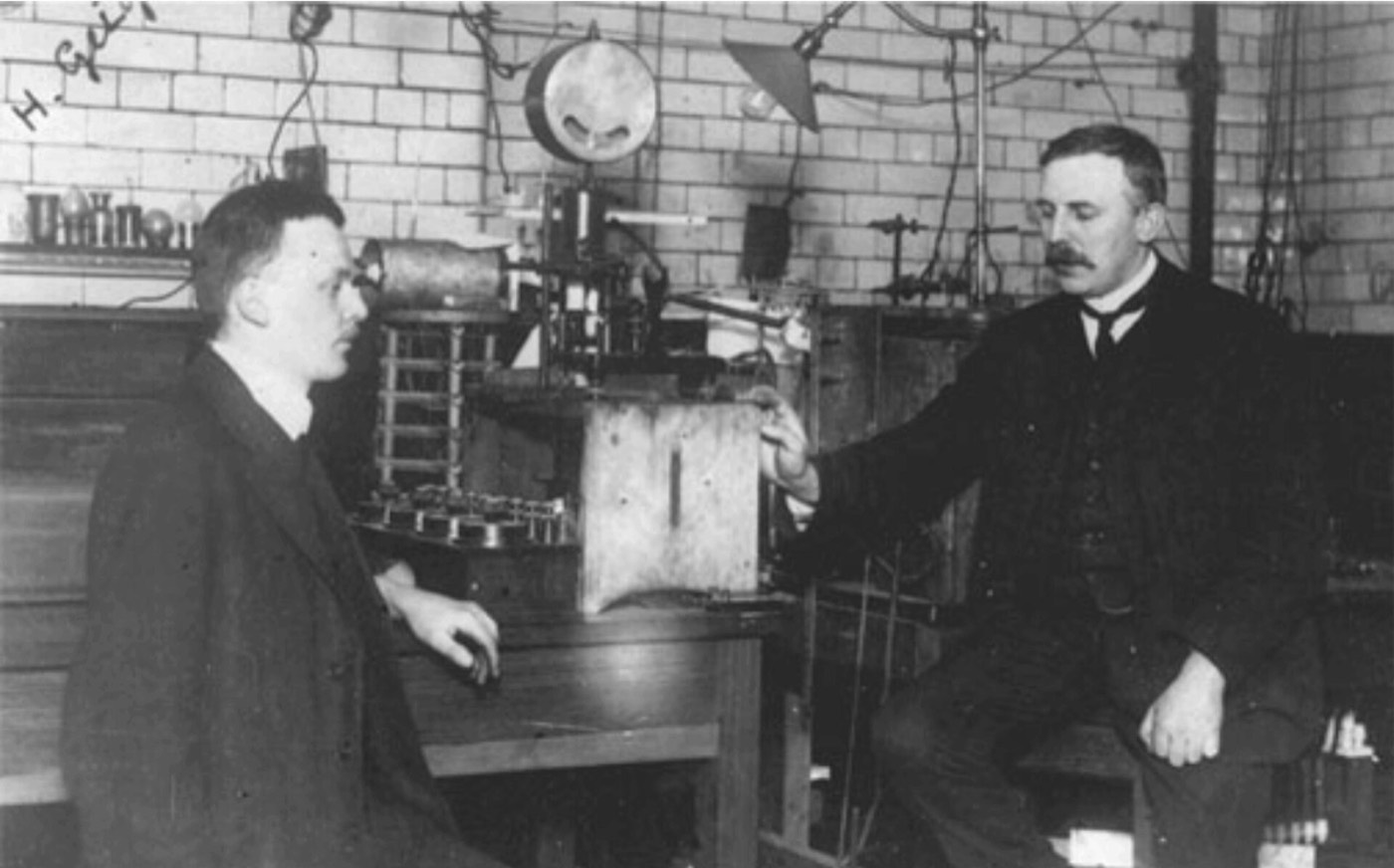
The story · Manchester, 1909
Background story · not assessed


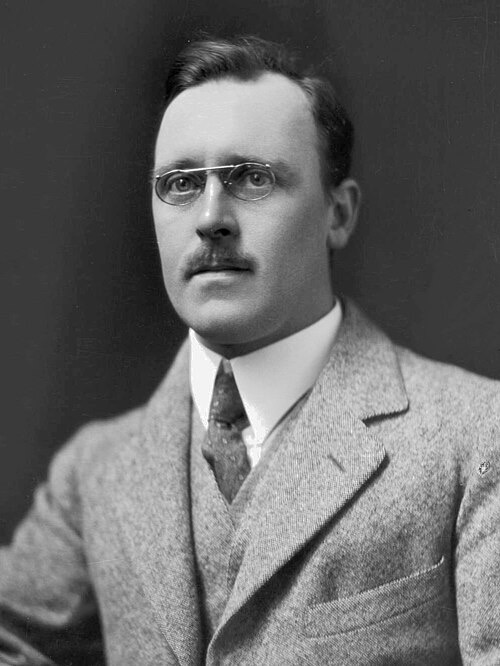
Photos: unknown photographer and S P Andrew Ltd, public domain. Diagram: Geiger and Marsden, 1913, public domain.
Geiger, Marsden & Rutherford (1909–1911)
Evidence → conclusion
Rutherford (1911)
Compare
| Plum pudding | Nuclear model | |
|---|---|---|
| Positive charge | Spread through the atom | In a tiny nucleus |
| Mass | Spread through the atom | Concentrated in the nucleus |
| Empty space? | No | Mostly empty space |
| Electrons | Embedded in the positive ball | Outside the nucleus |
Inside the atom
| Particle | Charge | Mass | Where? |
|---|---|---|---|
| Proton | \(+e\) | ≈ 1 u | Nucleus |
| Neutron | 0 | ≈ 1 u | Nucleus |
| Electron | \(-e\) | ≈ 0.0005 u | Around the nucleus |
Inside the atom
Inside the atom
Nature of science
Quick check
01Why did most alpha particles pass straight through?
02Why did a very few come straight back?
03How many neutrons in \({}^{56}_{26}\mathrm{Fe}\)?
04What is a nucleon?
05Roughly what is the ratio of an atom’s diameter to its nucleus’s diameter?
06What could the plum pudding model not explain?
Part 02 · SL + HL
Light as a message from inside the atom
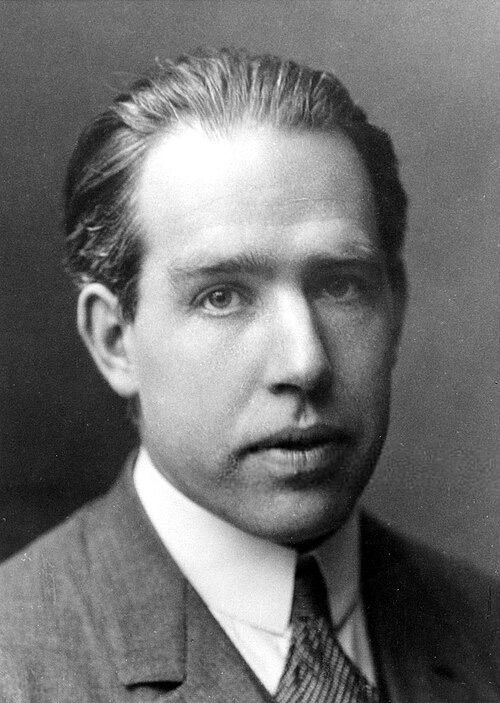
The story · Copenhagen, 1913
Background story · not assessed

Photo: AB Lagrelius & Westphal, public domain.
Energy levels
Photons
Atomic transitions
Worked example
Spectra
Spectra
Evidence → conclusion
Spectra
Quick check
01What is a photon?
02Electron drops from −1.51 eV to −3.40 eV. Photon energy?
03Which photon has more energy: red or violet?
04Why is an absorption line dark?
05How do spectra show energy levels are discrete?
06How can we tell what a star is made of?
Part 03 · Additional higher level
Nuclear radius and density · closest approach
Bohr’s energy levels · quantized angular momentum
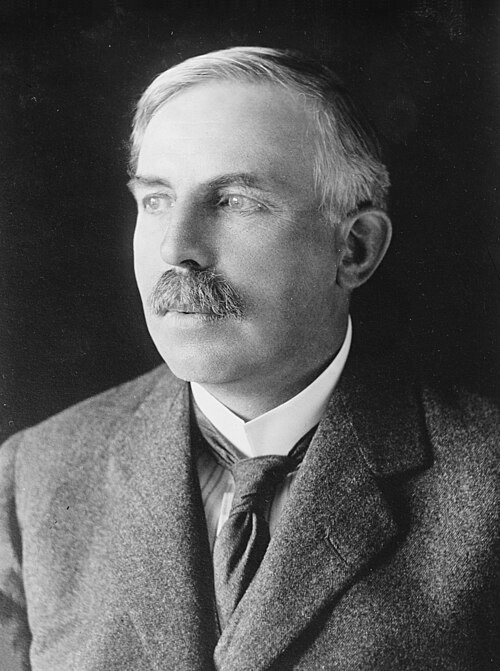
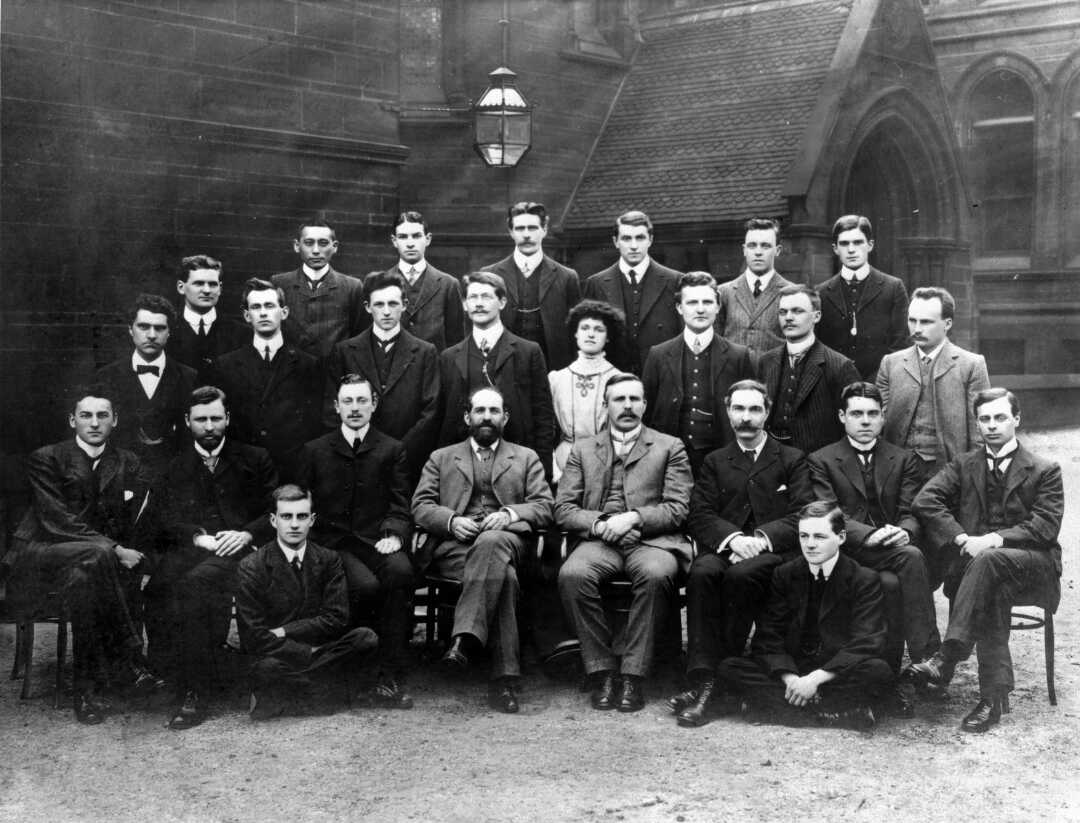
The story · Manchester, 1911
Background story · not assessed


Portrait: Bain Collection, Library of Congress, public domain. Group: unknown photographer, National Library of New Zealand, public domain.
Scattering, with numbers
Worked example
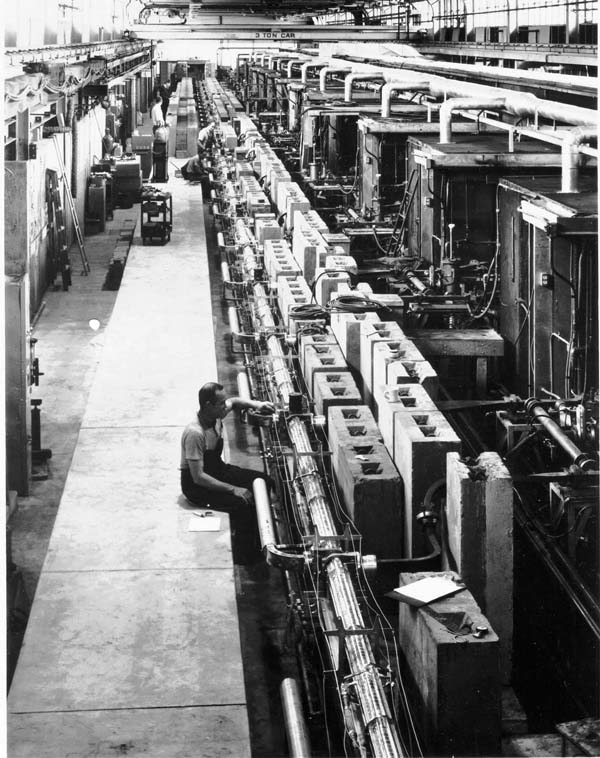
Scattering at high energies
The story · Stanford, 1953
Background story · not assessed


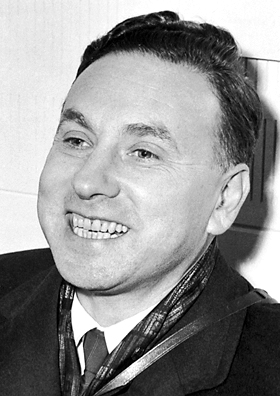
Portrait: Nobel Foundation, public domain. Accelerator: US Office of Naval Research, public domain.
Size of the nucleus
Size of the nucleus
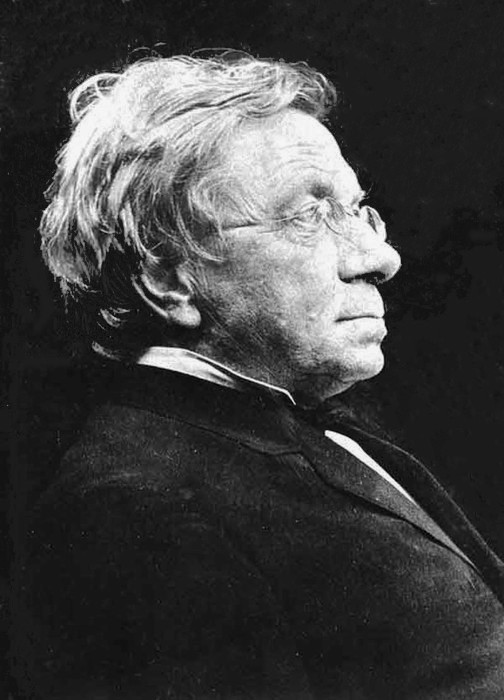
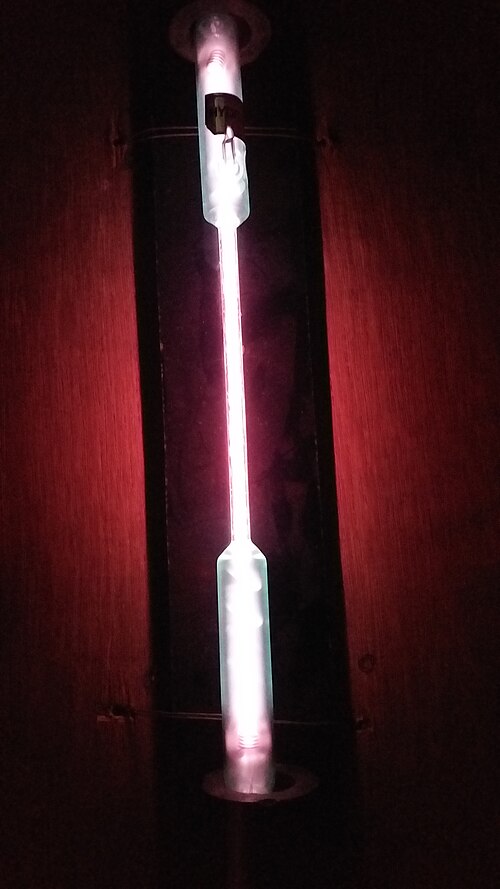
The story · Basel, 1885 · Copenhagen, 1913
Background story · not assessed


Portrait: unknown artist, public domain. Tube: Mohit Jhanjhotia, CC BY 4.0. Spectrum: Umop503, CC0.
The Bohr model for hydrogen
Nature of science
Quick check · HL
01Radius of a nucleus with \(A = 64\)? \((R_{0} = 1.20 \,\mathrm{fm})\)
02Why do all nuclei have about the same density?
03At closest approach, what has the kinetic energy become?
04Why does Rutherford’s formula fail at high energy?
05Energy of the \(n = 5\) level of hydrogen?
06What did Bohr say is quantized?
Summary