IB DP Physics · Theme D · Fields

Induction.

D.4 · Magnetic flux, Faraday’s law, Lenz’s law and the rotating coil
Higher level only: there is no standard level content in D.4

Additional HL · 6 hours D.3 Motion in electromagnetic fields ↗

The journey

Three parts.

Part 01

Flux and Faraday’s law

A changing flux induces an emf

Part 02

Lenz’s law and moving conductors

The direction of the emf, and \(\varepsilon = BvL\)

Part 03

The rotating coil

A sinusoidal emf, and the effect of frequency

In D.3 a current in a field gave a force. Here motion in a field gives an emf.
D.4 INDUCTION · HL ONLY

Part 01 · HL only

Flux and Faraday’s law.

What has to change for an emf to appear, and how large the emf is

D.4 INDUCTION · HL ONLY

The story · London, 1831

Background story · not assessed

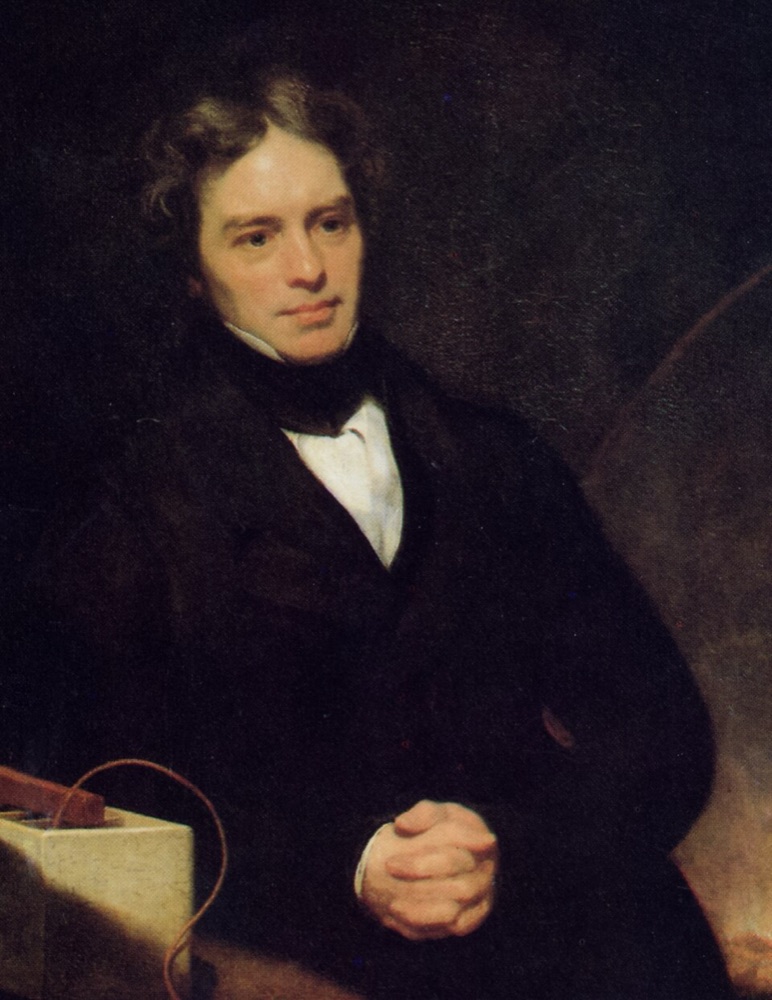
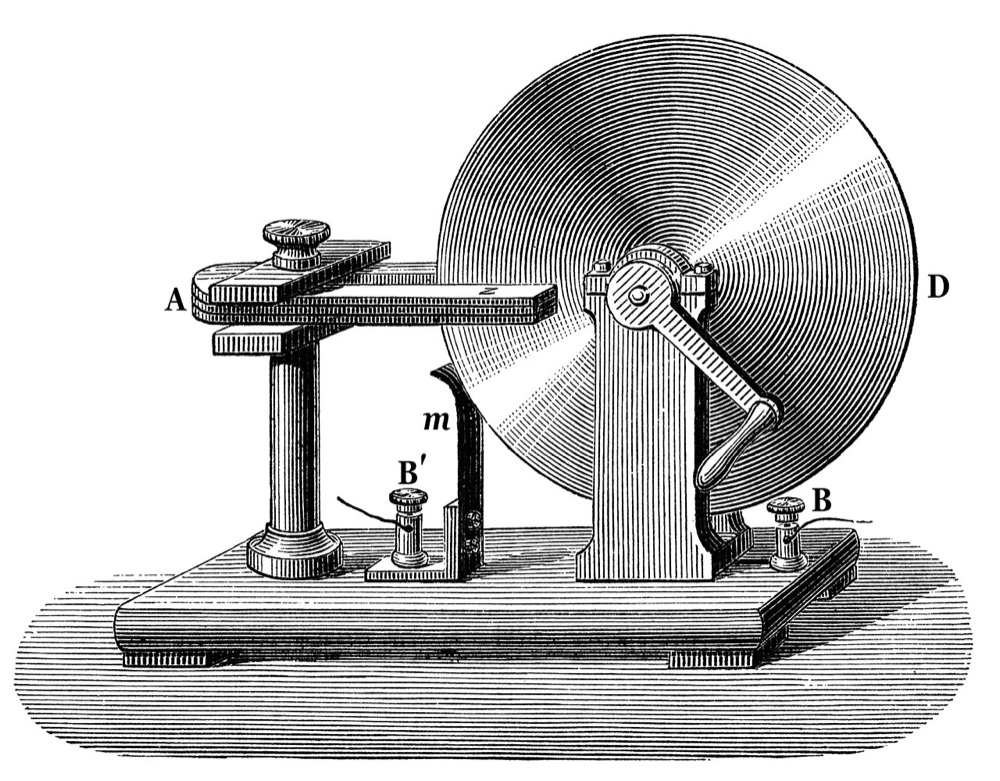
Faraday makes electricity from magnetism.

Painted portrait of Michael Faraday, a man with wavy gray hair in a dark coat and white cravat
Michael Faraday, painted by Thomas Phillips in 1842
Engraving of a copper disk mounted on an axle between the poles of a horseshoe magnet, with a handle to turn it and sliding contacts at its axle and rim
His disk generator of 1831 (engraving of 1884)
  • A bookbinder’s apprentice at 14, with little schooling
  • Ørsted got magnetism from electricity. Faraday wanted the reverse
  • 1831: two coils on an iron ring. Switching one gave a brief current in the other
  • Then a magnet into a coil, and a spinning copper disk
A magnet held still beside a coil does nothing. Only a change in the flux through the coil induces a current.

Portrait: Thomas Phillips, 1842, public domain. Engraving: Émile Alglave, 1884, public domain.

D.4 INDUCTION · HL ONLY

The basic observation

Inducing an emf.

  • Magnet moving in: the meter deflects
  • Magnet at rest: nothing
  • Magnet moving out: deflects the other way
  • Faster, a stronger magnet or more turns: a larger emf
A MAGNET AND A COIL
D.4 INDUCTION · HL ONLY

How much field passes through

Magnetic flux.

\(\Phi = BA \cos \theta\)
  • \(\theta\): the angle between the field and the normal to the area
  • Unit: the weber, \(1 \,\mathrm{Wb} = 1 \,\mathrm{T} \,\mathrm{m}^{2}\)
  • For a coil of \(N\) turns, the flux linkage is \(N \Phi\)
A LOOP IN A UNIFORM FIELD
D.4 INDUCTION · HL ONLY

Worked example

The flux through a coil.

\(B = 0.20 \,\mathrm{T}\) · area \(A = 0.030 \,\mathrm{m}^{2}\) \(\Phi = BA \cos \theta\) Facing the field: \(\theta = 0^{\circ}\) \(\Phi = 0.20 \times 0.030 \times \cos 0^{\circ} = \class{res}{6.0 \times 10^{-3} \,\mathrm{Wb}}\) Normal at \(60^{\circ}\) to the field \(\Phi = 0.20 \times 0.030 \times \cos 60^{\circ} = \class{res}{3.0 \times 10^{-3} \,\mathrm{Wb}}\)
The coil has 50 turns Flux linkage \(= N \Phi\) \(= 50 \times 6.0 \times 10^{-3} = \class{res}{0.30 \,\mathrm{Wb}}\) when facing the field
D.4 INDUCTION · HL ONLY

The size of the induced emf

Faraday’s law of induction.

\(\varepsilon = -N \dfrac{\Delta \Phi}{\Delta t}\)
  • The induced emf equals the rate of change of flux linkage
  • The minus sign: the emf opposes the change (Part 2)

Change \(B\)

A time-varying field

Move a magnet, or change the current in a nearby coil

Change \(A\)

A moving conductor

The area of the circuit in the field grows or shrinks

Change \(\theta\)

A rotating coil

The coil turns to face the field, then away

D.4 INDUCTION · HL ONLY

Worked example

A coil in a changing field.

200 turns · area \(4.0 \times 10^{-4} \,\mathrm{m}^{2}\), facing the field \(B\) rises from 0.10 T to 0.50 T in 0.020 s \(\Delta \Phi = A \Delta B\) \(\Delta \Phi = 4.0 \times 10^{-4} \times 0.40 = 1.6 \times 10^{-4} \,\mathrm{Wb}\) \(\varepsilon = -N \dfrac{\Delta \Phi}{\Delta t} = -\dfrac{200 \times 1.6 \times 10^{-4}}{0.020}\) \(\varepsilon = \class{res}{-1.6 \,\mathrm{V}}\)
  • Only the change in \(B\) matters: 0.40 T
  • \(\Delta\Phi = \Phi_\mathrm{f} - \Phi_\mathrm{i}\); emf magnitude \(|\varepsilon| = 1.6 \,\mathrm{V}\)
  • If \(B\) then stays at 0.50 T, the emf is zero
D.4 INDUCTION · HL ONLY

Reading graphs

Emf is the gradient of the flux graph.

  • Emf = minus the gradient of a flux–time graph
  • Flux constant: no emf
  • Steeper: a larger emf
  • Flux falling: the emf changes sign
FLUX AND EMF AGAINST TIME
D.4 INDUCTION · HL ONLY

Quick check

Flux and Faraday’s law.

01What is the unit of magnetic flux?

The weber, Wb (T m²)

02The plane of a coil lies along the field. Flux through it?

Zero

03A magnet rests inside a coil. Induced emf?

Zero: the flux is not changing

04Flux through one turn changes by 0.020 Wb in 0.10 s. Emf in 50 turns?

\(\frac{50 \times 0.020}{0.10} = 10 \,\mathrm{V}\)

05The same change happens in half the time. The emf?

It doubles

06What does the gradient of a flux–time graph give?

The size of the induced emf, per turn
PRESS → TO REVEAL EACH ANSWER

Part 02 · HL only

Lenz’s law and moving conductors.

Which way the induced current flows, and why it could not be otherwise

D.4 INDUCTION · HL ONLY

The direction of the induced emf

Lenz’s law.

  • The induced current flows in the direction that opposes the change that causes it
  • Flux increasing: its field is against the applied field
  • Flux decreasing: its field is with it
It opposes the change in flux, not the flux.
A MAGNET AND A COIL
D.4 INDUCTION · HL ONLY

Why it must oppose

Lenz’s law is conservation of energy.

ONE MAGNET, TWO TUBESPRESS → TO DROP
  • If the current helped the change, the magnet would speed up by itself: energy from nothing
  • Because it opposes, work must be done to move the magnet
  • That work becomes electrical energy in the circuit
D.4 INDUCTION · HL ONLY

Changing the area

A straight conductor moving across a field.

In a time \(\Delta t\) the rod moves \(v \Delta t\) \(\Delta \Phi = B \Delta A = B L v \Delta t\) \(|\varepsilon| = \dfrac{|\Delta \Phi|}{\Delta t}\) \(|\varepsilon| = BvL\)
Field, velocity and rod all at right angles.
A ROD ON TWO RAILS
D.4 INDUCTION · HL ONLY

Worked example

A rod pulled along rails.

\(B = 0.40 \,\mathrm{T}\) · \(L = 0.25 \,\mathrm{m}\) · \(v = 3.0 \,\mathrm{m} \,\mathrm{s}^{-1}\) · \(R = 1.5 \,\Omega\) \(\varepsilon = BvL = 0.40 \times 3.0 \times 0.25 = \class{res}{0.30 \,\mathrm{V}}\) \(I = \dfrac{\varepsilon}{R} = \dfrac{0.30}{1.5} = \class{res}{0.20 \,\mathrm{A}}\) \(F = BIL = 0.40 \times 0.20 \times 0.25 = \class{res}{0.020 \,\mathrm{N}}\)
Power to keep the rod moving \(P = Fv = 0.020 \times 3.0 = \class{res}{0.060 \,\mathrm{W}}\) Power dissipated in the resistor \(P = I^{2} R = 0.20^{2} \times 1.5 = \class{res}{0.060 \,\mathrm{W}}\)
D.4 INDUCTION · HL ONLY

In and out of a field

A rectangular coil moving through a field.

  • Entering: flux rising, an emf
  • Fully inside: flux constant, no emf
  • Leaving: flux falling, an emf of opposite sign
While entering or leaving: \(\varepsilon = NBvL\).
CONSTANT SPEED
D.4 INDUCTION · HL ONLY

Induction and oscillations

A magnet oscillating above a coil.

  • The flux through the coil rises and falls as the magnet moves
  • The emf alternates, at the frequency of the oscillation
  • Largest when the magnet moves fastest
  • If a current flows, the oscillation is damped
A MAGNET ON A SPRING
D.4 INDUCTION · HL ONLY

A coil acting on itself · qualitative only

Self-induction.

  • A coil carrying a current sits in its own magnetic field
  • When the current changes, the flux through the coil changes, so an emf is induced in the coil itself
  • By Lenz’s law that emf opposes the change of current

Switching on

The current rises gradually

The induced emf acts against the supply while the current is growing

Switching off

The current is hard to stop

The induced emf tries to keep it flowing, and can make a spark at the switch

D.4 INDUCTION · HL ONLY

Quick check

Lenz’s law and moving conductors.

01State Lenz’s law.

The induced current opposes the change that causes it

02Which conservation law does it follow from?

Conservation of energy

03A 0.50 m rod moves at 4.0 m s⁻¹ across a 0.20 T field. Emf?

\(0.20 \times 4.0 \times 0.50 = 0.40 \,\mathrm{V}\)

04A coil is completely inside a uniform field and moving. Emf?

Zero

05A north pole approaches a coil. Polarity of the near end?

North

06Why does a magnet fall slowly through a copper tube?

Induced currents oppose its motion
PRESS → TO REVEAL EACH ANSWER

Part 03 · HL only

The rotating coil.

Changing the angle: how a generator makes an alternating emf

D.4 INDUCTION · HL ONLY

Changing the angle

A coil rotating in a uniform field.

ONE ROTATIONCOIL AND EMF IN STEP
The flux linkage is \(NBA \cos \theta\). As the coil turns steadily, \(\theta\) grows steadily and the induced emf varies as a sine curve.
D.4 INDUCTION · HL ONLY

Two sine curves

Flux and emf, a quarter of a cycle apart.

  • Flux linkage: \(N \Phi = NBA \cos \omega t\)
  • Emf: minus its gradient, \(\varepsilon = NBA \omega \sin \omega t\)
  • Peak emf: \(\varepsilon_{0} = NBA \omega\), with \(\omega = 2 \pi f\)
More turns, a stronger field, a larger coil or faster rotation: a larger emf.
ONE AND A HALF ROTATIONS
D.4 INDUCTION · HL ONLY

Turning the coil faster

Changing the frequency of rotation.

  • Double the frequency of rotation:
  • The period halves: twice as many cycles each second
  • The peak emf doubles: the flux changes twice as fast
Both change together.
THE SAME COIL AT TWO SPEEDS
D.4 INDUCTION · HL ONLY

Worked example

A small generator.

100 turns · \(A = 0.020 \,\mathrm{m}^{2}\) · \(B = 0.30 \,\mathrm{T}\) Rotating at \(f = 50 \,\mathrm{Hz}\) \(\varepsilon_{0} = NBA \omega\)  with  \(\omega = 2 \pi f\) \(\omega = 2 \pi \times 50 = 314 \,\mathrm{rad} \,\mathrm{s}^{-1}\) \(\varepsilon_{0} = 100 \times 0.30 \times 0.020 \times 314\) \(\varepsilon_{0} = \class{res}{190 \,\mathrm{V}}\)
  • Greatest flux linkage: \(NBA = 0.60 \,\mathrm{Wb}\)
  • At 25 Hz the peak emf would be 94 V
  • The emf passes through zero 100 times a second
D.4 INDUCTION · HL ONLY

Quick check

The rotating coil.

01What shape is the graph of emf against time for a steadily rotating coil?

A sine curve

02In which position of the coil is the emf greatest?

Plane of the coil along the field

03What is the flux through the coil at that moment?

Zero

04The frequency of rotation is tripled. What happens to the peak emf?

It triples

05And to the period of the emf?

It falls to one third

06Give two other ways to increase the peak emf.

More turns, a stronger field or a larger area
PRESS → TO REVEAL EACH ANSWER

Summary

Induction on one slide.

Flux

\(\Phi = BA \cos \theta\)

In webers. \(\theta\) is measured from the normal
Flux linkage \(N \Phi\)

Faraday’s law

\(\varepsilon = -N \frac{\Delta \Phi}{\Delta t}\)

The rate of change of flux linkage
Gradient of a flux–time graph

Lenz’s law

Opposes the change

A consequence of conservation of energy

Moving conductor

\(\varepsilon = BvL\)

A coil entering or leaving a field
No emf while fully inside

Self-induction

A coil opposes changes in its own current

Qualitative only

Rotating coil

A sinusoidal emf

Peak when the flux is zero
Double the frequency: double the peak, half the period

D.4 INDUCTION · HL ONLY

Summary

Key words.

Magnetic fluxField × area facing the field
WeberThe unit of flux: 1 T m²
Flux linkageFlux × number of turns
Induced emfCaused by a changing flux
Faraday’s lawEmf = rate of change of flux linkage
Lenz’s lawThe emf opposes the change
Self-inductionA coil’s emf from its own changing current
Alternating emfReverses direction every half cycle
Peak emfThe greatest value in a cycle
D.4 INDUCTION · HL ONLY