IB DP Physics · Theme D · Fields

Motion in electromagnetic fields.

D.3 · Charged particles in electric and magnetic fields, and the forces on currents
Standard level and higher level

SL + HL · 6 hours

The journey

Three parts.

Part 01

Charges in electric fields

Constant force: speeding up, and parabolic paths

Part 02

Charges in magnetic fields

Circular paths, charge-to-mass ratio, crossed fields

Part 03

Forces on currents

A wire in a field, and two parallel wires

D.3 has no additional higher level content: every slide is for SL and HL.
D.3 MOTION IN ELECTROMAGNETIC FIELDS · SL + HL

Part 01 · SL + HL

Charges in electric fields.

A uniform field gives a constant force, so a constant acceleration

D.3 MOTION IN ELECTROMAGNETIC FIELDS · SL + HL

Along the field

A charge in a uniform electric field.

AN ELECTRON BETWEEN TWO PLATESPRESS → TO RELEASE
  • Constant force \(F = qE\), so constant acceleration
  • \(a = \dfrac{qE}{m}\)
  • Work done by the field becomes kinetic energy
\(qV = \dfrac{1}{2} m v^{2}\)
D.3 MOTION IN ELECTROMAGNETIC FIELDS · SL + HL

Worked example

An electron accelerated through 2000 V.

From rest · \(V = 2000 \,\mathrm{V}\) \(e = 1.60 \times 10^{-19} \,\mathrm{C}\) · \(m = 9.11 \times 10^{-31} \,\mathrm{kg}\) \(eV = \dfrac{1}{2} m v^{2}\)  so  \(v = \sqrt{\dfrac{2eV}{m}}\) \(v = \sqrt{\dfrac{2 \times 1.60 \times 10^{-19} \times 2000}{9.11 \times 10^{-31}}}\) \(v = \class{res}{2.65 \times 10^{7} \,\mathrm{m} \,\mathrm{s}^{-1}}\)
  • Kinetic energy gained: \(2000 \,\mathrm{eV} = 3.2 \times 10^{-16} \,\mathrm{J}\)
  • About 9% of the speed of light
  • Four times the voltage gives twice the speed
D.3 MOTION IN ELECTROMAGNETIC FIELDS · SL + HL

Across the field

Entering an electric field at right angles.

AN ELECTRON BETWEEN CHARGED PLATESPRESS → TO FIRE
  • Along the plates: no force, constant velocity
  • Across the plates: constant force, constant acceleration
  • The path is a parabola, like a projectile
  • Outside the field: a straight line
D.3 MOTION IN ELECTROMAGNETIC FIELDS · SL + HL

Worked example

How far is the electron deflected?.

\(v = 2.0 \times 10^{7} \,\mathrm{m} \,\mathrm{s}^{-1}\) along plates of length \(L = 5.0 \,\mathrm{cm}\) Field \(E = 2.0 \times 10^{4} \,\mathrm{V} \,\mathrm{m}^{-1}\) \(t = \dfrac{L}{v} = \dfrac{0.050}{2.0 \times 10^{7}} = 2.5 \times 10^{-9} \,\mathrm{s}\) \(a = \dfrac{eE}{m} = \dfrac{1.60 \times 10^{-19} \times 2.0 \times 10^{4}}{9.11 \times 10^{-31}}\) \(a = 3.5 \times 10^{15} \,\mathrm{m} \,\mathrm{s}^{-2}\)
Deflection across the plates \(y = \dfrac{1}{2} a t^{2}\) \(y = \dfrac{1}{2} \times 3.5 \times 10^{15} \times (2.5 \times 10^{-9})^{2}\) \(y = \class{res}{1.1 \times 10^{-2} \,\mathrm{m}}\)
D.3 MOTION IN ELECTROMAGNETIC FIELDS · SL + HL

Quick check

Charges in electric fields.

01What kind of acceleration does a charge have in a uniform electric field?

Constant

02A proton is accelerated from rest through 500 V. Kinetic energy gained?

500 eV = \(8.0 \times 10^{-17} \,\mathrm{J}\)

03What shape is the path when a charge enters at right angles to the field?

A parabola

04Which component of its velocity stays constant?

The one at right angles to the field

05The accelerating voltage is increased to nine times its initial value. The final speed?

Three times the initial speed

06Which way does an electron accelerate, relative to the field lines?

Against them
PRESS → TO REVEAL EACH ANSWER

Part 02 · SL + HL

Charges in magnetic fields.

A force at right angles to the motion: it changes the direction, never the speed

D.3 MOTION IN ELECTROMAGNETIC FIELDS · SL + HL

The magnetic force

The force on a moving charge.

\(F = qvB \sin \theta\)
  • \(B\): magnetic field strength, in tesla (T)
  • \(\theta\): the angle between the velocity and the field
  • Greatest at 90°. Zero when moving along the field, and zero at rest
A POSITIVE CHARGE, AT RIGHT ANGLES TO B
D.3 MOTION IN ELECTROMAGNETIC FIELDS · SL + HL

Which way?

The direction of the magnetic force.

  • At right angles to both the field and the velocity
  • Left-hand rule, “FBI”: thumb \(F\), index finger \(B\), middle finger \(I\)
  • \(I\), the current, is the way a positive charge moves
For an electron, point the middle finger opposite to its velocity.
THE LEFT HANDF · B · I
D.3 MOTION IN ELECTROMAGNETIC FIELDS · SL + HL

At right angles to the field

Circular motion in a magnetic field.

Magnetic force = centripetal force \(qvB = \dfrac{m v^{2}}{r}\) \(r = \dfrac{mv}{qB}\)
  • The force does no work: the speed and kinetic energy stay constant
A POSITIVE PARTICLE, FIELD INTO THE PAGE
D.3 MOTION IN ELECTROMAGNETIC FIELDS · SL + HL

Worked example

An electron in a 2.0 mT field.

\(v = 2.0 \times 10^{7} \,\mathrm{m} \,\mathrm{s}^{-1}\), at right angles to \(B\) \(r = \dfrac{mv}{eB}\) \(r = \dfrac{9.11 \times 10^{-31} \times 2.0 \times 10^{7}}{1.60 \times 10^{-19} \times 2.0 \times 10^{-3}}\) \(r = \class{res}{5.7 \times 10^{-2} \,\mathrm{m}}\)
Time for one circle \(T = \dfrac{2 \pi r}{v} = \dfrac{2 \pi m}{eB}\) \(T = \dfrac{2 \pi \times 9.11 \times 10^{-31}}{1.60 \times 10^{-19} \times 2.0 \times 10^{-3}}\) \(T = \class{res}{1.8 \times 10^{-8} \,\mathrm{s}}\)
D.3 MOTION IN ELECTROMAGNETIC FIELDS · SL + HL

The story · Berkeley, 1930–1939

Background story · not assessed

Lawrence’s cyclotron.

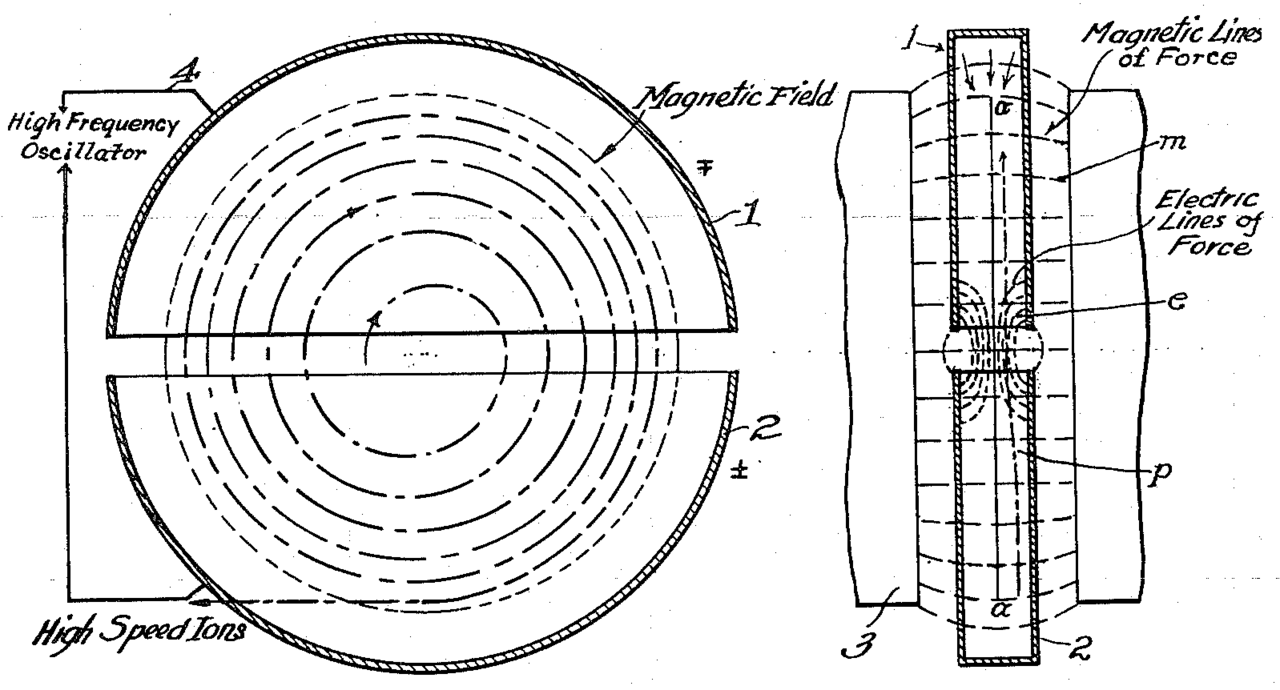
Patent drawing of two hollow D-shaped electrodes seen from above, with a spiral path drawn from the center outwards across the gap between them, and a side view of the electrodes between the poles of a magnet
From Lawrence’s patent: a spiral path through two hollow “dees”
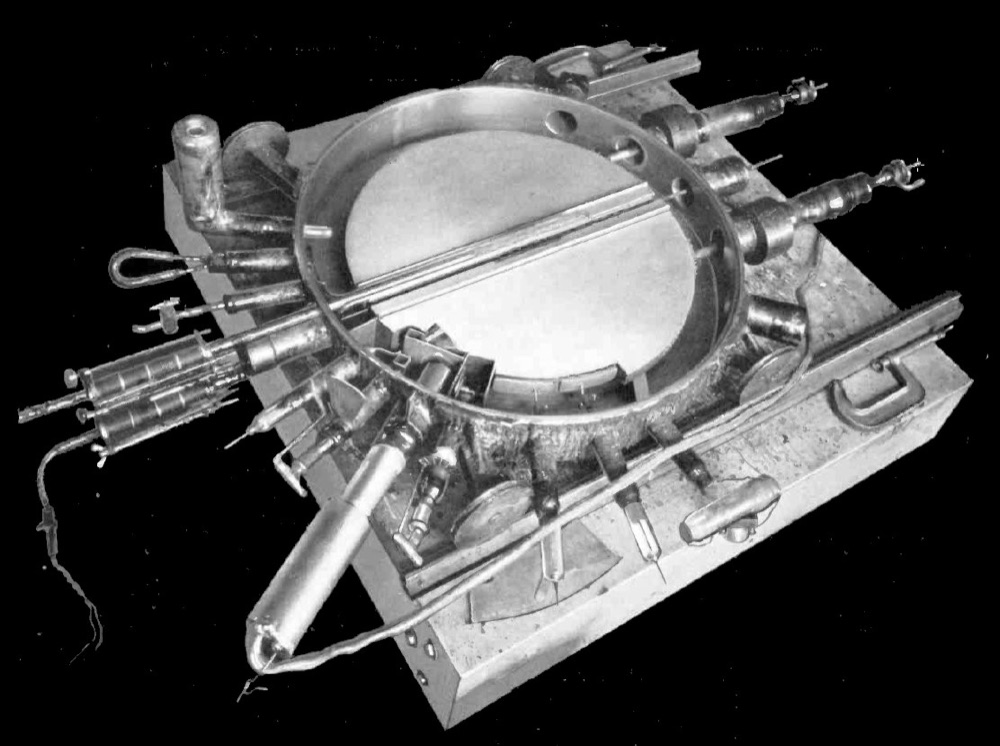
Photograph looking down into an open round metal vacuum chamber containing two D-shaped electrodes, with pipes and connections round its rim
The dees of the 27-inch cyclotron, 1935
  • A magnetic field keeps the particles circling. The period does not depend on their speed
  • An alternating voltage across the gap speeds them up twice in every turn, so the circle grows
  • Ernest Lawrence’s 27-inch machine of 1932 reached 4.8 MeV. Nobel Prize, 1939

Patent drawing: Ernest O. Lawrence, 1934, public domain. Photograph: John B. Livingood, 1935, public domain.

D.3 MOTION IN ELECTROMAGNETIC FIELDS · SL + HL

Identifying a particle from its path

The charge-to-mass ratio.

Accelerate through \(V\), then bend in \(B\) \(qV = \dfrac{1}{2} m v^{2}\)  and  \(qvB = \dfrac{m v^{2}}{r}\) \(v = \dfrac{qBr}{m}\) \(\dfrac{q}{m} = \dfrac{2V}{B^{2} r^{2}}\)
Measure \(V\), \(B\) and \(r\): the path gives \(\dfrac{q}{m}\).
A FINE BEAM TUBE
D.3 MOTION IN ELECTROMAGNETIC FIELDS · SL + HL

Worked example

Measuring \(\frac{e}{m}\) for the electron.

\(V = 250 \,\mathrm{V}\) · \(B = 1.0 \,\mathrm{mT}\) Diameter of the ring 10.6 cm, so \(r = 5.3 \,\mathrm{cm}\) \(\dfrac{e}{m} = \dfrac{2V}{B^{2} r^{2}}\) \(\dfrac{e}{m} = \dfrac{2 \times 250}{(1.0 \times 10^{-3})^{2} \times (5.3 \times 10^{-2})^{2}}\) \(\dfrac{e}{m} = \class{res}{1.8 \times 10^{11} \,\mathrm{C} \,\mathrm{kg}^{-1}}\)
  • Accepted value: \(1.76 \times 10^{11} \,\mathrm{C} \,\mathrm{kg}^{-1}\)
  • Measure the diameter and halve it
  • \(r\) is squared: its uncertainty counts twice
D.3 MOTION IN ELECTROMAGNETIC FIELDS · SL + HL

Neither along nor across

Velocity at an angle to the field.

  • Component along \(B\): no force, carries on at constant velocity
  • Component across \(B\): circular motion
  • Together: a helix round the field lines
Only \(v \sin \theta\), across the field, appears in the force.
A HELICAL PATH
D.3 MOTION IN ELECTROMAGNETIC FIELDS · SL + HL

In the sky · seen from orbit

Background story · not assessed

The aurora.

Photograph from orbit of the curved edge of the Earth at night, with a glowing green band of aurora above the clouds and part of the space station in the foreground
The aurora borealis photographed from the International Space Station, 2014
  • The Sun sends out a stream of electrons and protons
  • They spiral along the Earth’s magnetic field lines
  • The lines dip into the atmosphere near the poles
  • There the particles hit oxygen and nitrogen, which glow
A helix round a field line, a hundred kilometers up.

Photograph: NASA / Samantha Cristoforetti, public domain.

D.3 MOTION IN ELECTROMAGNETIC FIELDS · SL + HL

Both fields at once

Crossed electric and magnetic fields.

A VELOCITY SELECTORPRESS → TO FIRE THREE PARTICLES
  • The fields are at right angles, and the two forces oppose
  • Straight through when \(qE = qvB\)
\(v = \dfrac{E}{B}\)
The charge cancels: one speed passes, whatever the particle.
D.3 MOTION IN ELECTROMAGNETIC FIELDS · SL + HL

Quick check

Charges in magnetic fields.

01What is the magnetic force on a charge moving along the field lines?

Zero

02What happens to the kinetic energy of a particle in a magnetic field?

It stays constant

03The speed of a particle is doubled. What happens to the radius of its circle?

It doubles

04And to the time for one circle?

It does not change

05Fields \(E = 600 \,\mathrm{V} \,\mathrm{m}^{-1}\) and \(B = 2.0 \,\mathrm{mT}\) are crossed. Which speed passes undeflected?

\(\frac{600}{2.0 \times 10^{-3}} = 3.0 \times 10^{5} \,\mathrm{m} \,\mathrm{s}^{-1}\)

06What path does a particle follow when its velocity is at 30° to the field?

A helix
PRESS → TO REVEAL EACH ANSWER

Part 03 · SL + HL

Forces on currents.

A current is a stream of moving charges, so a wire in a field feels a force

D.3 MOTION IN ELECTROMAGNETIC FIELDS · SL + HL

A wire in a magnetic field

The force on a current-carrying conductor.

\(F = BIL \sin \theta\)
  • \(L\): the length of wire in the field
  • \(\theta\): the angle between the current and the field
  • Direction: the same left-hand rule
A WIRE BETWEEN THE POLES OF A MAGNET
D.3 MOTION IN ELECTROMAGNETIC FIELDS · SL + HL

Worked example

A wire in a 0.050 T field.

\(I = 3.0 \,\mathrm{A}\) · \(L = 0.20 \,\mathrm{m}\) of wire in the field \(F = BIL \sin \theta\) At right angles to the field: \(\theta = 90^{\circ}\) \(F = 0.050 \times 3.0 \times 0.20 \times \sin 90^{\circ} = \class{res}{0.030 \,\mathrm{N}}\)
The wire is turned to \(\theta = 30^{\circ}\) \(F = 0.050 \times 3.0 \times 0.20 \times \sin 30^{\circ}\) \(F = \class{res}{0.015 \,\mathrm{N}}\) Still at right angles to the wire and to the field
D.3 MOTION IN ELECTROMAGNETIC FIELDS · SL + HL

Currents act on each other

The force between two parallel wires.

LONG STRAIGHT WIRESPRESS → FOR EACH STEP
\(\dfrac{F}{L} = \mu_{0} \dfrac{I_{1} I_{2}}{2 \pi r}\)
  • \(\dfrac{F}{L}\): the force on each meter of wire
  • \(r\): the separation of the wires
  • \(\mu_{0} = 4 \pi \times 10^{-7} \,\mathrm{T} \,\mathrm{m} \,\mathrm{A}^{-1}\)
D.3 MOTION IN ELECTROMAGNETIC FIELDS · SL + HL

One wire in the field of the other

Why parallel currents attract.

  • Wire 1 makes a field at wire 2: \(B_{1} = \dfrac{\mu_{0} I_{1}}{2 \pi r}\)
  • Wire 2 carries a current in that field: \(F = B_{1} I_{2} L\)
  • So \(\dfrac{F}{L} = \mu_{0} \dfrac{I_{1} I_{2}}{2 \pi r}\)
Grip rule for the field, left-hand rule for the force.
SEEN END ONBOTH CURRENTS OUT OF THE PAGE
D.3 MOTION IN ELECTROMAGNETIC FIELDS · SL + HL

Worked example

Two wires 2.0 cm apart.

\(I_{1} = 5.0 \,\mathrm{A}\) · \(I_{2} = 8.0 \,\mathrm{A}\), in the same direction \(\dfrac{F}{L} = \mu_{0} \dfrac{I_{1} I_{2}}{2 \pi r}\) \(\dfrac{F}{L} = \dfrac{4 \pi \times 10^{-7} \times 5.0 \times 8.0}{2 \pi \times 0.020}\) \(\dfrac{F}{L} = \class{res}{4.0 \times 10^{-4} \,\mathrm{N} \,\mathrm{m}^{-1}}\), attractive
  • The \(\pi\) cancels: \(\dfrac{4 \pi}{2 \pi} = 2\)
  • On 1.5 m of either wire: \(4.0 \times 10^{-4} \times 1.5 = 6.0 \times 10^{-4} \,\mathrm{N}\)
  • Halve the separation: double the force
D.3 MOTION IN ELECTROMAGNETIC FIELDS · SL + HL

The story · Paris, 1820

Background story · not assessed

Ampère and the ampere.

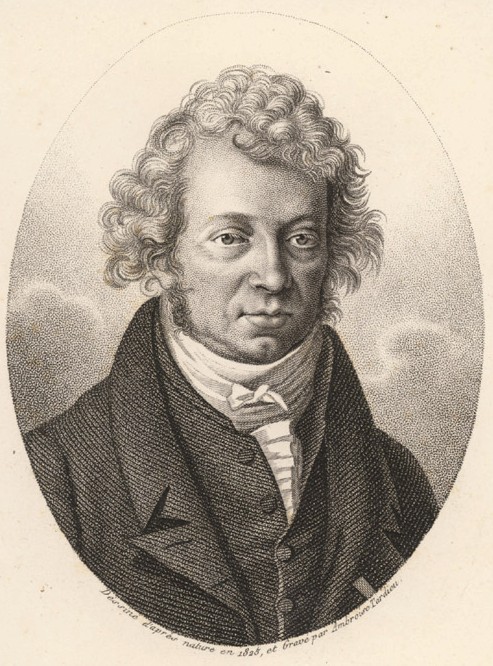
Engraved portrait of André-Marie Ampère, a man with curly hair in a high-collared coat
André-Marie Ampère, engraved in 1825
  • In September 1820 Ørsted’s discovery was shown in Paris
  • Ampère soon found that two parallel wires attract or repel, with no magnet involved
  • Until 2019 this force defined the ampere: \(2 \times 10^{-7} \,\mathrm{N}\) on each meter of two wires 1 m apart
  • The ampere is now defined from the charge of the electron
That old definition is where the value \(\mu_{0} = 4 \pi \times 10^{-7}\) comes from.

Portrait: Ambroise Tardieu, 1825, public domain.

D.3 MOTION IN ELECTROMAGNETIC FIELDS · SL + HL

Quick check

Forces on currents.

01A wire lies along the field lines. Force on it?

Zero

020.10 m of wire carries 2.0 A at right angles to a 0.50 T field. Force?

\(0.50 \times 2.0 \times 0.10 = 0.10 \,\mathrm{N}\)

03Two parallel wires carry currents in the same direction. Attract or repel?

Attract

04Both currents are doubled. What happens to the force per meter?

It becomes four times its original value

05The separation of the wires is tripled. Force per meter?

One third

06Wire 1 carries 1 A and wire 2 carries 5 A. Which feels the larger force?

Neither: the forces are equal
PRESS → TO REVEAL EACH ANSWER

Summary

Motion in electromagnetic fields on one slide.

Electric field

Constant force

\(F = qE\), and \(qV = \frac{1}{2} m v^{2}\)
A parabola when entering at right angles

Magnetic field

A sideways force

\(F = qvB \sin \theta\)
No work done: speed constant

Circular paths

\(r = \frac{mv}{qB}\)

Period independent of speed
The path gives \(\frac{q}{m}\)

Crossed fields

\(v = \frac{E}{B}\)

Only one speed passes straight through

A wire in a field

\(F = BIL \sin \theta\)

Left-hand rule for the direction

Parallel wires

\(\frac{F}{L} = \mu_{0} \frac{I_{1} I_{2}}{2 \pi r}\)

Same direction: attract
Opposite directions: repel

D.3 MOTION IN ELECTROMAGNETIC FIELDS · SL + HL

Summary

Key words.

Uniform fieldSame strength and direction everywhere
ElectronvoltEnergy of charge e through 1 V
Magnetic field strengthB, in tesla. Also called flux density
Tesla1 N on 1 C moving at 1 m s⁻¹
Left-hand ruleThumb F, index B, middle I
Charge-to-mass ratio\(\dfrac{q}{m}\), in C kg⁻¹
HelixCircling while moving along the field
Velocity selectorCrossed fields pass one speed
Permeability of free space\(\mu_{0}\), the magnetic constant
D.3 MOTION IN ELECTROMAGNETIC FIELDS · SL + HL