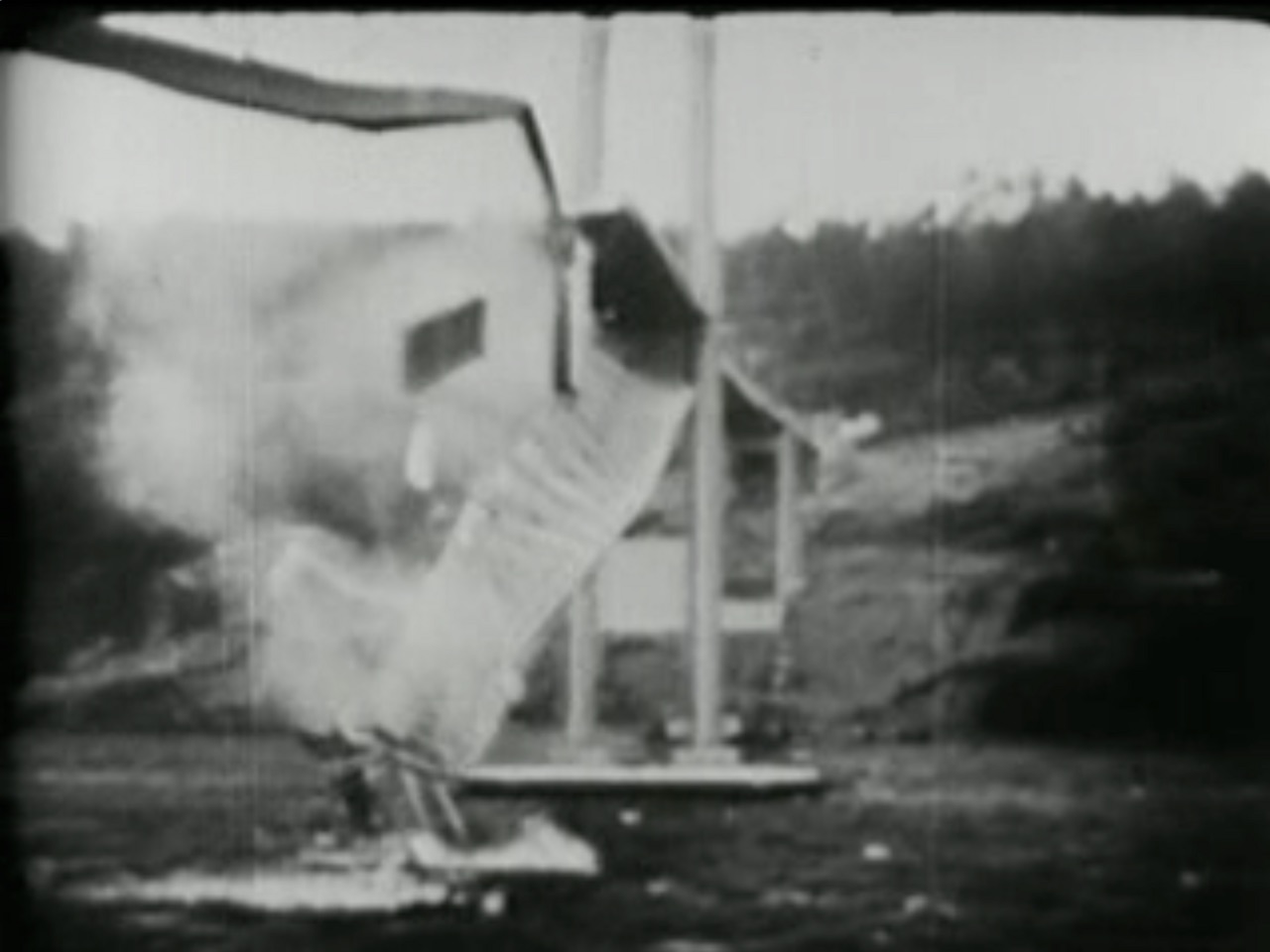
- Opened on 1 July 1940. Its 853 m span moved so much in wind that the builders gave it a nickname
- Four months later, in a wind of about 64 km h⁻¹, the deck began to twist and tore itself apart
- Textbooks long called it resonance. It was not
IB DP Physics · Theme C · Wave behavior
C.4 · Nodes and antinodes, strings and pipes, driven oscillations and damping
Standard level and higher level
© 2026 PanPhy Labs. All rights reserved.
The journey
Part 01
How they form, nodes and antinodes, amplitude and phase
Part 02
Boundary conditions and the harmonics they allow
Part 03
Natural and driving frequencies, and the effect of damping
Part 01
A wave that oscillates without going anywhere
Superposition again
The fixed points and the busiest points
How the points of a standing wave move
Compare
| Traveling wave | Standing wave | |
|---|---|---|
| Energy | Transferred along the wave | Not transferred: stored between the nodes |
| Amplitude | The same for every point | Varies from zero at nodes to greatest at antinodes |
| Phase | Changes steadily along the wave | The same within a loop; opposite in the next |
| Pattern | Moves at the wave speed | Stays in place |
| Wavelength | Crest to crest | Twice the node-to-node distance |
Quick check
01What two waves make a standing wave?
02What is a node?
03Neighboring nodes are 0.30 m apart. Wavelength?
04Two points in the same loop. Phase difference?
05Two points in neighboring loops. Phase difference?
06Does a standing wave transfer energy along the string?
Part 02
The ends decide which standing waves fit
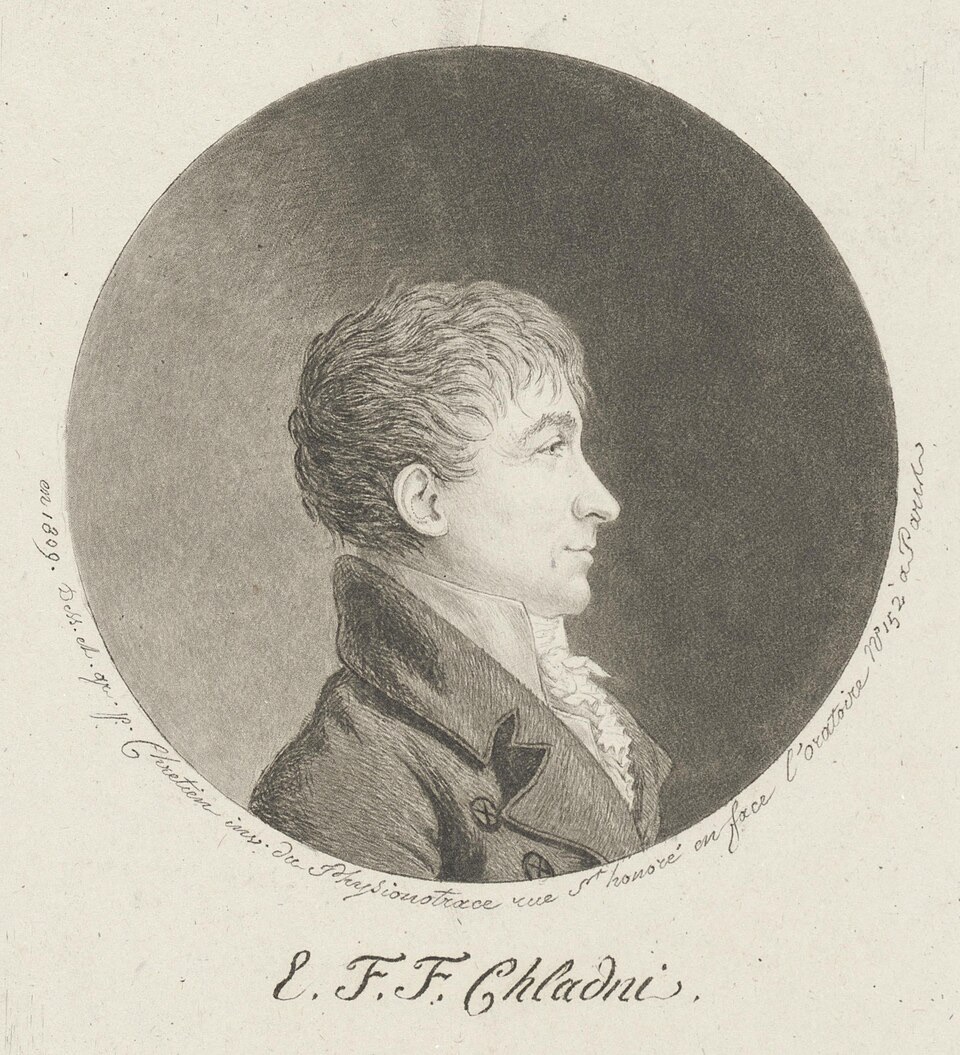
The story · Leipzig, 1787
Background story · not assessed


Portrait: Gilles-Louis Chrétien, 1809, public domain. Photograph: Rodrigo Tetsuo Argenton; exhibit by Estes Objethos Atelier, CC BY-SA 4.0.
What the ends allow
A fixed end of a string · a closed end of a pipe
The string is held, or the air is up against a wall: nothing can move there
A free end of a string · an open end of a pipe
Nothing holds it back, so the movement is greatest there
A node at each end
Worked example
An antinode at each end
A node at one end, an antinode at the other
Worked example
Quick check
01What is found at the closed end of a pipe?
02A 1.2 m string fixed at both ends, first harmonic. Wavelength?
03Its first harmonic is 100 Hz. Frequency of the fourth?
04Which harmonics does a pipe closed at one end have?
05A pipe closed at one end is 0.85 m long. First harmonic? (340 m s⁻¹)
06Its closed end is opened. The first harmonic becomes?
Part 03
What happens when an oscillator is pushed, and when it is held back
Free and forced oscillations
Left to itself
The frequency at which a system oscillates freely after being displaced and released. Set by the system: \(m\) and \(k\), or \(l\) and \(g\)
Pushed from outside
The frequency of a periodic force applied to the system. Set by whatever is doing the pushing
Driving at the natural frequency
Losing energy
Qualitative
Where it matters
Useful
Strings and air columns resonate at their harmonics; the body of a violin strengthens the sound
Useful
A circuit is set to resonate at the frequency of one station
Useful
Nuclei in a strong magnet absorb radio waves of one frequency
Destructive
Ground motion near a building’s natural frequency can bring it down
Destructive
Soldiers break step on a bridge; walkways are fitted with dampers
Destructive
An unbalanced wheel or engine shakes a car violently at one particular speed
The story · Washington State, 7 November 1940
Background story · not assessed

Film still: Barney Elliott, 1940, public domain.
Quick check
01At what frequency does a driven system oscillate?
02When does resonance occur?
03Which damping returns a system to rest fastest?
04Damping is increased. What happens to the height of the resonance peak?
05And to the frequency of the peak?
06Give one useful example of resonance.
Summary
Standing wave
No energy transferred
Node to node: \(\frac{\lambda}{2}\)
Along the wave
In phase within a loop, antiphase in the next
Same ends
String fixed at both ends; pipe open at both ends
All harmonics
Different ends
Pipe closed at one end
Odd harmonics only
Resonance
Greatest amplitude and energy transfer
Damping
More damping: a lower, broader peak at a slightly lower frequency
Summary