IB DP Physics · Theme B · The particulate nature of matter

Gas laws.

B.3 · Pressure, the mole, the ideal gas equation and the kinetic theory of gases
Standard level and higher level

SL + HL · 6 hours B.4 Thermodynamics (HL) ↗

The journey

Three parts.

Part 01

Pressure and amount

\(P = \frac{F}{A}\), the mole and the Avogadro constant

Part 02

The gas laws

Three experiments, and one equation: \(PV = nRT\)

Part 03

The kinetic theory

Explaining pressure and temperature by the motion of molecules

Parts 1 and 2 describe what a gas does. Part 3 explains why.
B.3 GAS LAWS · SL + HL

Part 01

Pressure and amount.

Two quantities needed before any gas law can be written

B.3 GAS LAWS · SL + HL

Force per unit area

Pressure.

\(P = \dfrac{F}{A}\)
  • \(F\): the force at right angles to the surface
  • Unit: the pascal, \(1 \,\mathrm{Pa} = 1 \,\mathrm{N} \,\mathrm{m}^{-2}\)
  • Atmospheric pressure is about \(1.0 \times 10^{5} \,\mathrm{Pa}\)
The air pushes on a window 1.2 m by 0.80 m \(P = \dfrac{F}{A}\)  so  \(F = PA\) \(F = 1.0 \times 10^{5} \times (1.2 \times 0.80)\) \(F = \class{res}{9.6 \times 10^{4} \,\mathrm{N}}\) The weight of about ten tonnes
B.3 GAS LAWS · SL + HL

Where the force comes from

The pressure of a gas.

  • The molecules move at random and hit the walls
  • Each collision changes a molecule’s momentum
  • So the wall exerts a force on the molecule, and the molecule an equal and opposite force on the wall
  • Force on each unit area: the pressure
A BOX OF GAS
B.3 GAS LAWS · SL + HL

Counting molecules

Amount of substance.

\(n = \dfrac{N}{N_\mathrm{A}}\)
  • \(n\): the amount, in moles
  • \(N\): the number of molecules
  • \(N_\mathrm{A} = 6.02 \times 10^{23} \,\mathrm{mol}^{-1}\), the Avogadro constant
8.0 g of helium · molar mass 4.0 g mol⁻¹ \(n = \dfrac{\text{mass}}{\text{molar mass}} = \dfrac{8.0}{4.0} = 2.0 \,\mathrm{mol}\) \(N = n N_\mathrm{A} = 2.0 \times 6.02 \times 10^{23}\) \(N = \class{res}{1.2 \times 10^{24}}\) atoms
B.3 GAS LAWS · SL + HL

Quick check

Pressure and amount.

01A 600 N force acts at right angles on 0.030 m². Pressure?

\(\frac{600}{0.030} = 2.0 \times 10^{4} \,\mathrm{Pa}\)

02What is 1 Pa in base SI units of force and area?

1 N m⁻²

03How many molecules are in 0.50 mol?

\(3.0 \times 10^{23}\)

04How many moles are in 56 g of nitrogen, N₂ (28 g mol⁻¹)?

2.0 mol

05What happens to a molecule’s momentum when it hits a wall?

It changes direction: a change of \(2mv\)

06Which of Newton’s laws gives the force on the wall?

The third (with the second)
PRESS → TO REVEAL EACH ANSWER

Part 02

The gas laws.

Three laws found by experiment, joined into one equation

B.3 GAS LAWS · SL + HL

The story · England, 1662

Background story · not assessed

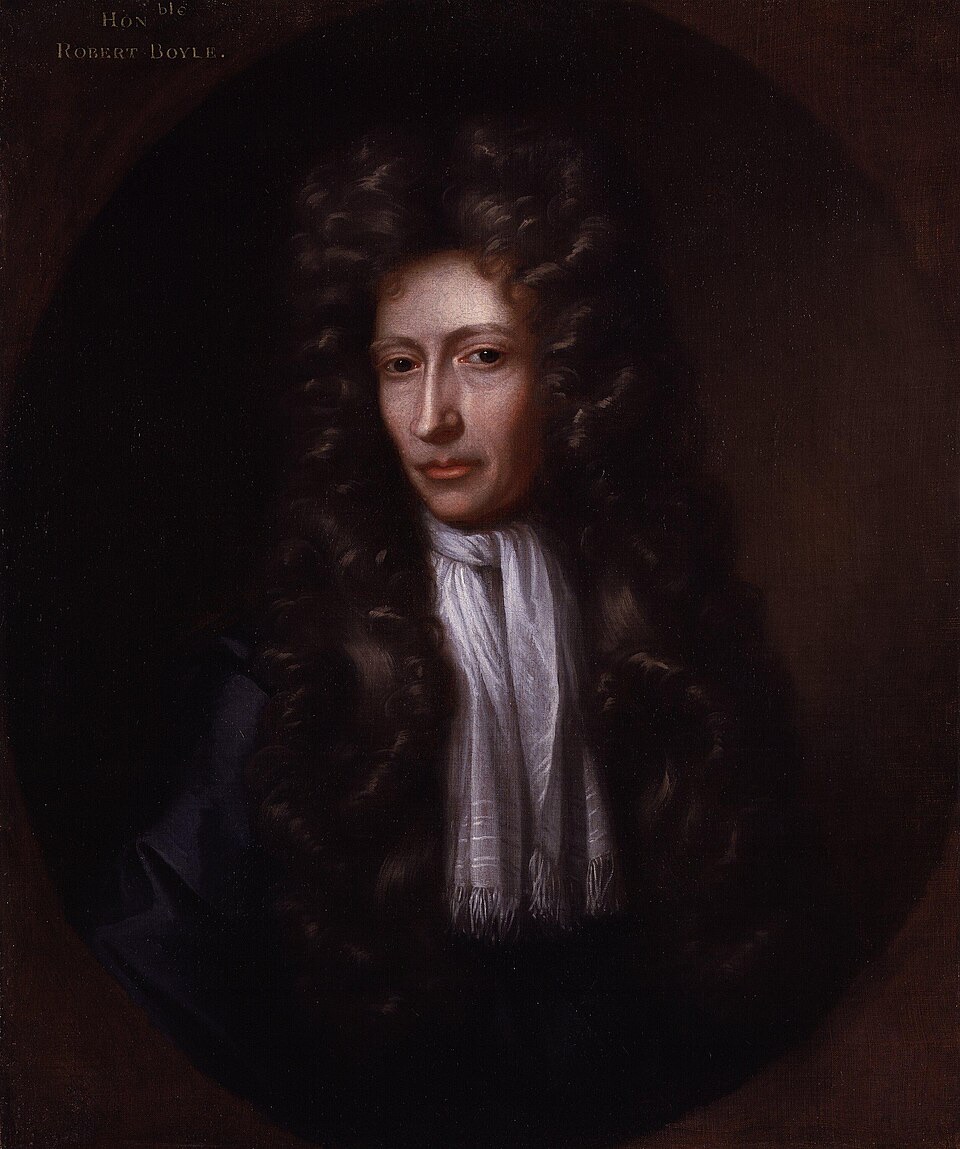
Boyle, Hooke and the spring of the air.

Painted portrait of Robert Boyle, a man with long curled hair
Robert Boyle, painted by Johann Kerseboom about 1689
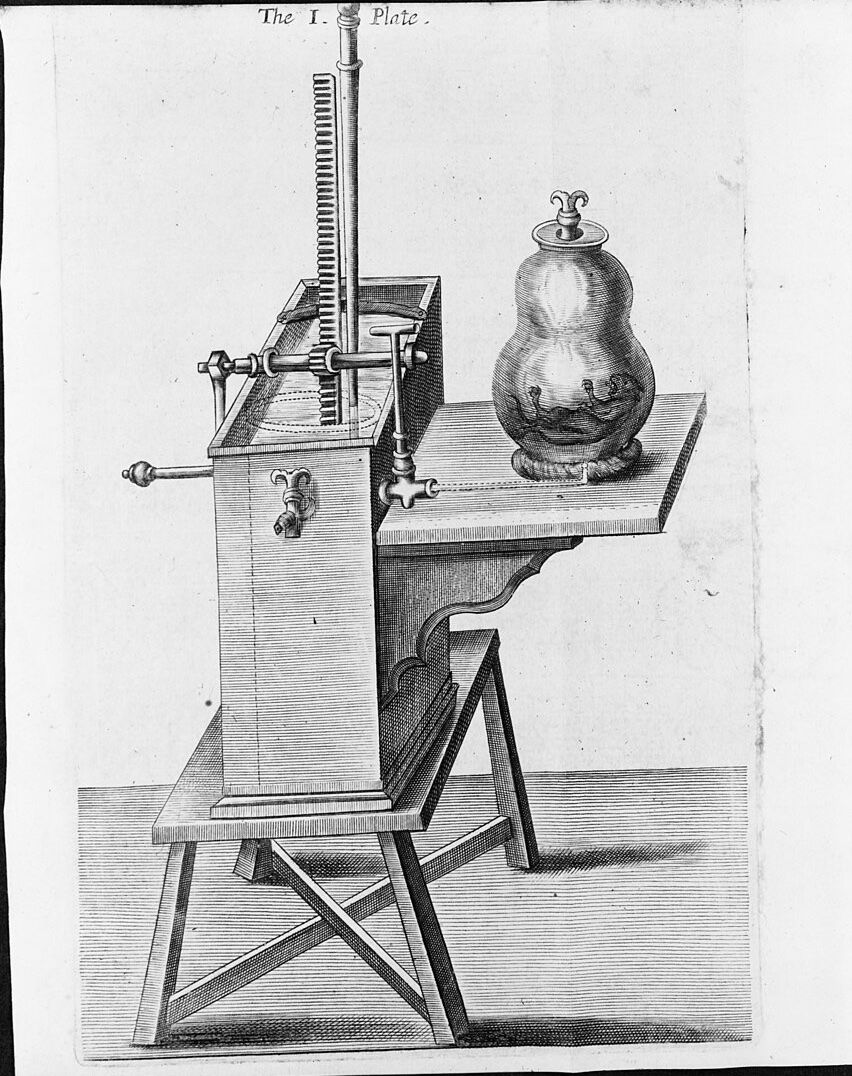
Engraving of an air pump: a tall box with a rack and handle on a wooden stand, joined by a pipe to a glass vessel with a small animal inside
His air pump, from a book of 1669
  • Boyle’s assistant Robert Hooke built the apparatus
  • Air trapped in the closed end of a J-shaped tube was squeezed by pouring in mercury
  • Double the pressure: half the volume. Published in 1662
  • Richard Towneley and Henry Power had noticed the pattern first; Edme Mariotte found it again in 1679
One of the first laws of physics to be established by measurement.

Portrait: Johann Kerseboom, about 1689, public domain. Engraving: Robert Boyle, 1669, Library of Congress, public domain (cropped).

B.3 GAS LAWS · SL + HL

First law · constant temperature

Pressure and volume.

\(PV = \text{constant}\)
  • For a fixed mass of gas at constant temperature
  • \(P \propto \dfrac{1}{V}\): halve the volume, double the pressure
SQUEEZING A GAS SLOWLY
B.3 GAS LAWS · SL + HL

Boyle’s law as a graph

Pressure against volume.

  • Each curve is for one temperature: an isotherm
  • Along it, \(P \times V\) has the same value at every point
  • A hotter gas has its curve further from the origin
TWO TEMPERATURES
B.3 GAS LAWS · SL + HL

Second law · constant volume

Pressure and temperature.

\(\dfrac{P}{T} = \text{constant}\)
  • For a fixed mass of gas at constant volume
  • \(P \propto T\), with \(T\) in kelvin
  • The line points back to −273 °C
A SEALED FLASK, HEATED
B.3 GAS LAWS · SL + HL

Third law · constant pressure

Volume and temperature.

\(\dfrac{V}{T} = \text{constant}\)
  • For a fixed mass of gas at constant pressure
  • \(V \propto T\), with \(T\) in kelvin
  • The same intercept: −273 °C
A GAS FREE TO EXPAND, HEATED
B.3 GAS LAWS · SL + HL

The story · Paris, 1783

Background story · not assessed

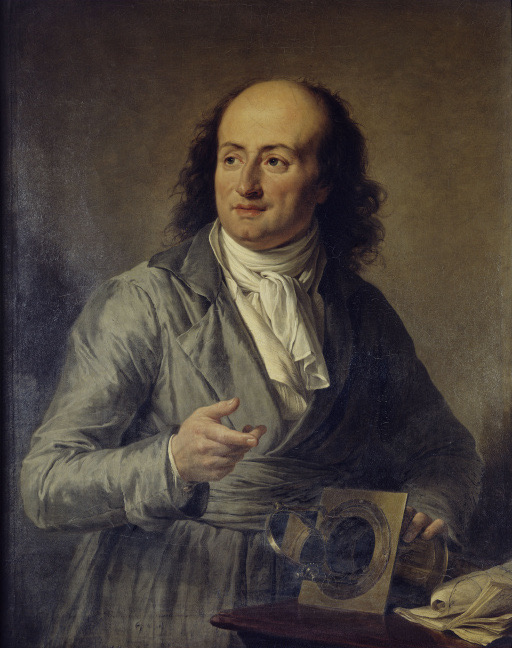
Jacques Charles goes up in a balloon.

Painted portrait of Jacques Charles, a man in a powdered wig and dark coat
Jacques Charles, about 1798
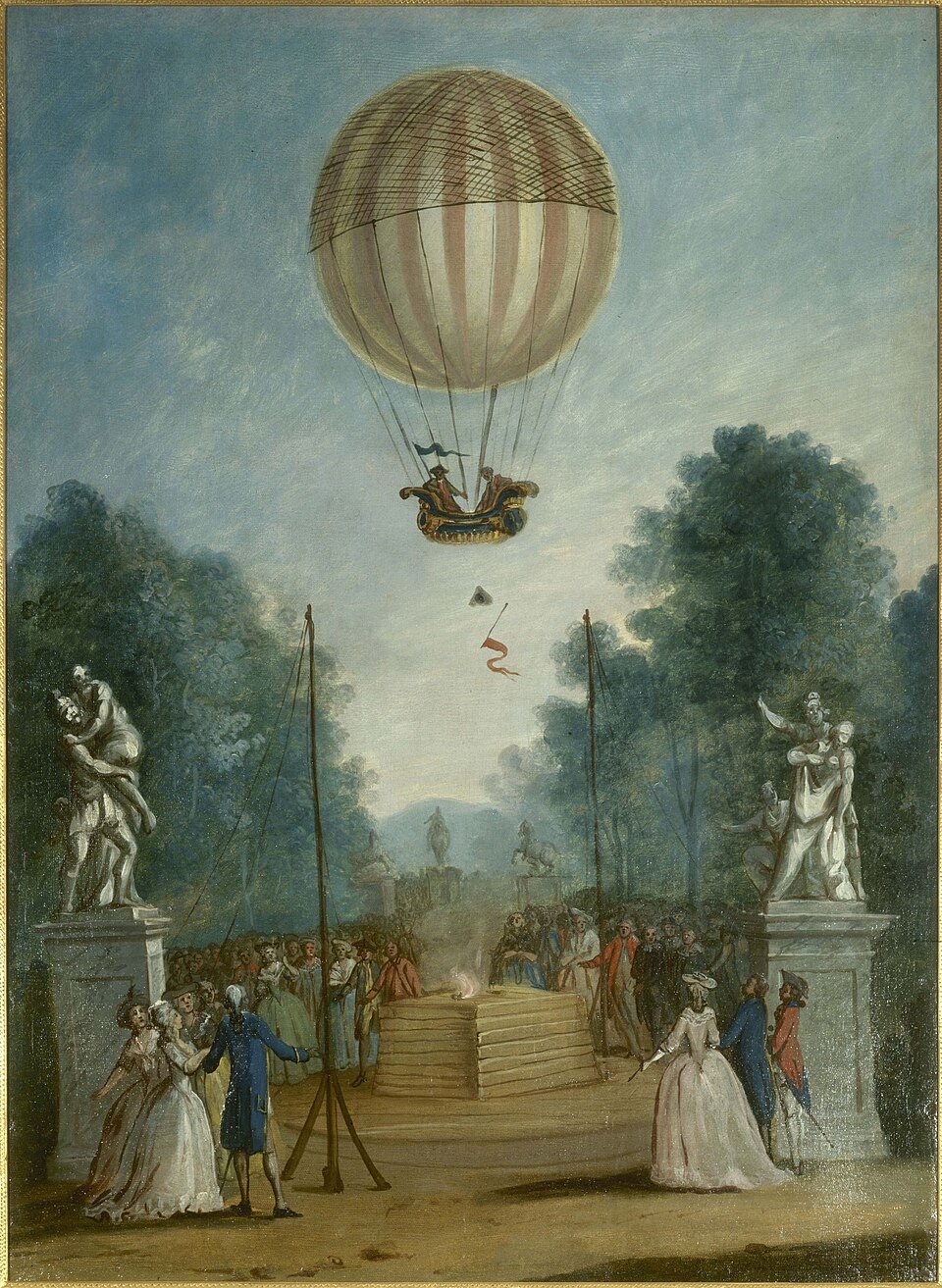
Painting of a striped balloon carrying two men in a boat-shaped basket, rising above a crowd in a garden with statues
The ascent from the Tuileries, 1 December 1783
  • 27 August 1783: Charles and the Robert brothers launch the first hydrogen balloon
  • 1 December: Charles and Nicolas-Louis Robert fly in one for 2 hours, covering 36 km
  • About 1787 he heated balloons of different gases and found that they expanded equally
  • He never published. Gay-Lussac did, in 1802, and named the law after Charles

Portrait: Adélaïde Labille-Guiard, about 1798, public domain. Painting: anonymous, 1783, public domain.

B.3 GAS LAWS · SL + HL

One relation for a fixed mass of gas

Combining the three laws.

\(\dfrac{PV}{T} = \text{constant}\)
  • Between two states: \(\dfrac{P_{1} V_{1}}{T_{1}} = \dfrac{P_{2} V_{2}}{T_{2}}\)
  • Hold one quantity constant and it reduces to one of the three laws
A weather balloon: 2.0 m³ at \(1.0 \times 10^{5}\) Pa and 290 K It rises to where \(P = 2.5 \times 10^{4}\) Pa and \(T = 232\) K \(V_{2} = \dfrac{P_{1} V_{1} T_{2}}{T_{1} P_{2}}\) \(V_{2} = \dfrac{1.0 \times 10^{5} \times 2.0 \times 232}{290 \times 2.5 \times 10^{4}}\) \(V_{2} = \class{res}{6.4 \,\mathrm{m}^{3}}\)
B.3 GAS LAWS · SL + HL

Putting a value on the constant

The ideal gas equation.

\(PV = nRT = N k_\mathrm{B} T\)
  • \(R = 8.31 \,\mathrm{J} \,\mathrm{K}^{-1} \,\mathrm{mol}^{-1}\), the gas constant
  • \(k_\mathrm{B} = 1.38 \times 10^{-23} \,\mathrm{J} \,\mathrm{K}^{-1}\), the Boltzmann constant

Counting in moles

\(PV = nRT\)

Use it when the amount is given in moles or as a mass

Counting molecules

\(PV = N k_\mathrm{B} T\)

Use it when the number of molecules is wanted

The link

\(k_\mathrm{B} = \frac{R}{N_\mathrm{A}}\)

The gas constant for one molecule

B.3 GAS LAWS · SL + HL

Worked example

A cylinder of oxygen.

\(V = 0.020 \,\mathrm{m}^{3}\) · \(P = 1.5 \times 10^{7} \,\mathrm{Pa}\) · \(T = 293 \,\mathrm{K}\) \(PV = nRT\)  so  \(n = \dfrac{PV}{RT}\) \(n = \dfrac{1.5 \times 10^{7} \times 0.020}{8.31 \times 293}\) \(n = \class{res}{123 \,\mathrm{mol}}\)
Oxygen, O₂: 32 g mol⁻¹ \(m = n \times \text{molar mass} = 123 \times 0.032\) \(m = \class{res}{3.9 \,\mathrm{kg}}\) Number of molecules \(N = n N_\mathrm{A} = 123 \times 6.02 \times 10^{23} = \class{res}{7.4 \times 10^{25}}\)
B.3 GAS LAWS · SL + HL

Showing a change of state

Changes on a pressure–volume diagram.

  • A point is one state of the gas: \(P\), \(V\) and so \(T\)
  • A line is a change from one state to another
  • Larger \(PV\): hotter
Each line can be followed in either direction.
THREE CHANGES FROM ONE STATE
B.3 GAS LAWS · SL + HL

Quick check

The gas laws.

01A gas at constant temperature is squeezed to a third of its volume. Pressure?

Three times as great

02A sealed tire at \(2.0 \times 10^{5}\) Pa warms from 280 K to 308 K. New pressure?

\(2.0 \times 10^{5} \times \frac{308}{280} = 2.2 \times 10^{5} \,\mathrm{Pa}\)

03Where does a graph of \(V\) against \(\theta\) in °C meet the temperature axis?

−273 °C

04What is the name of a constant-temperature curve on a \(P\)–\(V\) diagram?

An isotherm

05How are \(R\) and \(k_\mathrm{B}\) related?

\(k_\mathrm{B} = \frac{R}{N_\mathrm{A}}\)

06Volume of 2.0 mol at 300 K and \(1.0 \times 10^{5}\) Pa?

\(\frac{2.0 \times 8.31 \times 300}{1.0 \times 10^{5}} = 0.050 \,\mathrm{m}^{3}\)
PRESS → TO REVEAL EACH ANSWER

Part 03

The kinetic theory.

A model of molecules in motion that explains the gas laws

B.3 GAS LAWS · SL + HL

The assumptions of the kinetic model

The ideal gas.

Many, and random

A very large number of identical molecules in random motion

So averages are reliable

Tiny

The volume of the molecules is negligible

Compared with the volume of the container

No forces

No forces between molecules except during collisions

So no intermolecular potential energy

Elastic

All collisions are elastic

No kinetic energy is lost

Brief

A collision takes a negligible time

Compared with the time between collisions

Newtonian

The molecules obey Newton’s laws

Straight lines at constant speed between collisions

B.3 GAS LAWS · SL + HL

One molecule and one wall

Pressure from collisions.

One collision with the right-hand wall · right is positive \(\Delta p_\mathrm{molecule} = m(-v) - mv = -2mv\) Time between its collisions with that wall \(\Delta t = \dfrac{2L}{v}\) Average force on the wall \(F_\mathrm{wall} = -\dfrac{\Delta p_\mathrm{molecule}}{\Delta t} = \dfrac{m v^{2}}{L}\)
BACK AND FORTH
B.3 GAS LAWS · SL + HL

The result for the whole gas

Pressure and molecular speed.

\(P = \dfrac{1}{3} \rho v^{2}\)
  • \(\rho\): the density of the gas
  • \(v\): the average translational speed of the molecules
  • Links what a gauge reads to what the molecules are doing
Air: \(P = 1.01 \times 10^{5} \,\mathrm{Pa}\) · \(\rho = 1.2 \,\mathrm{kg} \,\mathrm{m}^{-3}\) \(P = \dfrac{1}{3} \rho v^{2}\)  so  \(v = \sqrt{\dfrac{3P}{\rho}}\) \(v = \sqrt{\dfrac{3 \times 1.01 \times 10^{5}}{1.2}}\) \(v = \class{res}{5.0 \times 10^{2} \,\mathrm{m} \,\mathrm{s}^{-1}}\)
B.3 GAS LAWS · SL + HL

Joining the two equations

Temperature and molecular energy.

\(N\) molecules, each of mass \(m\), in a volume \(V\) \(P = \dfrac{1}{3} \rho v^{2}\)  with  \(\rho = \dfrac{Nm}{V}\) \(PV = \dfrac{1}{3} N m v^{2}\) But also \(PV = N k_\mathrm{B} T\) \(\dfrac{1}{3} m v^{2} = k_\mathrm{B} T\) \(\dfrac{1}{2} m v^{2} = \class{res}{\dfrac{3}{2} k_\mathrm{B} T}\)
The average kinetic energy of a molecule depends only on the kelvin temperature.
Helium at 300 K · \(m = 6.64 \times 10^{-27}\) kg \(v = \sqrt{\dfrac{3 k_\mathrm{B} T}{m}} = \class{res}{1.4 \times 10^{3} \,\mathrm{m} \,\mathrm{s}^{-1}}\)
B.3 GAS LAWS · SL + HL

Macroscopic behavior from molecules

Explaining the gas laws.

Squeeze at constant temperature

Pressure rises

Same speed, but more molecules in each unit volume: more frequent collisions with the walls

Heat at constant volume

Pressure rises

Faster molecules: collisions are more frequent and each gives a larger change of momentum

Heat at constant pressure

Volume rises

Faster molecules push the walls outwards until the collisions are rare enough to restore the pressure

Always two questions: how often do molecules hit the wall, and how hard?
B.3 GAS LAWS · SL + HL

All of it is kinetic

Internal energy of an ideal monatomic gas.

\(U = \dfrac{3}{2} N k_\mathrm{B} T = \dfrac{3}{2} nRT\)
  • No forces between molecules: no potential energy
  • So \(U\) = number of molecules × average kinetic energy of each
  • Monatomic: single atoms, such as helium, neon, argon
2.0 mol of helium at 300 K \(U = \dfrac{3}{2} nRT\) \(U = \dfrac{3}{2} \times 2.0 \times 8.31 \times 300\) \(U = \class{res}{7.5 \times 10^{3} \,\mathrm{J}}\)
B.3 GAS LAWS · SL + HL

When the model works

Real gases and the ideal gas.

Low pressure

Molecules far apart

Their own volume is negligible compared with the container

Low density

Forces rarely act

Molecules are seldom close enough to attract each other

High temperature

Fast molecules

Their kinetic energy is far greater than any potential energy of attraction

A real gas is close to ideal at low pressure, low density and high temperature: well away from the conditions at which it would turn to liquid.
B.3 GAS LAWS · SL + HL

Quick check

The kinetic theory.

01A molecule of mass \(m\) and speed \(v\) rebounds from a wall. Change of momentum?

\(2mv\)

02The speed of the molecules doubles at constant density. Pressure?

Four times as great

03What kind of energy is the internal energy of an ideal gas?

Kinetic only

04The kelvin temperature of an ideal gas doubles. Its internal energy?

It doubles

05Hydrogen and oxygen at the same temperature. Which molecules are faster?

Hydrogen: the lighter ones

06Under which conditions is a real gas most nearly ideal?

Low pressure, low density, high temperature
PRESS → TO REVEAL EACH ANSWER

Summary

Gas laws on one slide.

Pressure and amount

\(P = \frac{F}{A}\) · \(n = \frac{N}{N_\mathrm{A}}\)

Pascals and moles

Fixed mass of gas

\(\frac{PV}{T} = \text{constant}\)

\(T\) in kelvin
Contains all three gas laws

Ideal gas equation

\(PV = nRT = N k_\mathrm{B} T\)

\(k_\mathrm{B} = \frac{R}{N_\mathrm{A}}\)

Kinetic theory

\(P = \frac{1}{3} \rho v^{2}\)

Pressure from the change of momentum of molecules at the walls

Internal energy

\(U = \frac{3}{2} nRT\)

Monatomic ideal gas: kinetic only

Real gases

Nearly ideal when thin and hot

Low pressure, low density, high temperature

B.3 GAS LAWS · SL + HL

Summary

Key words.

PressureForce at right angles to a surface, per unit area
MoleThe amount containing \(6.02 \times 10^{23}\) particles
Avogadro constantThe number of particles in one mole
IsothermA constant-temperature curve on a \(P\)–\(V\) diagram
Absolute zero0 K, −273 °C: where an ideal gas would have no pressure
Ideal gasThe model gas that obeys \(PV = nRT\) exactly
Kinetic theoryGas behavior explained by molecules in random motion
Elastic collisionNo kinetic energy is lost
MonatomicMade of single atoms
B.3 GAS LAWS · SL + HL