IB DP Physics · Theme B · The particulate nature of matter

Thermodynamics.

B.4 · The first law, gas processes, entropy and the second law, heat engines
Higher level only: there is no standard level content in B.4

Additional HL · 8 hours

The journey

Four parts.

Part 01

The first law

Heat, work and internal energy

Part 02

Gas processes

Four special changes, and cycles

Part 03

Entropy

Disorder, and the second law

Part 04

Heat engines

Efficiency and the Carnot limit

All calculations use a monatomic ideal gas, from B.3.
B.4 THERMODYNAMICS · HL ONLY

Part 01 · HL only

The first law.

Conservation of energy for a gas: heat in, work out, internal energy changed

B.4 THERMODYNAMICS · HL ONLY

What are we talking about?

System and surroundings.

  • The system is the thing studied, usually a fixed amount of gas. Everything else is the surroundings

Closed system

No mass in or out

Energy can cross the boundary, as heat or as work

Example: gas sealed in a cylinder with a piston

Isolated system

Neither mass nor energy in or out

Its total energy is fixed

Example: a sealed, perfectly insulated flask. The whole universe

B.4 THERMODYNAMICS · HL ONLY

Energy inside the gas

Internal energy of a monatomic ideal gas.

\(\Delta U = \dfrac{3}{2} n R \Delta T = \dfrac{3}{2} N k_\mathrm{B} \Delta T\)
  • The total random kinetic energy of the atoms
  • Depends only on temperature, for a fixed amount of gas
  • \(n\) moles, or \(N\) atoms
2.0 mol of helium heated from 300 K to 450 K \(\Delta U = \dfrac{3}{2} n R \Delta T\) \(\Delta U = \dfrac{3}{2} \times 2.0 \times 8.31 \times 150\) \(\Delta U = \class{res}{3.7 \times 10^{3} \,\mathrm{J}}\)
B.4 THERMODYNAMICS · HL ONLY

Moving the boundary

Work done by a gas.

GAS IN A CYLINDERPRESS → TO LET IT EXPAND
\(W = F \Delta x = P A \Delta x\) \(W = P \Delta V\)
  • At constant pressure
  • Expansion: work done by the gas, positive
  • Compression: work done on the gas, negative
B.4 THERMODYNAMICS · HL ONLY

When the pressure changes

Work on a pressure–volume diagram.

  • Work done = the area under the path
  • Path to the right: expansion, work done by the gas
  • Path to the left: compression, work done on the gas
  • Vertical path: no work
AN EXPANSION
B.4 THERMODYNAMICS · HL ONLY

Conservation of energy

The first law of thermodynamics.

\(\Delta U = Q - W\)
  • Internal energy rises by the thermal energy supplied, minus the work done by the gas
  • For a closed system
PositiveNegative
\(Q\)Thermal energy supplied to the systemThermal energy lost by it
\(W\)Work done by the systemWork done on it
\(\Delta U\)Temperature risesTemperature falls
B.4 THERMODYNAMICS · HL ONLY

Worked example

Using the first law.

A gas is supplied with 500 J of thermal energy and does 200 J of work as it expands \(\Delta U = Q - W\) \(\Delta U = 500 - 200 = \class{res}{+300 \,\mathrm{J}}\) Its temperature rises
150 J of work is done on a gas while it loses 400 J of thermal energy \(Q = -400 \,\mathrm{J}\)  ·  \(W = -150 \,\mathrm{J}\) \(\Delta U = Q - W = -400 - (-150) = \class{res}{-250 \,\mathrm{J}}\) Its temperature falls
B.4 THERMODYNAMICS · HL ONLY

Quick check

The first law.

01What can cross the boundary of a closed system?

Energy, but not mass

02On what does the internal energy of an ideal gas depend?

Its temperature (and the amount of gas)

03A gas at \(2.0 \times 10^{5} \,\mathrm{Pa}\) expands by \(3.0 \times 10^{-3} \,\mathrm{m}^{3}\). Work done?

\(600 \,\mathrm{J}\), by the gas

04What is the sign of \(W\) when a gas is compressed?

Negative

05\(Q = +800 \,\mathrm{J}\) and \(W = +300 \,\mathrm{J}\). Change in internal energy?

\(+500 \,\mathrm{J}\)

06What does the area under a P–V graph give?

The work done
PRESS → TO REVEAL EACH ANSWER

Part 02 · HL only

Gas processes.

Four changes, each with one thing held fixed, and how they join into a cycle

B.4 THERMODYNAMICS · HL ONLY

Keeping one variable fixed

Four processes.

  • Isobaric: constant pressure
  • Isovolumetric: constant volume
  • Isothermal: constant temperature
  • Adiabatic: no thermal energy in or out
FOUR LINES THROUGH ONE STATEEITHER DIRECTION
B.4 THERMODYNAMICS · HL ONLY

Constant volume, constant pressure

Isovolumetric and isobaric changes.

Isovolumetric

\(W = 0\), so \(\Delta U = Q\)

All the heat supplied raises the temperature

Isobaric

\(W = P \Delta V\), so \(\Delta U = Q - P \Delta V\)

Some of the heat is spent on work

Isobaric: \(P = 1.0 \times 10^{5} \,\mathrm{Pa}\) \(V\) from \(2.0 \times 10^{-3}\) to \(5.0 \times 10^{-3} \,\mathrm{m}^{3}\) \(W = P \Delta V = 1.0 \times 10^{5} \times 3.0 \times 10^{-3} = \class{res}{300 \,\mathrm{J}}\) \(\Delta U = \dfrac{3}{2} P \Delta V = \dfrac{3}{2} \times 300 = \class{res}{450 \,\mathrm{J}}\) \(\Delta U = Q - W\)  so  \(Q = \Delta U + W = \class{res}{750 \,\mathrm{J}}\)
B.4 THERMODYNAMICS · HL ONLY

Constant temperature

Isothermal changes.

  • \(T\) constant, so \(\Delta U = 0\)
  • First law: \(0 = Q - W\), so \(Q = W\)
  • \(PV\) = constant: Boyle’s law
All the heat supplied comes straight out as work.
AN ISOTHERMAL CHANGE
B.4 THERMODYNAMICS · HL ONLY

No thermal energy transferred

Adiabatic changes.

\(P V^{\frac{5}{3}} = \text{constant}\)
  • \(Q = 0\), so \(\Delta U = -W\)
  • Expansion: the gas does work and cools
  • Compression: work is done on it and it warms
ADIABATIC AND ISOTHERMAL COMPARED
B.4 THERMODYNAMICS · HL ONLY

Worked example

An adiabatic compression.

\(P_{1} = 1.0 \times 10^{5} \,\mathrm{Pa}\) · \(V_{1} = 4.0 \times 10^{-3} \,\mathrm{m}^{3}\) · \(T_{1} = 300 \,\mathrm{K}\) Compressed to \(V_{2} = 1.0 \times 10^{-3} \,\mathrm{m}^{3}\) \(P_{1} V_{1}^{\frac{5}{3}} = P_{2} V_{2}^{\frac{5}{3}}\)  so  \(P_{2} = P_{1} \left(\dfrac{V_{1}}{V_{2}}\right)^{\frac{5}{3}}\) \(P_{2} = 1.0 \times 10^{5} \times 4.0^{\frac{5}{3}} = \class{res}{1.0 \times 10^{6} \,\mathrm{Pa}}\)
The new temperature \(\dfrac{P_{1} V_{1}}{T_{1}} = \dfrac{P_{2} V_{2}}{T_{2}}\) \(T_{2} = T_{1} \dfrac{P_{2} V_{2}}{P_{1} V_{1}} = 300 \times \dfrac{10.1 \times 1.0}{1.0 \times 4.0}\) \(T_{2} = \class{res}{760 \,\mathrm{K}}\)
B.4 THERMODYNAMICS · HL ONLY

Side by side

The four processes compared.

ProcessConstantFirst law becomesOn a P–V diagram
Isovolumetric\(V\)\(\Delta U = Q\)Vertical line
Isobaric\(P\)\(\Delta U = Q - P \Delta V\)Horizontal line
Isothermal\(T\)\(\Delta U = 0\), so \(Q = W\)Curve, \(PV\) constant
Adiabaticnone: \(Q = 0\)\(\Delta U = -W\)Steeper curve
B.4 THERMODYNAMICS · HL ONLY

Back to the start

Cyclic processes.

  • The gas returns to its starting state: over a cycle \(\Delta U = 0\)
  • Net work done = the area enclosed
  • Clockwise: net work done by the gas
Pressure in \(10^{5} \,\mathrm{Pa}\) · volume in \(10^{-3} \,\mathrm{m}^{3}\) \(W_\mathrm{net} = (P_\mathrm{high} - P_\mathrm{low})(V_\mathrm{max} - V_\mathrm{min})\) \(W = 2.0 \times 10^{5} \times 3.0 \times 10^{-3} = \class{res}{600 \,\mathrm{J}}\)
A RECTANGULAR CYCLE
B.4 THERMODYNAMICS · HL ONLY

Quick check

Gas processes.

01In which process is no work done?

Isovolumetric

02In which process is \(\Delta U = 0\)?

Isothermal

03A gas expands adiabatically. What happens to its temperature?

It falls

04Which is steeper on a P–V diagram, an isothermal or an adiabatic curve?

The adiabatic curve

05What is \(\Delta U\) over one complete cycle?

Zero

06What does the area inside a cycle on a P–V diagram give?

The net work done
PRESS → TO REVEAL EACH ANSWER

Part 03 · HL only

Entropy and the second law.

Why some things happen by themselves and their reverse never does

B.4 THERMODYNAMICS · HL ONLY

A direction for time

Processes that only go one way.

GAS IN HALF A BOXPRESS → TO REMOVE THE PARTITION
  • The gas spreads out. It never un-spreads
  • Heat flows from hot to cold, never back
  • Energy would be conserved either way: the first law allows both
  • Real processes are irreversible
B.4 THERMODYNAMICS · HL ONLY

Counting the ways

Microstates and macrostates.

  • Macrostate: what you can see, such as “2 heads”
  • Microstate: the exact arrangement, such as HTHT
  • Every microstate is equally likely
  • \(\Omega\): the number of microstates of a macrostate
FOUR COINS16 MICROSTATES
B.4 THERMODYNAMICS · HL ONLY

A measure of disorder

Entropy.

\(S = k_\mathrm{B} \ln \Omega\)
  • More microstates: more disorder, more entropy
  • Unit: J K⁻¹
  • \(k_\mathrm{B} = 1.38 \times 10^{-23} \,\mathrm{J} \,\mathrm{K}^{-1}\)
Four coins, all heads: \(\Omega = 1\) \(S = k_\mathrm{B} \ln 1 = \class{res}{0}\) Two heads and two tails: \(\Omega = 6\) \(S = 1.38 \times 10^{-23} \times \ln 6\) \(S = \class{res}{2.5 \times 10^{-23} \,\mathrm{J} \,\mathrm{K}^{-1}}\)
B.4 THERMODYNAMICS · HL ONLY

The story · Vienna, 1877–1906

Background story · not assessed

The equation on a tombstone.

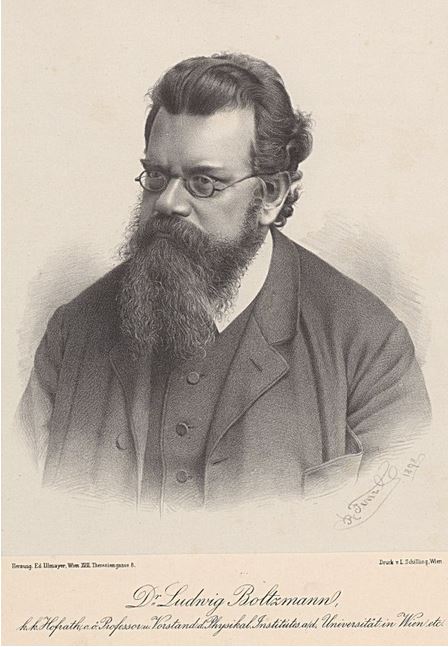
Photographic portrait of Ludwig Boltzmann, a man with a full beard and small round glasses
Ludwig Boltzmann in 1898
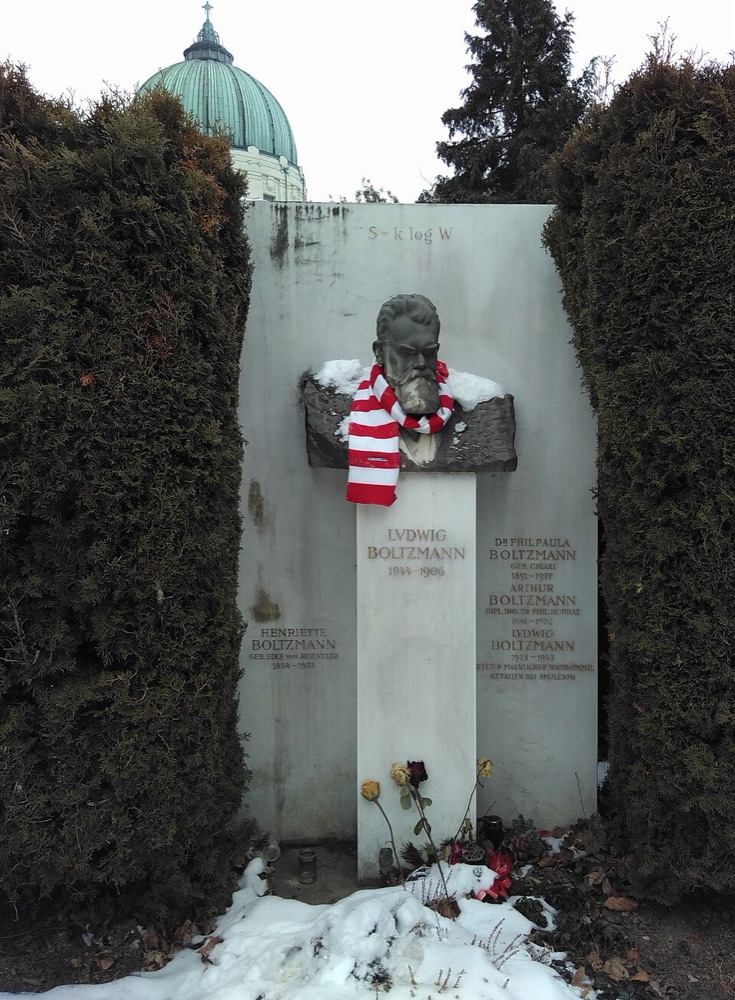
A white marble tombstone with a bust of Boltzmann on top and the formula S = k. log W carved above it
His grave in Vienna, with S = k. log W carved above the bust
  • In 1877 Boltzmann linked entropy to the number of arrangements of atoms
  • Many physicists then doubted that atoms existed at all
  • He defended the idea for thirty years, and died in 1906
  • Within a few years experiments on Brownian motion had settled the question
His W is our \(\Omega\). The constant \(k\) now carries his name.

Portrait: Rudolf Fenzl, 1898, public domain. Grave: Feldkurat Katz, CC BY-SA 4.0.

B.4 THERMODYNAMICS · HL ONLY

The large-scale view

Entropy change from thermal energy.

\(\Delta S = \dfrac{\Delta Q}{T}\)
  • \(\Delta Q\): thermal energy transferred at absolute temperature \(T\)
  • Energy in: entropy rises. Energy out: it falls
  • The same heat counts for more at a low temperature
0.10 kg of ice melts at 273 K Specific latent heat \(3.34 \times 10^{5} \,\mathrm{J} \,\mathrm{kg}^{-1}\) \(\Delta Q = mL = 0.10 \times 3.34 \times 10^{5} = 3.34 \times 10^{4} \,\mathrm{J}\) \(\Delta S = \dfrac{\Delta Q}{T} = \dfrac{3.34 \times 10^{4}}{273}\) \(\Delta S = \class{res}{+122 \,\mathrm{J} \,\mathrm{K}^{-1}}\)
B.4 THERMODYNAMICS · HL ONLY

Three ways of saying it

The second law of thermodynamics.

Entropy form

The entropy of an isolated system never decreases

Reversible process: it stays the same
Irreversible process: it increases

Clausius form

Heat does not flow by itself from cold to hot

Moving thermal energy from a colder body to a hotter one needs work

Kelvin form

No engine can turn heat entirely into work

Working in a cycle, it must reject some thermal energy to a colder body

B.4 THERMODYNAMICS · HL ONLY

Worked example

Why heat flows from hot to cold.

600 J flows from a body at 400 K to one at 300 K \(\Delta S = \dfrac{\Delta Q}{T}\) for each body Hot body: \(\Delta S = \dfrac{-600}{400} = -1.5 \,\mathrm{J} \,\mathrm{K}^{-1}\) Cold body: \(\Delta S = \dfrac{+600}{300} = +2.0 \,\mathrm{J} \,\mathrm{K}^{-1}\) Total: \(\class{res}{+0.5 \,\mathrm{J} \,\mathrm{K}^{-1}}\)
  • The total entropy rises: this happens by itself
  • Reversed, the total would be \(-0.5 \,\mathrm{J} \,\mathrm{K}^{-1}\): forbidden
  • The hot body’s entropy fell, but the cold body’s rose by more
B.4 THERMODYNAMICS · HL ONLY

Systems that are not isolated

Entropy can fall locally.

  • The entropy of a system that is not isolated can decrease
  • The entropy of its surroundings then rises by at least as much

Water freezing

Liquid to ordered crystal

The latent heat it gives out raises the entropy of the colder air

A refrigerator

Cools its contents

It rejects more thermal energy to the room than it removes

A living thing

Builds order from food

It gives out heat and waste of higher entropy

B.4 THERMODYNAMICS · HL ONLY

Quick check

Entropy and the second law.

01What is a microstate?

One exact arrangement of all the particles

02How many microstates have three heads from four coins?

4

03900 J is supplied to a body at 300 K. Entropy change?

\(\frac{900}{300} = +3.0 \,\mathrm{J} \,\mathrm{K}^{-1}\)

04What happens to the entropy of a real isolated system?

It always increases

05State the Clausius form of the second law.

Heat does not flow by itself from cold to hot

06Water freezes: its entropy falls. Why is that allowed?

The surroundings gain more
PRESS → TO REVEAL EACH ANSWER

Part 04 · HL only

Heat engines.

Turning thermal energy into work, and the limit that no design can beat

B.4 THERMODYNAMICS · HL ONLY

The story · Paris, 1824

Background story · not assessed

Carnot’s question.

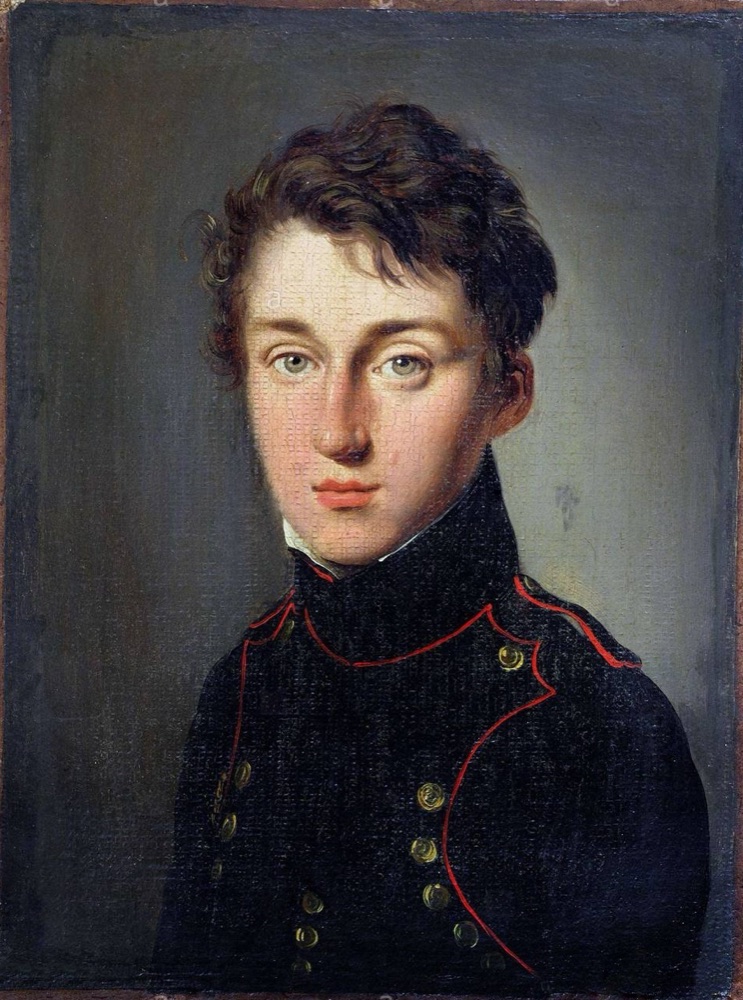
Painted portrait of Sadi Carnot as a young man in the dark uniform of the École polytechnique
Sadi Carnot at 17, painted by Louis-Léopold Boilly
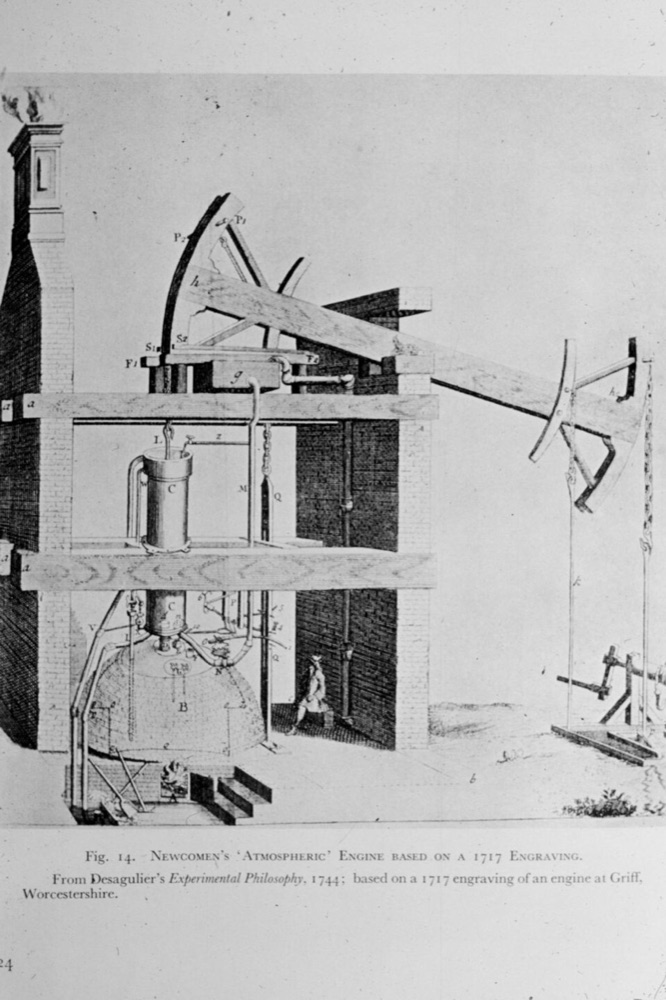
Engraving of an early steam engine: a brick boiler and furnace below a vertical cylinder, whose piston hangs from one end of a large rocking beam with pump rods on the other end
A Newcomen engine, from an engraving of 1717
  • Steam engines had been pumping mines since 1712, improved by trial and error
  • Carnot, a young army engineer, asked: is there a limit to how good an engine can be?
  • His answer, in 1824: yes, and it depends only on the two temperatures
  • He paid to print 600 copies. He died of cholera at 36
The limit came before the first and second laws were known.

Portrait: Louis-Léopold Boilly, 1813, public domain. Engine: Digital Public Library of America, public domain.

B.4 THERMODYNAMICS · HL ONLY

Work from thermal energy

Heat engines.

\(\eta = \dfrac{\text{useful work}}{\text{input energy}} = \dfrac{W}{Q_\mathrm{h}}\)
  • Takes in \(Q_\mathrm{h}\) from a hot reservoir
  • Does work \(W\), using a gas taken round a cycle
  • Rejects \(Q_\mathrm{c}\) to a cold reservoir
  • \(W = Q_\mathrm{h} - Q_\mathrm{c}\)
ENERGY FLOW IN ONE CYCLE
B.4 THERMODYNAMICS · HL ONLY

The best possible engine

The Carnot cycle.

  • A → B: isothermal expansion at \(T_\mathrm{h}\), taking in \(Q_\mathrm{h}\)
  • B → C: adiabatic expansion, cooling to \(T_\mathrm{c}\)
  • C → D: isothermal compression at \(T_\mathrm{c}\), rejecting \(Q_\mathrm{c}\)
  • D → A: adiabatic compression, warming to \(T_\mathrm{h}\)
TWO ISOTHERMALS, TWO ADIABATICS
B.4 THERMODYNAMICS · HL ONLY

The limit

The Carnot efficiency.

\(\eta_\mathrm{Carnot} = 1 - \dfrac{T_\mathrm{c}}{T_\mathrm{h}}\)
  • The greatest efficiency possible between two reservoirs
  • Depends only on their temperatures, in kelvin
  • Real engines always do worse
Steam at 800 K · cooling water at 300 K \(\eta_\mathrm{Carnot} = 1 - \dfrac{T_\mathrm{c}}{T_\mathrm{h}} = 1 - \dfrac{300}{800} = \class{res}{0.63}\) A real engine: 2000 J in, 600 J of work \(\eta = \dfrac{W}{Q_\mathrm{h}} = \dfrac{600}{2000} = \class{res}{0.30}\)
B.4 THERMODYNAMICS · HL ONLY

The story · Zürich, 1865

Background story · not assessed

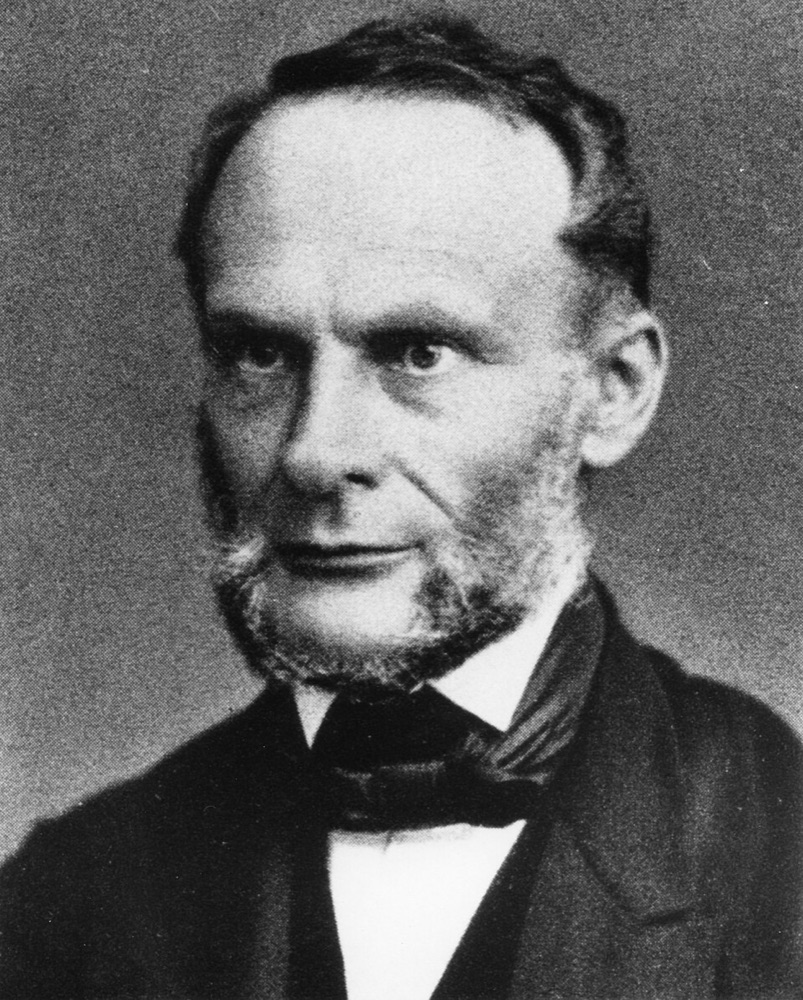
Clausius names entropy.

Photographic portrait of Rudolf Clausius, an older man with white hair and a white beard, in a dark coat
Rudolf Clausius
  • In 1850 Clausius put Carnot’s result together with Joule’s: energy is conserved, and heat will not flow uphill
  • In 1865 he found the quantity that measures this, \(\frac{\Delta Q}{T}\), and named it entropy
  • He built the word from the Greek for “transformation”, to sound like “energy”
His summary: the energy of the universe is constant; its entropy tends to a maximum.

Portrait: AIP Emilio Segrè Visual Archives, CC0.

B.4 THERMODYNAMICS · HL ONLY

Quick check

Heat engines.

01An engine takes in 500 J and rejects 350 J. Work done?

150 J

02Its efficiency?

\(\frac{150}{500} = 0.30\)

03Which four processes make up a Carnot cycle?

Two isothermal and two adiabatic

04Reservoirs at 600 K and 300 K. Greatest possible efficiency?

\(1 - \frac{300}{600} = 0.50\)

05Why must an engine reject heat?

To remove the entropy it took in

06How can the Carnot efficiency be raised?

Hotter source or colder sink
PRESS → TO REVEAL EACH ANSWER

Summary

Thermodynamics on one slide.

First law

\(\Delta U = Q - W\)

\(Q\) into the gas, \(W\) done by it
\(\Delta U = \frac{3}{2} n R \Delta T\)

Work

\(W = P \Delta V\)

Area under a P–V path
Area inside a cycle: net work

Processes

One thing fixed

Isovolumetric, isobaric, isothermal
Adiabatic: \(P V^{\frac{5}{3}}\) constant

Entropy

\(S = k_\mathrm{B} \ln \Omega\)

\(\Delta S = \frac{\Delta Q}{T}\)
A measure of disorder

Second law

Entropy never decreases

In an isolated system
Clausius and Kelvin forms

Heat engines

\(\eta_\mathrm{Carnot} = 1 - \frac{T_\mathrm{c}}{T_\mathrm{h}}\)

\(\eta = \frac{W}{Q_\mathrm{h}}\), always below the Carnot limit

B.4 THERMODYNAMICS · HL ONLY

Summary

Key words.

Closed systemEnergy can cross, mass cannot
Isolated systemNothing crosses its boundary
Internal energyTotal random energy of the particles
IsothermalAt constant temperature
AdiabaticNo thermal energy transferred
IsobaricAt constant pressure
IsovolumetricAt constant volume
MicrostateOne exact arrangement
EntropyA measure of disorder, in J K⁻¹
IrreversibleRaises the total entropy
Heat engineTurns thermal energy into work
Carnot cycleThe most efficient cycle possible
B.4 THERMODYNAMICS · HL ONLY