The puzzle
Muons are unstable particles made when cosmic rays strike the top of the atmosphere. At rest they last 2.2 μs on average. Even at almost the speed of light, a muon would cover only \(0.995 \times 3.00 \times 10^{8} \times 2.2 \times 10^{-6} = 660\) m in one lifetime. A descent of 1920 m takes 6.4 μs, nearly three lifetimes, and after three lifetimes only about one in twenty would be left.
The measurement
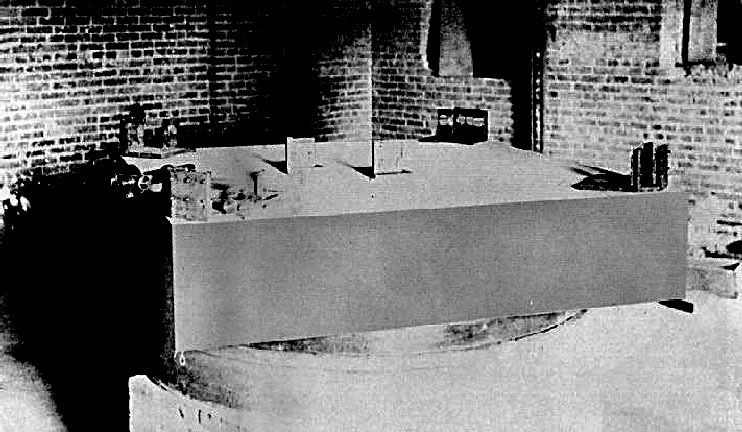
In 1963 David Frisch and James Smith counted muons of this speed on Mount Washington, 1917 m up, and again at sea level. On the mountain: 563 an hour. At sea level, without relativity, they should have found about 27. They found 412.
Two explanations, one result
In the Earth frame the muons’ clocks run slow by \(\gamma = 10\): they live 22 μs, and 6.4 μs is less than a third of a lifetime. In the muons’ frame they live 2.2 μs as usual, but the mountain is only 192 m high and rushes past in 0.64 μs: again less than a third of a lifetime. The same fraction survives either way.