IB DP Physics · Theme D · Fields

Gravitational fields.

D.1 · Kepler’s laws, Newton’s law of gravitation, field strength, potential and orbits
Standard level and higher level

SL + HL · 5 hours Additional HL · 7 hours

The journey

Four parts.

Part 01 · SL + HL

Kepler’s laws

How the planets move round the Sun

Part 02 · SL + HL

Newton’s law of gravitation

The force between any two masses

Part 03 · SL + HL

Gravitational fields

Field strength and field lines

Part 04 · HL only

Energy and orbits

Potential, orbital speed and escape speed

Slides with a terracotta edge and an HL only flag are additional higher level. Every other slide is for SL and HL.
D.1 GRAVITATIONAL FIELDS · SL + HL

Part 01 · SL + HL

Kepler’s laws.

Three rules that describe every orbit, found before anyone knew why

D.1 GRAVITATIONAL FIELDS · SL + HL

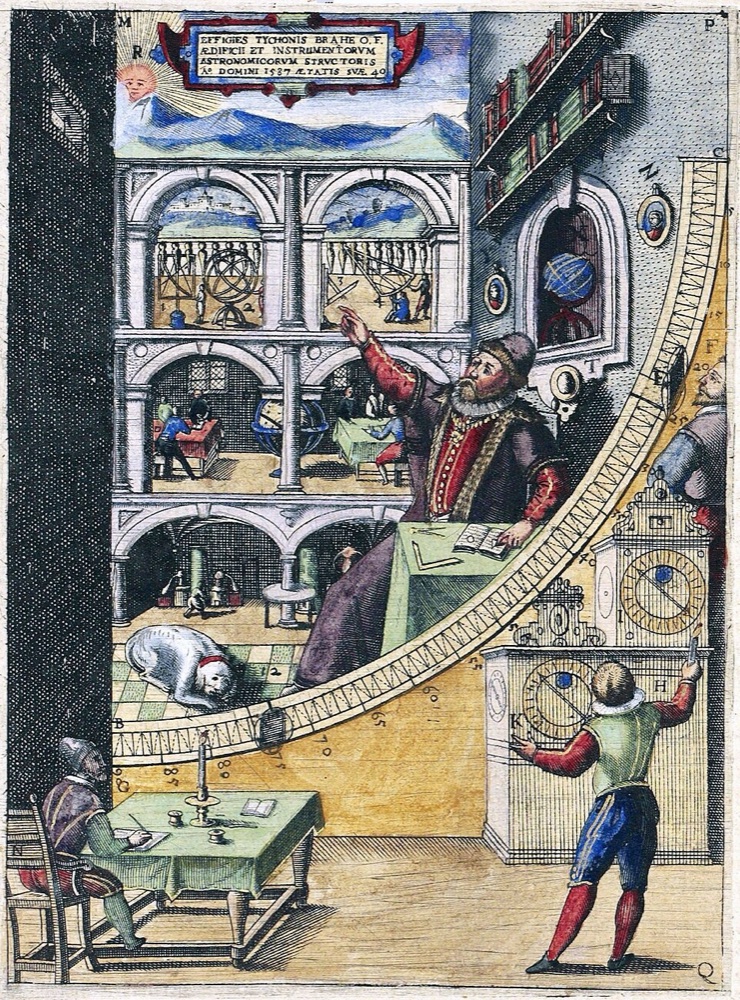
The story · Prague, 1600–1619

Background story · not assessed

Tycho’s numbers, Kepler’s laws.

Colored engraving of Tycho Brahe seated inside his observatory, pointing upwards, beside a large brass quadrant fixed to the wall, with assistants reading the instrument and a clock
Tycho Brahe and his great mural quadrant, engraved in 1598
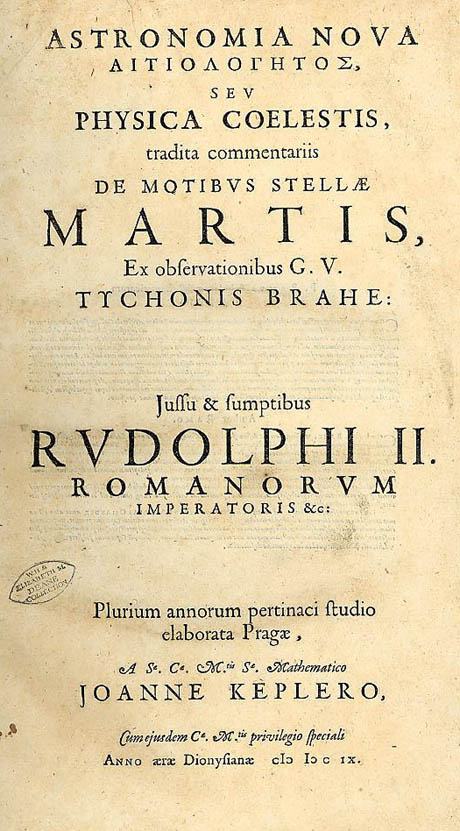
Printed Latin title page of Astronomia Nova
Kepler’s Astronomia Nova, 1609
  • Tycho measured planets by eye, with no telescope, to about one arcminute
  • Johannes Kepler joined him in Prague in 1600 and worked on the orbit of Mars
  • His best circular model missed Tycho’s data by eight arcminutes. He trusted the data and gave up circles
  • Two laws in 1609, the third in 1619
A small disagreement with good data overturned 2000 years of circles.

Quadrant: from Tycho’s Astronomiae instauratae mechanica, public domain. Title page: Johannes Kepler, public domain.

D.1 GRAVITATIONAL FIELDS · SL + HL

The shape of an orbit

Kepler’s first law.

  • Each planet moves in an ellipse
  • The Sun is at one focus of the ellipse
  • The distance from the Sun changes round the orbit
  • A circle is the special ellipse whose two foci coincide
AN ELLIPTICAL ORBITMUCH EXAGGERATED
D.1 GRAVITATIONAL FIELDS · SL + HL

The speed round an orbit

Kepler’s second law.

  • The line from the Sun to a planet sweeps out equal areas in equal times
  • Near the Sun the line is short, so the planet must move faster
  • Far from the Sun it moves slower
In a circular orbit the speed is constant.
ONE ORBIT, AT THE RIGHT SPEEDS
D.1 GRAVITATIONAL FIELDS · SL + HL

Comparing orbits

Kepler’s third law.

\(T^{2} \propto r^{3}\)
  • \(T\): the orbital period
  • \(r\): the average radius of the orbit
  • So \(\dfrac{T^{2}}{r^{3}}\) is the same for every body orbiting the same center
Planet\(r\) / AU\(T\) / years\(\frac{T^{2}}{r^{3}}\)
Mercury0.3870.2411.00
Earth1.001.001.00
Mars1.521.881.00
Jupiter5.2011.91.00
D.1 GRAVITATIONAL FIELDS · SL + HL

Worked example

How long is the year of Ceres?.

Ceres orbits the Sun at \(r = 2.77 \,\mathrm{AU}\) Earth: \(r_\mathrm{E} = 1.00 \,\mathrm{AU}\), \(T_\mathrm{E} = 1.00\) year \(\dfrac{T^{2}}{r^{3}} = \dfrac{T_\mathrm{E}^{2}}{r_\mathrm{E}^{3}}\) \(T = T_\mathrm{E} \left(\dfrac{r}{r_\mathrm{E}}\right)^{\frac{3}{2}}\) \(T = 1.00 \times 2.77^{\frac{3}{2}} = \class{res}{4.61 \text{ years}}\)
  • Compare with a body whose orbit you know
  • Use any units, as long as they are the same for both bodies
  • The power \(\frac{3}{2}\) means “cube, then square root”
D.1 GRAVITATIONAL FIELDS · SL + HL

Quick check

Kepler’s laws.

01What shape is the orbit of a planet, and where is the Sun?

An ellipse, with the Sun at one focus

02Where in its orbit does a planet move fastest?

Where it is closest to the Sun

03What is the same for two equal time intervals on one orbit?

The area swept out by the line from the Sun

04Which quantity is the same for every planet round the Sun?

\(\frac{T^{2}}{r^{3}}\)

05A planet orbits at 4.0 AU. Its period?

\(4.0^{\frac{3}{2}} = 8.0\) years

06Can the third law compare the Moon with Mars?

No: they orbit different bodies
PRESS → TO REVEAL EACH ANSWER

Part 02 · SL + HL

Newton’s law of gravitation.

One force explains the falling apple, the Moon and all three of Kepler’s laws

D.1 GRAVITATIONAL FIELDS · SL + HL

The force between two masses

Newton’s universal law of gravitation.

\(F = G \dfrac{m_{1} m_{2}}{r^{2}}\)
  • Every mass attracts every other mass
  • \(r\) is the distance between their centers
  • \(G = 6.67 \times 10^{-11} \,\mathrm{N} \,\mathrm{m}^{2} \,\mathrm{kg}^{-2}\)
TWO MASSESEQUAL AND OPPOSITE FORCES
D.1 GRAVITATIONAL FIELDS · SL + HL

How the force depends on distance

An inverse square law.

  • \(F \propto \dfrac{1}{r^{2}}\)
  • Double the separation: a quarter of the force
  • Three times the separation: one ninth
  • The force never quite reaches zero
FORCE AGAINST SEPARATION
D.1 GRAVITATIONAL FIELDS · SL + HL

When is a body a point?

Point masses and spheres.

  • The law is for point masses
  • A body acts as a point mass when it is small compared with the separation
  • A uniform sphere acts as if all its mass were at its center, for anything outside it
OUTSIDE THE SPHERE, THE SAME FIELD
D.1 GRAVITATIONAL FIELDS · SL + HL

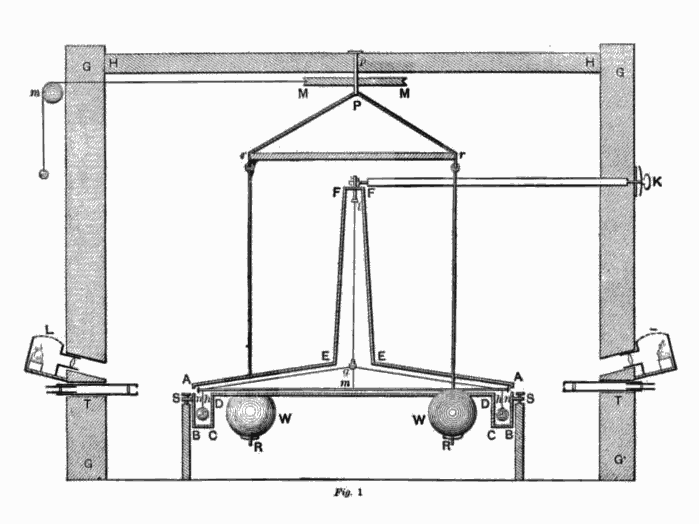
The story · London, 1798

Background story · not assessed

Cavendish weighs the Earth.

Engraved cross-section of a room containing a long horizontal rod hung from a wire, with a small lead ball at each end and a large lead ball hung close to each of them
The torsion balance, from Cavendish’s paper of 1798
  • The force between laboratory masses is tiny: Newton never knew the value of \(G\)
  • John Michell designed the apparatus but died in 1793. Henry Cavendish rebuilt it
  • Two 158 kg lead balls pulled two 0.73 kg balls on a 1.8 m rod, twisting the wire that held it
  • His result: the Earth is 5.45 times as dense as water. Today’s value is 5.51
From his result comes \(G\), and from \(G\) the mass of the Earth.

Drawing: Henry Cavendish, Philosophical Transactions, 1798, public domain.

D.1 GRAVITATIONAL FIELDS · SL + HL

Worked example

The force that holds the Moon.

Earth \(5.97 \times 10^{24} \,\mathrm{kg}\) · Moon \(7.35 \times 10^{22} \,\mathrm{kg}\) Center to center: \(r = 3.84 \times 10^{8} \,\mathrm{m}\) \(F = G \dfrac{m_{1} m_{2}}{r^{2}}\) \(F = \dfrac{6.67 \times 10^{-11} \times 5.97 \times 10^{24} \times 7.35 \times 10^{22}}{(3.84 \times 10^{8})^{2}}\) \(F = \class{res}{1.98 \times 10^{20} \,\mathrm{N}}\)
  • Distances in meters, between centers
  • The same force acts on the Earth, towards the Moon
This force is the Moon’s centripetal force.
D.1 GRAVITATIONAL FIELDS · SL + HL

Gravitation and circular motion

Where Kepler’s third law comes from.

A body of mass \(m\) in a circular orbit round mass \(M\) Gravitational force = centripetal force \(G \dfrac{M m}{r^{2}} = \dfrac{4 \pi^{2} m r}{T^{2}}\) \(T^{2} = \dfrac{4 \pi^{2}}{G M} r^{3}\)
  • Gravity is the only force: it provides all the centripetal force
  • The orbiting mass \(m\) cancels
  • The constant is \(\dfrac{4 \pi^{2}}{G M}\): it depends only on the central mass
D.1 GRAVITATIONAL FIELDS · SL + HL

Worked example

Finding the mass of the Sun.

Earth’s orbit: \(r = 1.50 \times 10^{11} \,\mathrm{m}\) \(T = 1\) year \(= 3.16 \times 10^{7} \,\mathrm{s}\) \(T^{2} = \dfrac{4 \pi^{2}}{G M} r^{3}\)  so  \(M = \dfrac{4 \pi^{2} r^{3}}{G T^{2}}\) \(M = \dfrac{4 \pi^{2} \times (1.50 \times 10^{11})^{3}}{6.67 \times 10^{-11} \times (3.16 \times 10^{7})^{2}}\) \(M = \class{res}{2.00 \times 10^{30} \,\mathrm{kg}}\)
  • An orbit measures the mass at its center
  • Only \(r\) and \(T\) of the orbiting body are needed
  • The mass of the Earth does not appear
D.1 GRAVITATIONAL FIELDS · SL + HL

Quick check

Newton’s law of gravitation.

01The separation of two masses is doubled. What happens to the force?

It falls to a quarter

02One of the masses is doubled. What happens to the force?

It doubles

03The Earth pulls the Moon. How big is the force of the Moon on the Earth?

The same size, in the opposite direction

04From where is \(r\) measured for a planet?

From its center

05What provides the centripetal force on a satellite?

The gravitational force

06Which mass sets the constant in \(T^{2} \propto r^{3}\)?

The central mass \(M\)
PRESS → TO REVEAL EACH ANSWER

Part 03 · SL + HL

Gravitational fields.

What a mass does to the space around it

D.1 GRAVITATIONAL FIELDS · SL + HL

Force per unit mass

Gravitational field strength.

\(g = \dfrac{F}{m}\)
  • A field is a region where a mass experiences a force
  • \(g\) is the force per unit mass on a small point mass placed at that point
  • A vector, in N kg⁻¹, pointing the way the force acts

Why “small”?

A test mass

It must not disturb the mass that produces the field

Same quantity, two names

N kg⁻¹ = m s⁻²

The field strength at a point equals the acceleration of free fall there

D.1 GRAVITATIONAL FIELDS · SL + HL

Field strength round a planet

The field of a point mass or sphere.

\(g = \dfrac{F}{m} = G \dfrac{M}{r^{2}}\)
  • \(M\): the mass that produces the field
  • An inverse square law again
  • Valid at the surface and outside it
THE EARTH’S FIELD STRENGTH
D.1 GRAVITATIONAL FIELDS · SL + HL

Drawing a field

Gravitational field lines.

  • An arrow shows the direction of the force on a mass: always towards the mass that makes the field
  • Lines closer together: a stronger field
  • Lines never cross
  • Close to the surface the field is nearly uniform
TWO FIELDS TO KNOW
D.1 GRAVITATIONAL FIELDS · SL + HL

Worked example

The Earth’s field, on the ground and in orbit.

\(M = 5.97 \times 10^{24} \,\mathrm{kg}\) · radius \(R = 6.37 \times 10^{6} \,\mathrm{m}\) \(g = G \dfrac{M}{r^{2}}\) At the surface: \(r = R\) \(g = \dfrac{6.67 \times 10^{-11} \times 5.97 \times 10^{24}}{(6.37 \times 10^{6})^{2}} = \class{res}{9.81 \,\mathrm{N} \,\mathrm{kg}^{-1}}\)
400 km up: \(r = R + h = 6.77 \times 10^{6} \,\mathrm{m}\) \(g = \dfrac{6.67 \times 10^{-11} \times 5.97 \times 10^{24}}{(6.77 \times 10^{6})^{2}}\) \(g = \class{res}{8.69 \,\mathrm{N} \,\mathrm{kg}^{-1}}\)
D.1 GRAVITATIONAL FIELDS · SL + HL

Adding fields

The resultant field of two bodies.

  • Field strengths add as vectors
  • On the line between two bodies they point opposite ways: subtract
Zero resultant field at P \(G \dfrac{M_\mathrm{E}}{x^{2}} = G \dfrac{M_\mathrm{M}}{(d - x)^{2}}\) \(\dfrac{x}{d - x} = \sqrt{\dfrac{M_\mathrm{E}}{M_\mathrm{M}}} = \sqrt{81.2} = 9.01\) \(x = \dfrac{9.01}{10.01} d = \class{res}{0.90 d}\)
BETWEEN THE EARTH AND THE MOONNOT TO SCALE
D.1 GRAVITATIONAL FIELDS · SL + HL

Quick check

Gravitational fields.

01Define gravitational field strength.

Force per unit mass on a small point mass

02A 3.0 kg mass feels 11.1 N on Mars. Field strength?

\(\frac{11.1}{3.0} = 3.7 \,\mathrm{N} \,\mathrm{kg}^{-1}\)

03\(g\) is 9.8 N kg⁻¹ at the surface. What is it at \(r = 2R\)?

\(\frac{9.8}{4} = 2.5 \,\mathrm{N} \,\mathrm{kg}^{-1}\)

04What do field lines that spread apart tell you?

The field is getting weaker

05Describe the field lines of a uniform field.

Parallel and evenly spaced

06Which way do gravitational field lines point?

Towards the mass that produces the field
PRESS → TO REVEAL EACH ANSWER

Part 04 · Additional higher level

Energy and orbits.

Potential energy and potential · equipotentials
Orbital speed · escape speed · atmospheric drag

D.1 GRAVITATIONAL FIELDS · ADDITIONAL HL

Energy of two masses

Gravitational potential energy.

\(E_\mathrm{p} = -G \dfrac{m_{1} m_{2}}{r}\)
  • The work done to assemble the system from infinite separation
  • Zero when the masses are infinitely far apart
  • Negative everywhere else, because gravity attracts
A MASS NEAR A PLANET
D.1 GRAVITATIONAL FIELDS · ADDITIONAL HL

Energy per unit mass

Gravitational potential.

\(V_\mathrm{g} = -G \dfrac{M}{r}\)
  • The work done per unit mass in bringing a mass from infinity to the point
  • A scalar, in J kg⁻¹. Zero at infinity
  • Potential energy of a mass \(m\) there: \(E_\mathrm{p} = m V_\mathrm{g}\)
THE EARTH’S POTENTIAL
D.1 GRAVITATIONAL FIELDS · ADDITIONAL HL

Worked example

Lifting a 500 kg satellite.

From the surface, \(R = 6.37 \times 10^{6} \,\mathrm{m}\), to \(r = 2R\) \(W = m \Delta V_\mathrm{g}\)  with  \(V_\mathrm{g} = -\dfrac{G M}{r}\) \(V_\mathrm{surface} = -\dfrac{3.98 \times 10^{14}}{6.37 \times 10^{6}} = -6.25 \times 10^{7} \,\mathrm{J} \,\mathrm{kg}^{-1}\) \(V_{2R} = -3.13 \times 10^{7} \,\mathrm{J} \,\mathrm{kg}^{-1}\) \(W = 500 \times (-3.13 + 6.25) \times 10^{7} = \class{res}{1.56 \times 10^{10} \,\mathrm{J}}\)
  • \(G M = 3.98 \times 10^{14} \,\mathrm{N} \,\mathrm{m}^{2} \,\mathrm{kg}^{-1}\) for the Earth
  • \(\Delta V_\mathrm{g}\) = final − initial: here it is positive
  • The work does not depend on the path taken
D.1 GRAVITATIONAL FIELDS · ADDITIONAL HL

Linking the two descriptions

Field strength is the potential gradient.

\(g = -\dfrac{\Delta V_\mathrm{g}}{\Delta r}\)
  • The gradient of a potential–distance graph gives the field strength
  • Steep graph: strong field
  • The minus sign: the field points towards lower potential
THE TANGENT AT 2R
D.1 GRAVITATIONAL FIELDS · ADDITIONAL HL

Mapping a field with potential

Equipotential surfaces.

  • A surface on which the potential is the same everywhere
  • No work is done moving a mass along one
  • Field lines cross them at right angles
  • Equal steps of potential: surfaces closer together where the field is stronger
ROUND THE EARTHSTEPS OF 10 MJ kg⁻¹
D.1 GRAVITATIONAL FIELDS · ADDITIONAL HL

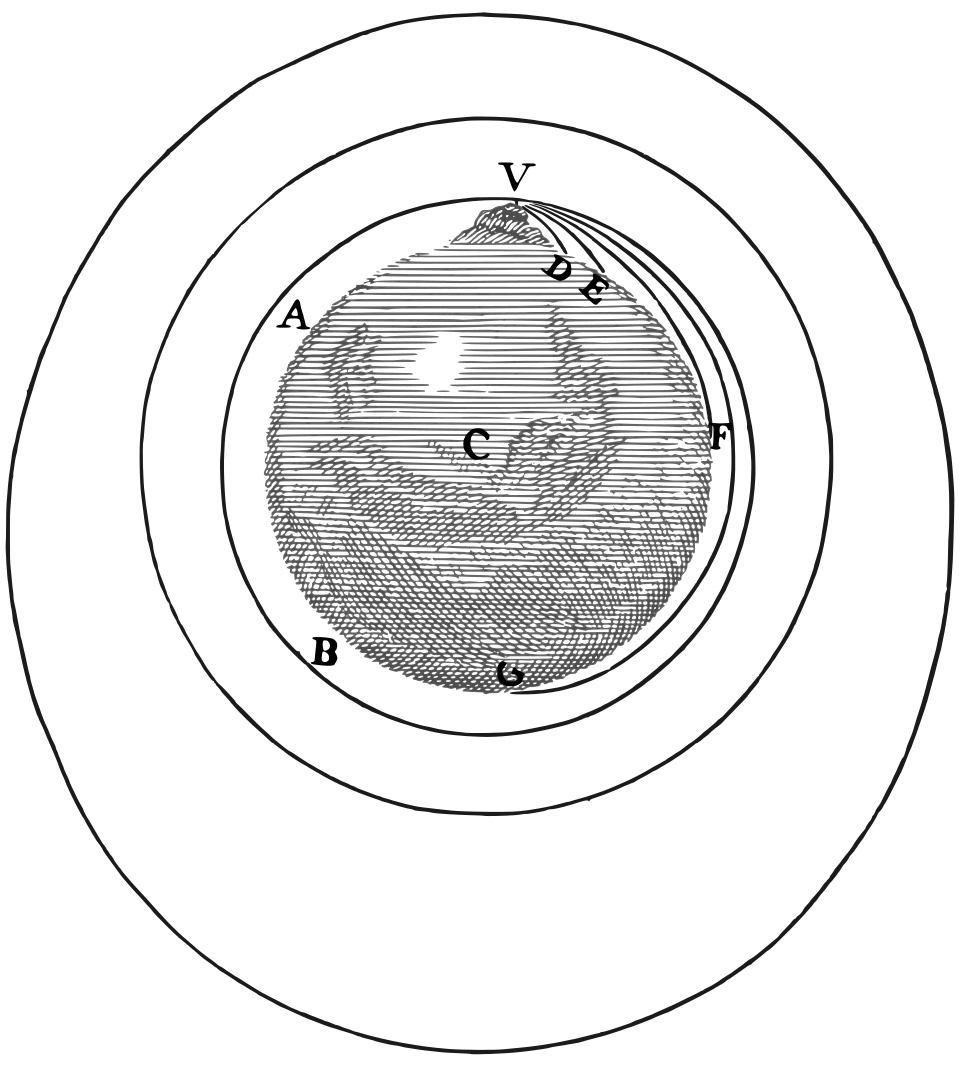
The story · published 1728

Background story · not assessed

Newton’s cannon on a mountain.

Engraving of the Earth with a mountain at the top. Curved paths leave the mountain top: short ones fall back to the ground, longer ones reach further round, and the longest go all the way round the Earth
From A Treatise of the System of the World, 1728
  • Fire a cannonball horizontally from a very high mountain
  • Faster shots land further away, as the ground curves away beneath them
  • Fast enough, and the ball falls all the way round without ever landing
  • Printed the year after Newton died. The first artificial satellite flew 229 years later
An orbit is free fall that keeps missing the ground.

Engraving: Isaac Newton, 1728, public domain.

D.1 GRAVITATIONAL FIELDS · ADDITIONAL HL

Staying in a circular orbit

Orbital speed.

\(G \dfrac{M m}{r^{2}} = \dfrac{m v^{2}}{r}\) \(v_\mathrm{orbital} = \sqrt{\dfrac{G M}{r}}\)
  • One speed for each radius. The mass of the satellite cancels
  • A larger orbit needs a lower speed
TWO CIRCULAR ORBITS
D.1 GRAVITATIONAL FIELDS · ADDITIONAL HL

Kinetic, potential and total

The energy of a satellite in orbit.

  • Kinetic: \(E_\mathrm{k} = \dfrac{1}{2} m v^{2} = \dfrac{G M m}{2r}\)
  • Potential: \(E_\mathrm{p} = -\dfrac{G M m}{r}\)
  • Total: \(E = E_\mathrm{k} + E_\mathrm{p} = -\dfrac{G M m}{2r}\)
A larger orbit has more total energy but less kinetic energy.
ENERGY AGAINST ORBITAL RADIUS
D.1 GRAVITATIONAL FIELDS · ADDITIONAL HL

Worked example

Raising a 500 kg satellite to a higher orbit.

From \(r_{1} = 6.77 \times 10^{6} \,\mathrm{m}\) to \(r_{2} = 4.22 \times 10^{7} \,\mathrm{m}\) \(E = -\dfrac{G M m}{2r}\) \(\Delta E = \dfrac{G M m}{2} \left(\dfrac{1}{r_{1}} - \dfrac{1}{r_{2}}\right)\) \(\Delta E = \dfrac{3.98 \times 10^{14} \times 500}{2} \left(\dfrac{1}{6.77 \times 10^{6}} - \dfrac{1}{4.22 \times 10^{7}}\right)\) \(\Delta E = \class{res}{1.23 \times 10^{10} \,\mathrm{J}}\)
Low orbitHigh orbit
\(E_\mathrm{k}\) / GJ+14.7+2.4
\(E_\mathrm{p}\) / GJ−29.4−4.7
Total / GJ−14.7−2.4
Kinetic energy falls by 12.3 GJ. Potential energy rises by 24.7 GJ.
D.1 GRAVITATIONAL FIELDS · ADDITIONAL HL

Leaving for good

Escape speed.

Just escapes: total energy zero \(\dfrac{1}{2} m v_\mathrm{esc}^{2} - \dfrac{G M m}{r} = 0\) \(v_\mathrm{esc} = \sqrt{\dfrac{2 G M}{r}}\) From the Earth’s surface \(\sqrt{\dfrac{2 \times 3.98 \times 10^{14}}{6.37 \times 10^{6}}} = \class{res}{11.2 \,\mathrm{km} \,\mathrm{s}^{-1}}\)
FOUR LAUNCH SPEEDS
D.1 GRAVITATIONAL FIELDS · ADDITIONAL HL

Worked example

From the launch pad to a low orbit.

A 500 kg satellite, at rest on a planet that does not rotate \(R = 6.37 \times 10^{6} \,\mathrm{m}\) · orbit \(r = 6.77 \times 10^{6} \,\mathrm{m}\) \(E_\mathrm{surface} = -\dfrac{G M m}{R}\)  ·  \(E_\mathrm{orbit} = -\dfrac{G M m}{2r}\) \(\Delta E = G M m \left(\dfrac{1}{R} - \dfrac{1}{2r}\right)\) \(\Delta E = 3.98 \times 10^{14} \times 500 \left(\dfrac{1}{6.37 \times 10^{6}} - \dfrac{1}{1.354 \times 10^{7}}\right)\) \(\Delta E = \class{res}{1.65 \times 10^{10} \,\mathrm{J}}\)
  • On the pad: potential energy only
  • In orbit: potential and kinetic
  • Most of the energy goes into speed, not height
To escape from that orbit: a further \(\dfrac{G M m}{2r} = 1.47 \times 10^{10} \,\mathrm{J}\).
D.1 GRAVITATIONAL FIELDS · ADDITIONAL HL

A small resistive force

A satellite in the thin upper atmosphere.

  • A small viscous drag does negative work: the total energy falls
  • Total energy \(-\dfrac{G M m}{2r}\) falls, so \(r\) gets smaller
  • \(v = \sqrt{\dfrac{G M}{r}}\), so the speed rises
Drag makes the satellite go faster.
A SLOWLY DECAYING ORBITMUCH EXAGGERATED
D.1 GRAVITATIONAL FIELDS · ADDITIONAL HL

Quick check · additional higher level

Energy and orbits.

01Where is gravitational potential zero?

At infinity

02The potential at a point is −40 MJ kg⁻¹. Potential energy of 2.0 kg there?

\(2.0 \times (-40) = -80 \,\mathrm{MJ}\)

03How much work is done moving a mass along an equipotential?

None

04What does the gradient of a potential–distance graph give?

The field strength (with a minus sign)

05The orbital speed at some radius is 5.0 km s⁻¹. Escape speed there?

\(\sqrt{2} \times 5.0 = 7.1 \,\mathrm{km} \,\mathrm{s}^{-1}\)

06Drag acts on a satellite. What happens to its speed?

It increases, as the orbit shrinks
PRESS → TO REVEAL EACH ANSWER

Summary

Gravitational fields on one slide.

Kepler’s laws

How orbits behave

Ellipses with the Sun at a focus. Equal areas in equal times
\(T^{2} \propto r^{3}\)

Newton’s law

An inverse square force

\(F = G \frac{m_{1} m_{2}}{r^{2}}\), between centers
Gravity is the centripetal force of an orbit

Field strength

Force per unit mass

\(g = \frac{F}{m} = G \frac{M}{r^{2}}\), a vector
Radial round a planet, uniform near its surface

Potential · HL

Energy per unit mass

\(V_\mathrm{g} = -\frac{G M}{r}\), zero at infinity
\(W = m \Delta V_\mathrm{g}\) and \(g = -\frac{\Delta V_\mathrm{g}}{\Delta r}\)

Equipotentials · HL

At right angles to the field

No work is done along one
Closer together where the field is stronger

Orbits · HL

Two speeds

\(v_\mathrm{orbital} = \sqrt{\frac{G M}{r}}\) and \(v_\mathrm{esc} = \sqrt{\frac{2 G M}{r}}\)
Drag: smaller orbit, higher speed

D.1 GRAVITATIONAL FIELDS · SL + HL

Summary

Key words.

EllipseThe shape of an orbit
Orbital periodThe time for one complete orbit
Point massSmall compared with the separation
Inverse square lawForce \(\propto \dfrac{1}{r^{2}}\)
Gravitational field strengthForce per unit mass. A vector
Field lineDirection of the force on a mass
Uniform fieldSame strength and direction everywhere
Gravitational potentialWork done per unit mass from infinity
Potential gradientPotential change per meter
Equipotential surfaceJoins points at the same potential
Orbital speedSpeed for a circular orbit
Escape speedThe least speed to reach infinity
D.1 GRAVITATIONAL FIELDS · SL + HL