IB DP Physics · Theme A · Space, time and motion

Rigid body mechanics.

A.4 · Torque, rotational motion, moment of inertia and angular momentum
Higher level only: there is no standard level content in A.4

Additional HL · 7 hours A.2 Forces and momentum ↗

The journey

Four parts.

Part 01

Torque and equilibrium

\(\tau = Fr \sin \theta\), and when a body does not start to turn

Part 02

Rotational motion

Angular displacement, velocity and acceleration

Part 03

Moment of inertia

\(I = \Sigma m r^{2}\) and \(\tau = I \alpha\)

Part 04

Angular momentum and energy

\(L = I \omega\), its conservation, and \(\frac{1}{2} I \omega^{2}\)

Every idea here has a twin in A.1 to A.3. Force becomes torque, mass becomes moment of inertia.
A.4 RIGID BODY MECHANICS · HL ONLY

Part 01 · HL only

Torque and equilibrium.

The turning effect of a force, and how to balance it

A.4 RIGID BODY MECHANICS · HL ONLY

The turning effect of a force

Torque.

\(\tau = F r \sin \theta\)
  • \(r\): from the axis to where the force acts
  • \(\theta\): the angle between the force and that line
  • Unit: N m
  • A sense: clockwise or counterclockwise
A SPANNER ON A NUT
A.4 RIGID BODY MECHANICS · HL ONLY

The story · Syracuse, third century BC

Background story · not assessed

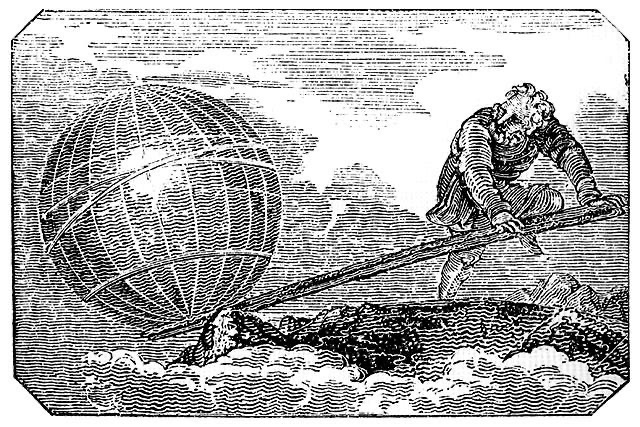
A lever to move the world.

Engraving of a bearded man pushing down on the end of a long lever resting on a rock, lifting a globe of the Earth at its other end
Archimedes moving the Earth, from the Mechanics Magazine of 1824
  • People had used levers for thousands of years: the Egyptians moved obelisks of over a hundred tonnes with them
  • The earliest surviving writing on why they work is from the third century BC, and is credited to Archimedes
  • The boast attributed to him: give me a lever long enough and a place to rest it, and I shall move the world

Engraving: Mechanics Magazine, 1824, public domain.

A.4 RIGID BODY MECHANICS · HL ONLY

No resultant torque

Rotational equilibrium.

  • Resultant torque zero: clockwise torques = counterclockwise torques
  • About any axis you choose
  • For complete equilibrium, the resultant force is zero too
\(W_{1} d_{1} = W_{2} d_{2}\)
A BALANCED SEESAW
A.4 RIGID BODY MECHANICS · HL ONLY

Worked example

A plank on two supports.

Torques about the left-hand support \(F_{2} \times 3.0 = 200 \times 1.0 + 60 \times 1.5\) \(F_{2} = \dfrac{290}{3.0} = \class{res}{97 \,\mathrm{N}}\) Resultant force zero \(F_{1} + F_{2} = 200 + 60\) \(F_{1} = 260 - 97 = \class{res}{163 \,\mathrm{N}}\)
UNIFORM PLANK, WEIGHT 60 N
A.4 RIGID BODY MECHANICS · HL ONLY

Quick check

Torque and equilibrium.

01A 20 N force acts at right angles, 0.30 m from an axis. Torque?

6.0 N m

02The same force acts along the line to the axis. Torque?

Zero

03State the two conditions for equilibrium.

Zero resultant force; zero resultant torque

04400 N sits 1.5 m from a pivot. Where must 600 N sit to balance it?

1.0 m on the other side

05Why take torques about a point where an unknown force acts?

Its torque is zero there

06Where does the weight of a uniform beam act?

At its midpoint, the center of mass
PRESS → TO REVEAL EACH ANSWER

Part 02 · HL only

Rotational motion.

A.1 again, with angles in place of distances

A.4 RIGID BODY MECHANICS · HL ONLY

Three angular quantities

Describing rotation.

  • Angular displacement \(\Delta \theta\), in rad
  • Angular velocity \(\omega = \dfrac{\Delta \theta}{\Delta t}\), in rad s⁻¹
  • Angular acceleration \(\alpha = \dfrac{\Delta \omega}{\Delta t}\), in rad s⁻²
  • A point at radius \(r\): \(v = \omega r\) and \(a = \alpha r\)
A TURNING WHEEL
A.4 RIGID BODY MECHANICS · HL ONLY

Constant angular acceleration

The equations of rotational motion.

Linear, from A.1RotationalMissing
\(s = \dfrac{u + v}{2} t\)\(\Delta \theta = \dfrac{\omega_\mathrm{f} + \omega_\mathrm{i}}{2} t\)\(\alpha\)
\(v = u + at\)\(\omega_\mathrm{f} = \omega_\mathrm{i} + \alpha t\)\(\Delta \theta\)
\(s = ut + \dfrac{1}{2} a t^{2}\)\(\Delta \theta = \omega_\mathrm{i} t + \dfrac{1}{2} \alpha t^{2}\)\(\omega_\mathrm{f}\)
\(v^{2} - u^{2} = 2as\)\(\omega_\mathrm{f}^{2} - \omega_\mathrm{i}^{2} = 2 \alpha \Delta \theta\)\(t\)
A.4 RIGID BODY MECHANICS · HL ONLY

Worked example

Speeding up and slowing down.

From rest, \(\alpha = 2.5 \,\mathrm{rad} \,\mathrm{s}^{-2}\) for 8.0 s \(\omega_\mathrm{f} = \omega_\mathrm{i} + \alpha t = 0 + 2.5 \times 8.0\) \(\omega_\mathrm{f} = \class{res}{20 \,\mathrm{rad} \,\mathrm{s}^{-1}}\) \(\Delta \theta = \omega_\mathrm{i} t + \dfrac{1}{2} \alpha t^{2} = \dfrac{1}{2} \times 2.5 \times 8.0^{2}\) \(\Delta \theta = \class{res}{80 \,\mathrm{rad}}\)
A disk at 30 rad s⁻¹ stops in 50 rad \(\omega_\mathrm{f}^{2} - \omega_\mathrm{i}^{2} = 2 \alpha \Delta \theta\) \(\alpha = \dfrac{\omega_\mathrm{f}^{2} - \omega_\mathrm{i}^{2}}{2 \Delta \theta} = \dfrac{0 - 30^{2}}{2 \times 50}\) \(\alpha = \class{res}{-9.0 \,\mathrm{rad} \,\mathrm{s}^{-2}}\)
A.4 RIGID BODY MECHANICS · HL ONLY

Gradient and area

Graphs of rotational motion.

  • Gradient of an \(\omega\)–\(t\) graph: the angular acceleration
  • Area under it: the angular displacement
  • Gradient of a \(\theta\)–\(t\) graph: the angular velocity
CONSTANT ANGULAR ACCELERATION
A.4 RIGID BODY MECHANICS · HL ONLY

Quick check

Rotational motion.

01How many radians in one revolution?

\(2 \pi\)

02A wheel turns at 12 rad s⁻¹. Speed of a point 0.50 m from the axis?

6.0 m s⁻¹

03From 4.0 to 10 rad s⁻¹ in 3.0 s. Angular acceleration?

2.0 rad s⁻²

04And the angle turned in that time?

\(\frac{4.0 + 10}{2} \times 3.0 = 21 \,\mathrm{rad}\)

05What does the area under an \(\omega\)–\(t\) graph give?

Angular displacement

06What must be true for the four equations to apply?

Constant angular acceleration
PRESS → TO REVEAL EACH ANSWER

Part 03 · HL only

Moment of inertia.

How hard a body is to spin up, and Newton’s second law for rotation

A.4 RIGID BODY MECHANICS · HL ONLY

The rotational twin of mass

Moment of inertia.

\(I = \Sigma m r^{2}\)
  • \(r\): the distance of each mass from the axis
  • Unit: \(\mathrm{kg} \,\mathrm{m}^{2}\)
  • Depends on how the mass is distributed, and on which axis
THE SAME MASS, TWO ARRANGEMENTS
A.4 RIGID BODY MECHANICS · HL ONLY

Given when needed

Some moments of inertia.

Body of mass M, about its axis of symmetryI
Hoop or thin ring, radius \(R\)\(M R^{2}\)
Solid disk or cylinder, radius \(R\)\(\tfrac{1}{2} M R^{2}\)
Solid sphere, radius \(R\)\(\tfrac{2}{5} M R^{2}\)
Thin rod, length \(L\), about its center\(\tfrac{1}{12} M L^{2}\)
  • A hoop has all its mass at radius \(R\): the largest \(I\) for its size
  • A disk or sphere has much of its mass nearer the axis
The formula for a shape is provided in the question. Do not learn them.
A.4 RIGID BODY MECHANICS · HL ONLY

Torque and angular acceleration

Newton’s second law for rotation.

\(\tau = I \alpha\)
  • \(\tau\): the resultant torque
  • The rotational form of \(F = ma\)
  • A larger \(I\): a smaller \(\alpha\) for the same torque
A disk, \(I = 0.18 \,\mathrm{kg} \,\mathrm{m}^{2}\), radius 0.30 m A 6.0 N force acts along its rim \(\tau = Fr = 6.0 \times 0.30 = 1.8 \,\mathrm{N} \,\mathrm{m}\) \(\alpha = \dfrac{\tau}{I} = \dfrac{1.8}{0.18}\) \(\alpha = \class{res}{10 \,\mathrm{rad} \,\mathrm{s}^{-2}}\)
A.4 RIGID BODY MECHANICS · HL ONLY

Worked example · two bodies joined

A falling mass turns a wheel.

\(m = 0.50 \,\mathrm{kg}\) · \(I = 0.020 \,\mathrm{kg} \,\mathrm{m}^{2}\) · \(r = 0.10 \,\mathrm{m}\) Mass: \(mg - T = ma\) Wheel: \(Tr = I \alpha\)  with  \(a = \alpha r\) \(a = \dfrac{mg}{m + \dfrac{I}{r^{2}}} = \dfrac{0.50 \times 9.8}{0.50 + 2.0}\) \(a = \class{res}{2.0 \,\mathrm{m} \,\mathrm{s}^{-2}}\) \(T = m(g - a) = \class{res}{3.9 \,\mathrm{N}}\)
A STRING WOUND ROUND THE RIM
A.4 RIGID BODY MECHANICS · HL ONLY

Quick check

Moment of inertia.

01A 3.0 kg point mass is 2.0 m from an axis. Moment of inertia?

12 kg m²

02It is moved to 1.0 m. Moment of inertia now?

3.0 kg m²: a quarter

03Which has the larger \(I\): a hoop or a disk of the same mass and radius?

The hoop

04A torque of 8.0 N m acts on \(I\) = 2.0 kg m². Angular acceleration?

4.0 rad s⁻²

05What is the unit of moment of inertia?

kg m²

06What links \(a\) and \(\alpha\) for a string round a wheel of radius \(r\)?

\(a = \alpha r\)
PRESS → TO REVEAL EACH ANSWER

Part 04 · HL only

Angular momentum and energy.

Two more conservation laws, for things that spin

A.4 RIGID BODY MECHANICS · HL ONLY

The rotational twin of momentum

Angular momentum.

\(L = I \omega\)
  • Unit: \(\mathrm{kg} \,\mathrm{m}^{2} \,\mathrm{s}^{-1}\)
  • Conserved unless a resultant torque acts from outside
  • If \(I\) falls, \(\omega\) must rise
A SKATER, SEEN FROM ABOVE
A.4 RIGID BODY MECHANICS · HL ONLY

Worked example

A skater pulls in their arms.

\(I\) falls from 4.0 to 1.6 kg m² · \(\omega_{1} = 3.0 \,\mathrm{rad} \,\mathrm{s}^{-1}\) \(I_{1} \omega_{1} = I_{2} \omega_{2}\) \(\omega_{2} = \dfrac{I_{1} \omega_{1}}{I_{2}} = \dfrac{4.0 \times 3.0}{1.6}\) \(\omega_{2} = \class{res}{7.5 \,\mathrm{rad} \,\mathrm{s}^{-1}}\)
Rotational kinetic energy, \(E_\mathrm{k} = \tfrac{1}{2} I \omega^{2}\) Before: \(\tfrac{1}{2} \times 4.0 \times 3.0^{2} = 18 \,\mathrm{J}\) After: \(\tfrac{1}{2} \times 1.6 \times 7.5^{2} = \class{res}{45 \,\mathrm{J}}\) Work done by the skater: 27 J
A.4 RIGID BODY MECHANICS · HL ONLY

The story · Paris, 1852

Background story · not assessed

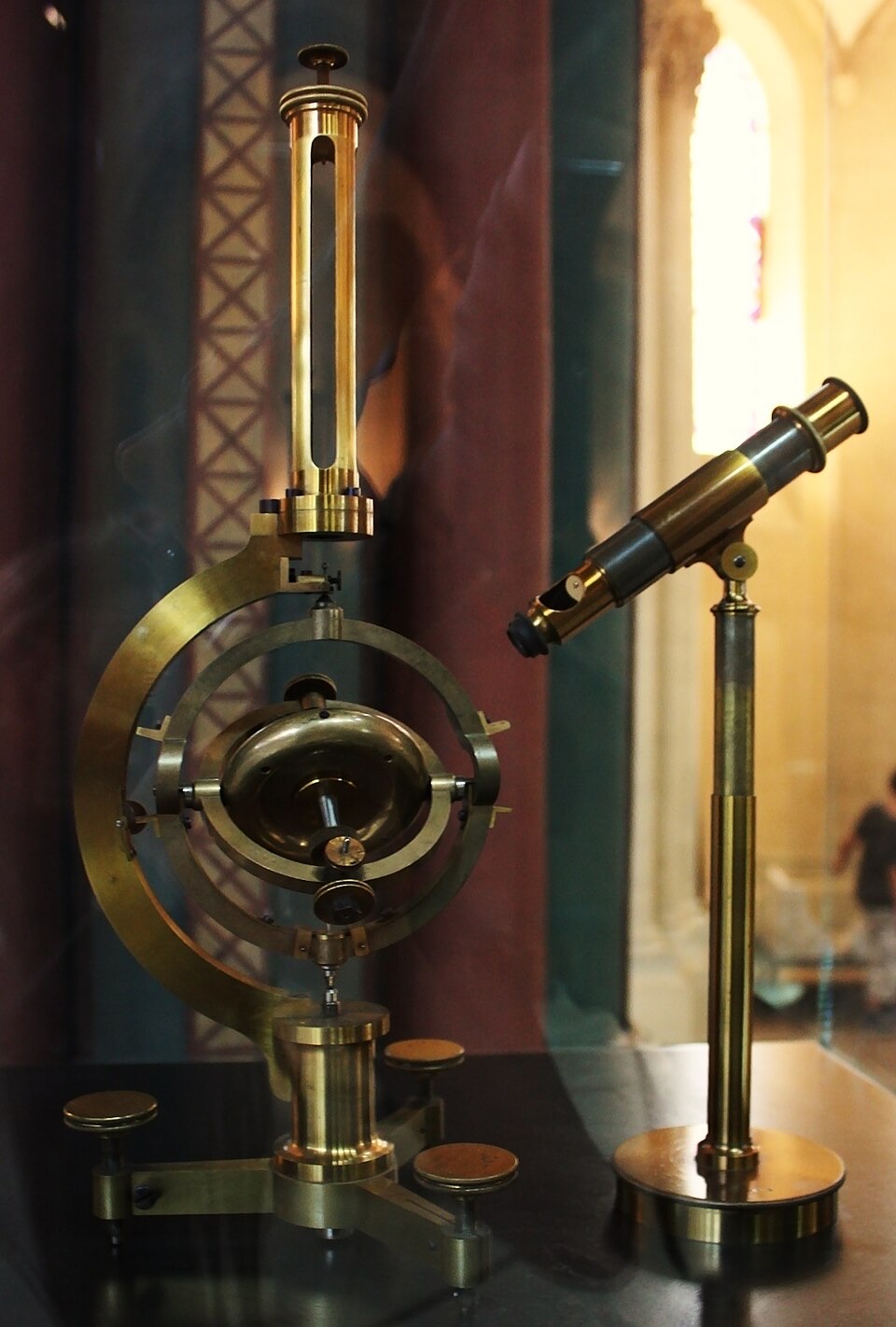
A wheel that shows the Earth turning.

A brass instrument in a museum case: a heavy wheel mounted inside rings that let it turn in any direction, with a small viewing microscope beside it
Foucault’s gyroscope, with its microscope
  • A fast-spinning wheel in freely turning rings: no torque can reach it
  • So its angular momentum, and the direction of its axis, stay fixed
  • In 1852 Léon Foucault watched one through a microscope and saw the laboratory, and the Earth, turn slowly round it
  • He could watch for 8 to 10 minutes before friction slowed the wheel
He named it from the Greek for “to see the rotation”.

Photograph: Stéphane Magnenat, public domain.

A.4 RIGID BODY MECHANICS · HL ONLY

Worked example · two bodies join

One disk dropped onto another.

Spinning: \(I_{1} = 0.20 \,\mathrm{kg} \,\mathrm{m}^{2}\) at \(12 \,\mathrm{rad} \,\mathrm{s}^{-1}\) Dropped on: \(I_{2} = 0.10 \,\mathrm{kg} \,\mathrm{m}^{2}\), at rest \(I_{1} \omega_{1} = (I_{1} + I_{2}) \omega\) \(\omega = \dfrac{I_{1} \omega_{1}}{I_{1} + I_{2}} = \dfrac{0.20 \times 12}{0.30}\) \(\omega = \class{res}{8.0 \,\mathrm{rad} \,\mathrm{s}^{-1}}\)
ON THE SAME AXLEPRESS → TO DROP
A.4 RIGID BODY MECHANICS · HL ONLY

Changing angular momentum

Angular impulse.

\(\Delta L = \tau \Delta t = \Delta (I \omega)\)
  • A resultant torque acting for a time changes the angular momentum
  • \(\tau \Delta t\): the angular impulse
  • The area under a torque–time graph
A torque of 3.0 N m acts for 4.0 s on a wheel of \(I = 2.0 \,\mathrm{kg} \,\mathrm{m}^{2}\) \(\Delta L = \tau \Delta t = 3.0 \times 4.0\) \(\Delta L = \class{res}{12 \,\mathrm{kg} \,\mathrm{m}^{2} \,\mathrm{s}^{-1}}\) \(\Delta \omega = \dfrac{\Delta L}{I} = \dfrac{12}{2.0} = \class{res}{6.0 \,\mathrm{rad} \,\mathrm{s}^{-1}}\)
A.4 RIGID BODY MECHANICS · HL ONLY

Energy of a spinning body

Rotational kinetic energy and rolling.

\(E_\mathrm{k} = \dfrac{1}{2} I \omega^{2} = \dfrac{L^{2}}{2I}\)
  • Rolling without slipping: \(v = \omega r\)
  • Total: \(\dfrac{1}{2} m v^{2} + \dfrac{1}{2} I \omega^{2}\)
A RACE DOWN A SLOPE
A.4 RIGID BODY MECHANICS · HL ONLY

Worked example

A sphere rolls down a slope.

Solid sphere, \(I = \tfrac{2}{5} m r^{2}\) · height fallen \(h = 1.0 \,\mathrm{m}\) \(mgh = \dfrac{1}{2} m v^{2} + \dfrac{1}{2} I \omega^{2}\)  with  \(\omega = \dfrac{v}{r}\) \(mgh = \dfrac{1}{2} m v^{2} + \dfrac{1}{5} m v^{2} = \dfrac{7}{10} m v^{2}\) \(v = \sqrt{\dfrac{10 g h}{7}} = \sqrt{\dfrac{10 \times 9.8 \times 1.0}{7}}\) \(v = \class{res}{3.7 \,\mathrm{m} \,\mathrm{s}^{-1}}\)
  • A hoop, \(I = m r^{2}\): \(v = \sqrt{gh} = 3.1 \,\mathrm{m} \,\mathrm{s}^{-1}\)
  • Sliding with no friction: \(v = \sqrt{2gh} = 4.4 \,\mathrm{m} \,\mathrm{s}^{-1}\)
The mass and the radius have canceled.
A.4 RIGID BODY MECHANICS · HL ONLY

The twins, side by side

Linear and rotational.

LinearRotational
Position, velocity, acceleration\(s\), \(v\), \(a\)\(\theta\), \(\omega\), \(\alpha\)
InertiaMass \(m\)Moment of inertia \(I\)
Cause of accelerationForce: \(F = ma\)Torque: \(\tau = I \alpha\)
Momentum\(p = mv\)\(L = I \omega\)
Impulse\(F \Delta t = \Delta p\)\(\tau \Delta t = \Delta L\)
Kinetic energy\(\tfrac{1}{2} m v^{2} = \dfrac{p^{2}}{2m}\)\(\tfrac{1}{2} I \omega^{2} = \dfrac{L^{2}}{2I}\)
A.4 RIGID BODY MECHANICS · HL ONLY

Quick check

Angular momentum and energy.

01\(I\) = 0.50 kg m², \(\omega\) = 6.0 rad s⁻¹. Angular momentum?

3.0 kg m² s⁻¹

02When is angular momentum conserved?

No resultant external torque

03A spinning star shrinks to half its moment of inertia. Its angular velocity?

It doubles

04And its rotational kinetic energy?

It doubles: \(\frac{L^{2}}{2I}\)

05Rotational kinetic energy for \(I\) = 0.50 kg m² at 6.0 rad s⁻¹?

\(\frac{1}{2} \times 0.50 \times 6.0^{2} = 9.0 \,\mathrm{J}\)

06Which reaches the bottom of a slope first: a rolling hoop or a rolling solid sphere?

The sphere
PRESS → TO REVEAL EACH ANSWER

Summary

Rigid body mechanics on one slide.

Torque

\(\tau = F r \sin \theta\)

Equilibrium: resultant torque and resultant force both zero

Rotational motion

\(\omega_\mathrm{f} = \omega_\mathrm{i} + \alpha t\)

The equations of A.1, with \(\Delta \theta\), \(\omega\) and \(\alpha\)

Moment of inertia

\(I = \Sigma m r^{2}\)

Depends on where the mass is, and on the axis

Second law

\(\tau = I \alpha\)

Angular impulse: \(\Delta L = \tau \Delta t\)

Angular momentum

\(L = I \omega\)

Conserved when no resultant external torque acts

Energy

\(E_\mathrm{k} = \frac{1}{2} I \omega^{2} = \frac{L^{2}}{2I}\)

Rolling: add \(\frac{1}{2} m v^{2}\), with \(v = \omega r\)

A.4 RIGID BODY MECHANICS · HL ONLY

Summary

Key words.

TorqueThe turning effect of a force about an axis
Rotational equilibriumZero resultant torque
Center of massWhere the mass can be taken to be for linear motion
Angular velocityRate of change of angle, in rad s⁻¹
Angular accelerationRate of change of angular velocity
Moment of inertiaResistance to angular acceleration: \(\Sigma m r^{2}\)
Angular momentum\(I \omega\)
Angular impulseTorque × time: the change in angular momentum
Rolling without slipping\(v = \omega r\)
A.4 RIGID BODY MECHANICS · HL ONLY