IB DP Physics · Theme A · Space, time and motion

Work, energy and power.

A.3 · Work done by a force, mechanical energy and its conservation, power, efficiency and fuels
Standard level and higher level

SL + HL · 8 hours

The journey

Four parts.

Part 01

Work

A force transfers energy

Part 02

Kinetic and potential energy

Three kinds of mechanical energy

Part 03

Conservation

With and without resistive forces

Part 04

Power and efficiency

Rates, Sankey diagrams, energy density

A.3 has no additional higher level content: every slide is for SL and HL.
A.3 WORK, ENERGY AND POWER · SL + HL

Part 01 · SL + HL

Work.

Energy is conserved. Work is how a force moves it from one place to another

A.3 WORK, ENERGY AND POWER · SL + HL

The principle behind the whole topic

Conservation of energy.

  • Energy cannot be created or destroyed. It can only be transferred or changed from one form to another
  • The total energy of an isolated system stays constant

Mechanical energy

Kinetic and potential

Of moving bodies, raised masses and stretched springs

Transfer by a force

Work

A force acting through a distance

Other forms

Thermal, chemical, nuclear …

Where “lost” mechanical energy goes, and where fuels store it

A.3 WORK, ENERGY AND POWER · SL + HL

Transferring energy

Work done by a force.

\(W = Fs \cos \theta\)
  • For a constant force
  • \(\theta\): the angle between the force and the displacement
  • Work done = energy transferred. Unit: \(1 \,\mathrm{J} = 1 \,\mathrm{N} \,\mathrm{m}\)
PULLING A BLOCK
A.3 WORK, ENERGY AND POWER · SL + HL

The sign of the work

Positive, negative and zero work.

\(\theta\) less than 90°

Positive work

The force has a component along the motion. It gives energy to the body

Example: gravity on a falling ball

\(\theta\) equal to 90°

No work

The force is at right angles to the motion

Examples: the normal force on a sliding block, the centripetal force in a circle

\(\theta\) more than 90°

Negative work

The force has a component against the motion. It takes energy from the body

Example: friction, \(\cos 180^{\circ} = -1\)

A.3 WORK, ENERGY AND POWER · SL + HL

Worked example

Pulling a sledge across snow.

Rope at \(30^{\circ}\) to the ground · tension \(F = 120 \,\mathrm{N}\) The sledge moves \(s = 25 \,\mathrm{m}\) \(W = Fs \cos \theta\) \(W = 120 \times 25 \times \cos 30^{\circ}\) \(W = \class{res}{2.6 \times 10^{3} \,\mathrm{J}}\)
Friction 104 N, at constant velocity \(W_\mathrm{f} = F_\mathrm{f} s \cos 180^{\circ}\) \(W_\mathrm{f} = 104 \times 25 \times (-1) = \class{res}{-2.6 \times 10^{3} \,\mathrm{J}}\) Total work: zero
A.3 WORK, ENERGY AND POWER · SL + HL

When the force is not constant

Work from a force–displacement graph.

  • Work done = the area under a force–displacement graph
  • Constant force: a rectangle, \(F \times s\)
  • Varying force: count squares, or split into simple shapes
  • Use the component of force along the displacement
A VARYING FORCE
A.3 WORK, ENERGY AND POWER · SL + HL

The story · Manchester, 1845

Background story · not assessed

Joule’s paddle wheel.

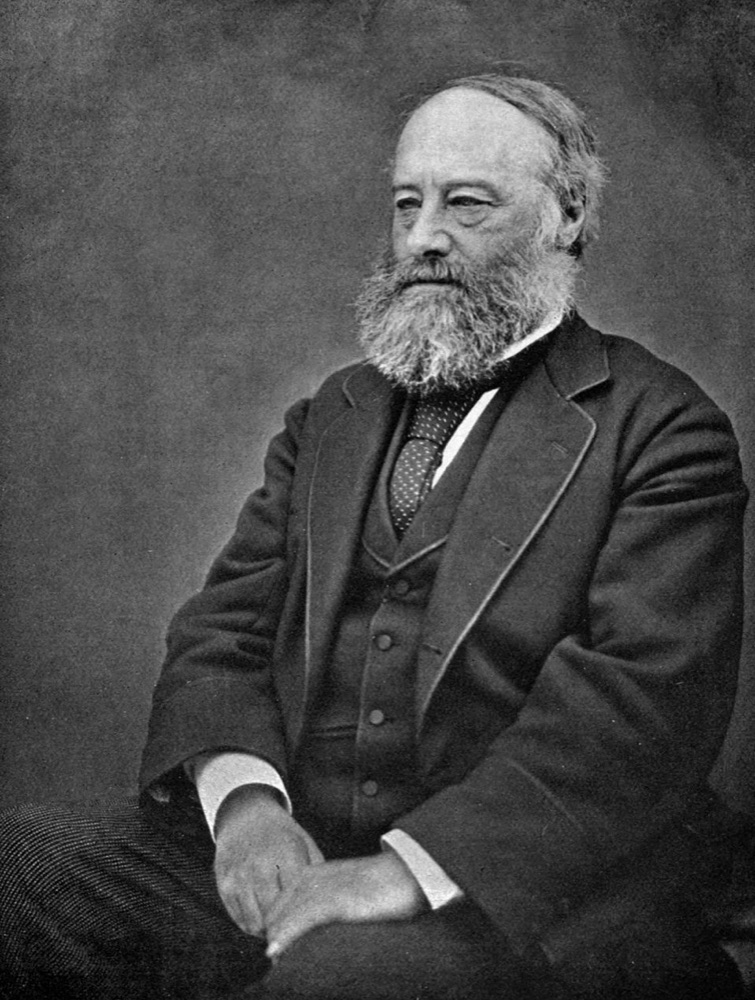
Photograph of James Prescott Joule as an older man with a white beard, seated beside a table
James Prescott Joule, brewer and amateur scientist
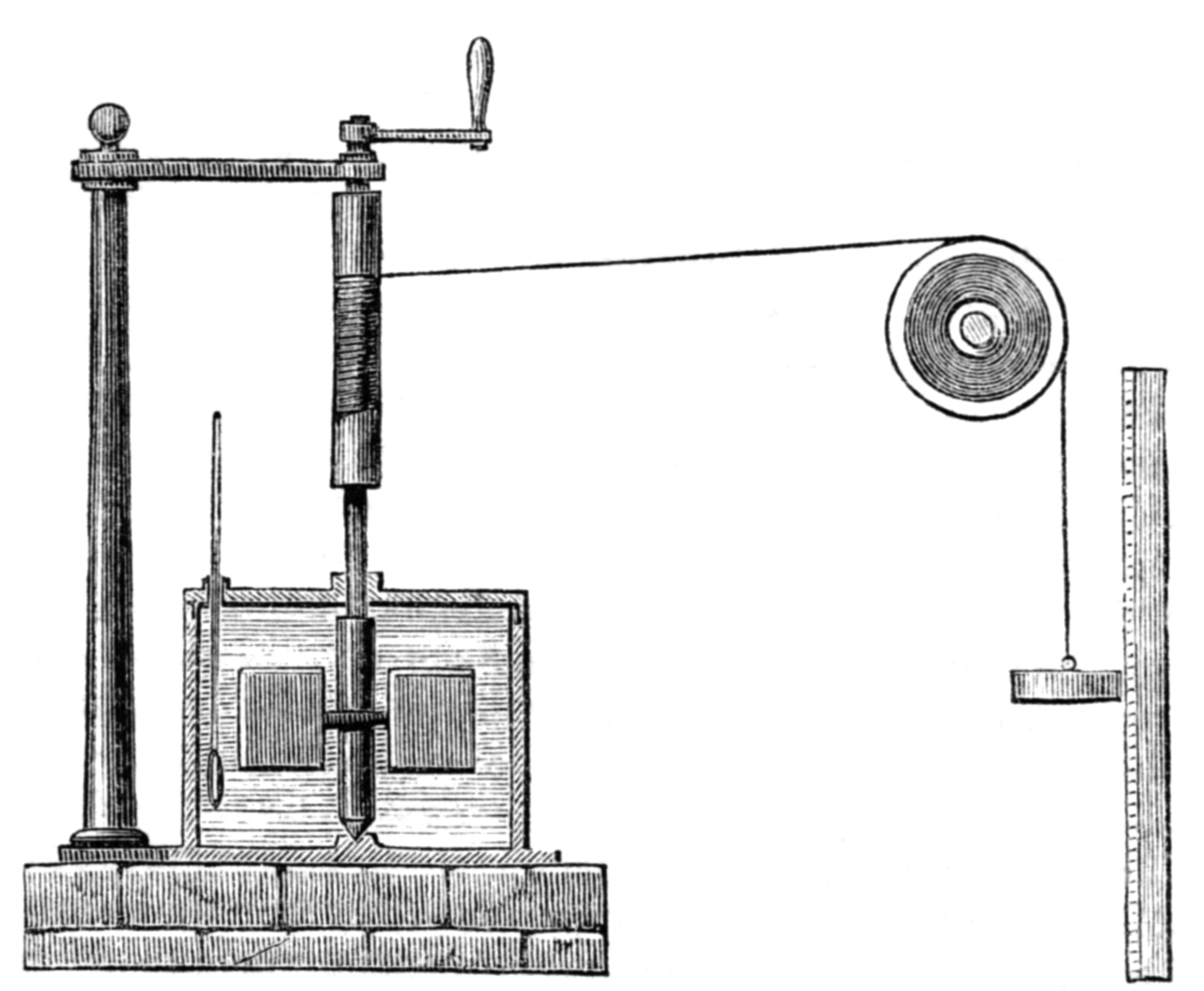
Engraving of Joule’s apparatus: a weight hanging from a string that passes over a pulley and turns a spindle with paddles inside a closed vessel of water, with a thermometer in the lid
A falling weight turns paddles in water (engraving of 1869)
  • Heat was thought to be a fluid, separate from mechanical energy
  • Joule let a falling weight churn water and measured the tiny rise in temperature
  • The same work always gave the same heating
  • His 1850 value is within 1% of the modern one
Work and heat are both transfers of energy. The unit carries his name.

Portrait: from Henry Roscoe, 1906, public domain. Apparatus: Harper’s New Monthly Magazine, 1869, public domain.

A.3 WORK, ENERGY AND POWER · SL + HL

Quick check

Work.

01A 20 N force moves a box 3.0 m in its own direction. Work done?

\(20 \times 3.0 = 60 \,\mathrm{J}\)

02The same force acts at 60° to the motion. Work done?

\(60 \cos 60^{\circ} = 30 \,\mathrm{J}\)

03How much work does the normal force do on a sliding block?

None: it is at right angles to the motion

04Friction of 8.0 N acts over 5.0 m. Work done by friction?

\(-40 \,\mathrm{J}\)

05What does the area under a force–displacement graph give?

The work done

06Is work a scalar or a vector?

A scalar
PRESS → TO REVEAL EACH ANSWER

Part 02 · SL + HL

Kinetic and potential energy.

The three kinds of mechanical energy, each found from the work done

A.3 WORK, ENERGY AND POWER · SL + HL

Energy of motion

Kinetic energy.

\(E_\mathrm{k} = \dfrac{1}{2} m v^{2} = \dfrac{p^{2}}{2m}\)
  • Depends on the square of the speed
  • A scalar: never negative, whatever the direction
  • \(p = mv\) is the momentum
A resultant force \(F\) acts over a distance \(s\), from rest \(W = Fs = mas\) \(v^{2} - u^{2} = 2as\)  with  \(u = 0\):  \(as = \dfrac{v^{2}}{2}\) \(W = \dfrac{1}{2} m v^{2}\)
A.3 WORK, ENERGY AND POWER · SL + HL

Work done by the resultant force

Work and the change in kinetic energy.

  • The work done by the resultant force equals the change in kinetic energy
  • \(F s = \dfrac{1}{2} m v^{2} - \dfrac{1}{2} m u^{2}\)
  • No times, no accelerations: just the start and the end
A 1200 kg car at \(20 \,\mathrm{m} \,\mathrm{s}^{-1}\) · braking force 6000 N \(W_\mathrm{brakes} = \Delta E_\mathrm{k} = E_{\mathrm{k,f}} - E_{\mathrm{k,i}}\) \(-F s = 0 - \dfrac{1}{2} m u^{2}\)  so  \(s = \dfrac{m u^{2}}{2F}\) \(s = \dfrac{1200 \times 20^{2}}{2 \times 6000} = \class{res}{40 \,\mathrm{m}}\)
A.3 WORK, ENERGY AND POWER · SL + HL

Energy of position

Gravitational potential energy.

\(\Delta E_\mathrm{p} = mg \Delta h\)
  • The work done against gravity in raising a mass
  • Only the change in height matters, not the route
  • Valid close to the Earth’s surface, where \(g\) is constant
TWO ROUTES TO THE SAME HEIGHT
A.3 WORK, ENERGY AND POWER · SL + HL

Energy stored in a spring

Elastic potential energy.

\(E_\mathrm{H} = \dfrac{1}{2} k (\Delta x)^{2}\)
  • \(k\): spring constant. \(\Delta x\): extension or compression
  • The force grows from 0 to \(k \Delta x\): the average force is half of that
  • The same for stretching and for squashing
FORCE AGAINST EXTENSION
A.3 WORK, ENERGY AND POWER · SL + HL

Worked example

A spring launcher.

\(k = 200 \,\mathrm{N} \,\mathrm{m}^{-1}\) · \(\Delta x = 0.15 \,\mathrm{m}\) · ball 0.050 kg \(E_\mathrm{H} = \dfrac{1}{2} k (\Delta x)^{2}\) \(E_\mathrm{H} = \dfrac{1}{2} \times 200 \times 0.15^{2} = \class{res}{2.25 \,\mathrm{J}}\) \(\Delta E_\mathrm{k} + \Delta E_\mathrm{H} = \dfrac{1}{2} m v^{2} - E_{\mathrm{H,i}} = 0\) \(v = \sqrt{\dfrac{2 \times 2.25}{0.050}} = \class{res}{9.5 \,\mathrm{m} \,\mathrm{s}^{-1}}\)
RELEASED FROM RESTPRESS → TO PLAY
A.3 WORK, ENERGY AND POWER · SL + HL

Quick check

Kinetic and potential energy.

01A 2.0 kg mass moves at 3.0 m s⁻¹. Kinetic energy?

\(\frac{1}{2} \times 2.0 \times 3.0^{2} = 9.0 \,\mathrm{J}\)

02Its speed doubles. What happens to its kinetic energy?

Four times as large

03A 5.0 kg mass is raised 2.0 m. Gain in potential energy?

\(5.0 \times 9.8 \times 2.0 = 98 \,\mathrm{J}\)

04A spring with \(k = 400 \,\mathrm{N} \,\mathrm{m}^{-1}\) is stretched 0.10 m. Energy stored?

\(\frac{1}{2} \times 400 \times 0.10^{2} = 2.0 \,\mathrm{J}\)

05A body has momentum 6.0 kg m s⁻¹ and mass 3.0 kg. Kinetic energy?

\(\frac{6.0^{2}}{2 \times 3.0} = 6.0 \,\mathrm{J}\)

06What equals the work done by the resultant force?

The change in kinetic energy
PRESS → TO REVEAL EACH ANSWER

Part 03 · SL + HL

Conservation of mechanical energy.

When it holds, when it does not, and where the missing energy has gone

A.3 WORK, ENERGY AND POWER · SL + HL

Without resistive forces

Mechanical energy is conserved.

A CART ON A FRICTIONLESS TRACKKINETIC + POTENTIAL = CONSTANT
Total mechanical energy = \(E_\mathrm{k} + E_\mathrm{p} + E_\mathrm{H}\). With no frictional or resistive forces, it stays the same.
A.3 WORK, ENERGY AND POWER · SL + HL

Worked example

A roller coaster drops 20 m.

From rest at the top · no resistive forces \(\Delta E_\mathrm{k} + \Delta E_\mathrm{p} = 0\) \(\dfrac{1}{2} m v^{2} + mg \Delta h = 0,\quad \Delta h = -20 \,\mathrm{m}\) \(v = \sqrt{-2 g \Delta h} = \sqrt{-2 \times 9.8 \times (-20)}\) \(v = \class{res}{20 \,\mathrm{m} \,\mathrm{s}^{-1}}\)
  • The mass cancels: every car reaches the same speed
  • The shape of the track does not matter
  • If it starts at \(5.0 \,\mathrm{m} \,\mathrm{s}^{-1}\): \(v = \sqrt{u^{2} - 2 g \Delta h} = 20.4 \,\mathrm{m} \,\mathrm{s}^{-1}\)
A.3 WORK, ENERGY AND POWER · SL + HL

When mechanical energy is not conserved

With frictional and resistive forces.

  • Friction and drag do negative work: mechanical energy falls
  • Change in mechanical energy = work done by the non-conservative forces
  • The “lost” energy becomes thermal energy
\(\Delta E_\mathrm{total} = 0\), including thermal energy.
A 70 kg skier descends 30 m, from rest, and arrives at \(18 \,\mathrm{m} \,\mathrm{s}^{-1}\) \(W = \Delta E_\mathrm{mech} = \dfrac{1}{2} m v^{2} + mg \Delta h\) \(W = \dfrac{1}{2} \times 70 \times 18^{2} + 70 \times 9.8 \times (-30)\) \(W = 11\,340 - 20\,580 = \class{res}{-9.2 \times 10^{3} \,\mathrm{J}}\)
A.3 WORK, ENERGY AND POWER · SL + HL

Quick check

Conservation of mechanical energy.

01Name the three kinds of mechanical energy.

Kinetic, gravitational potential, elastic potential

02When is the total mechanical energy conserved?

When there are no frictional or resistive forces

03A ball is dropped 5.0 m. Speed at the bottom, ignoring drag?

\(\sqrt{2 \times 9.8 \times 5.0} = 9.9 \,\mathrm{m} \,\mathrm{s}^{-1}\)

04Does that speed depend on the mass of the ball?

No: the mass cancels

05A block loses 50 J of potential energy and gains 35 J of kinetic. Work done by friction?

\(-15 \,\mathrm{J}\)

06Where has that energy gone?

To thermal energy of the surfaces
PRESS → TO REVEAL EACH ANSWER

Part 04 · SL + HL

Power and efficiency.

How fast energy is transferred, how much of it is useful, and how much a fuel holds

A.3 WORK, ENERGY AND POWER · SL + HL

The rate of doing work

Power.

\(P = \dfrac{\Delta W}{\Delta t} = Fv\)
  • The rate of doing work, or of transferring energy
  • Unit: the watt, \(1 \,\mathrm{W} = 1 \,\mathrm{J} \,\mathrm{s}^{-1}\)
  • \(P = Fv\) for a force along the velocity
A lift raises 800 kg through 15 m in 12 s \(P = \dfrac{\Delta W}{\Delta t} = \dfrac{mg \Delta h}{\Delta t} = \dfrac{800 \times 9.8 \times 15}{12} = \class{res}{9.8 \,\mathrm{kW}}\) A car at a steady \(30 \,\mathrm{m} \,\mathrm{s}^{-1}\) against 600 N of drag \(P = Fv = 600 \times 30 = \class{res}{18 \,\mathrm{kW}}\)
A.3 WORK, ENERGY AND POWER · SL + HL

The story · Birmingham, 1780s

Background story · not assessed

Watt and the horse.

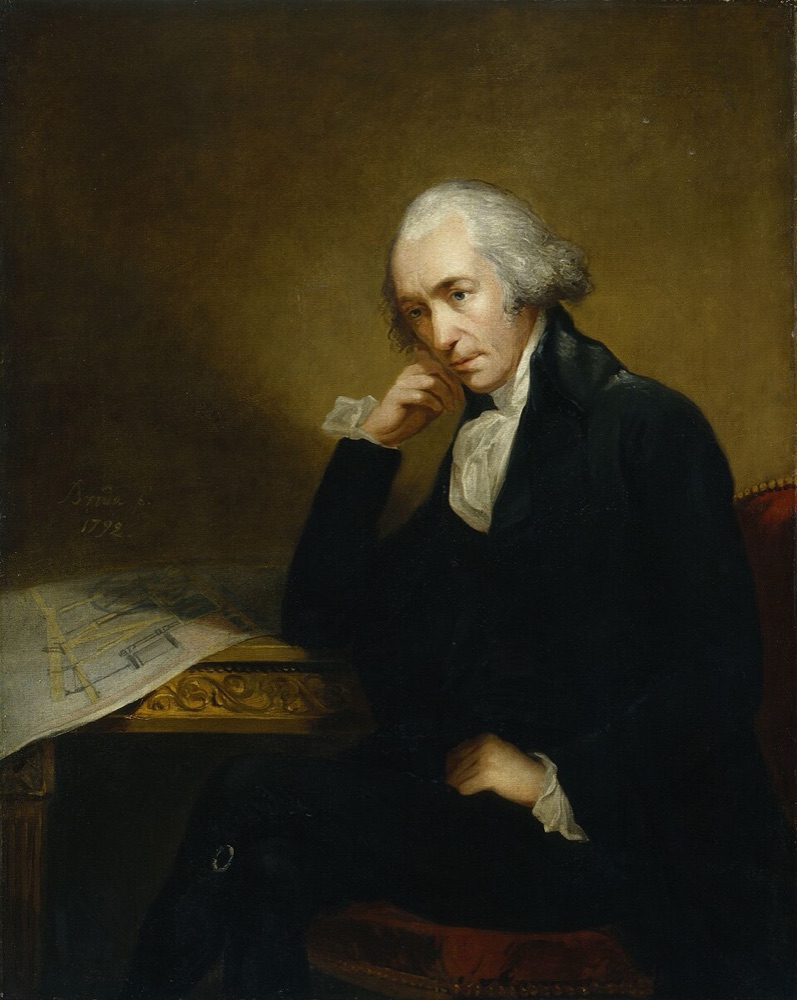
Painted portrait of James Watt, a gray-haired man in a dark coat, seated with a drawing of an engine in front of him
James Watt, painted by Carl Frederik von Breda in 1792
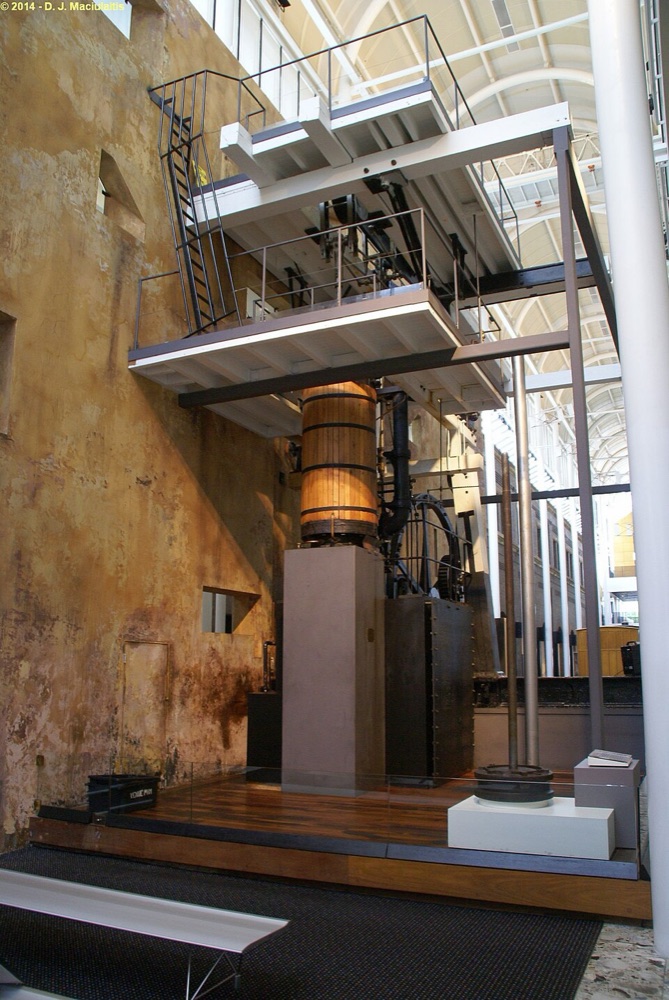
A large steam engine in a museum, with a wooden beam overhead, a tall vertical cylinder and a big spoked flywheel
A Boulton & Watt engine of 1785, now in Sydney
  • In 1765 Watt saw how to stop the steam engine wasting most of its fuel: a separate condenser
  • His customers were replacing horses, so he needed a way to compare
  • He settled on 33 000 foot-pounds per minute for one horse: about 746 W
  • In 1882 it was proposed to name the unit of power the watt
An engine is sold by its power, not its energy.

Portrait: Carl Frederik von Breda, 1792, public domain. Engine: David Maciulaitis, CC BY 2.0.

A.3 WORK, ENERGY AND POWER · SL + HL

How much is useful?

Efficiency and Sankey diagrams.

\(\eta = \dfrac{E_\mathrm{output}}{E_\mathrm{input}} = \dfrac{P_\mathrm{output}}{P_\mathrm{input}}\)
  • The useful output as a fraction of the total input
  • No unit. Always less than 1
  • Sankey diagram: the width of each arrow shows the energy
A PETROL ENGINE\(\eta = 0.30\)
A.3 WORK, ENERGY AND POWER · SL + HL

Worked example

The efficiency of an electric motor.

Input power 500 W It lifts 20 kg at a steady \(1.5 \,\mathrm{m} \,\mathrm{s}^{-1}\) \(P_\mathrm{output} = Fv = mgv\) \(P_\mathrm{output} = 20 \times 9.8 \times 1.5 = 294 \,\mathrm{W}\) \(\eta = \dfrac{P_\mathrm{output}}{P_\mathrm{input}} = \dfrac{294}{500} = \class{res}{0.59}\)
  • At a steady speed the lifting force equals the weight
  • As a percentage: 59%
  • Wasted: \(500 - 294 = 206 \,\mathrm{W}\), as thermal energy
A.3 WORK, ENERGY AND POWER · SL + HL

How much energy a fuel holds

Energy density of fuels.

  • Specific energy: energy released per unit mass, in J kg⁻¹
  • Energy density: energy released per unit volume, in J m⁻³
  • High values: less fuel to carry and to store
Hydrogen: the most energy per kilogram, very little per cubic meter.
Fuel (approximate values)MJ kg⁻¹MJ m⁻³
Wood, dry16\(1 \times 10^{4}\)
Petrol46\(3.4 \times 10^{4}\)
Natural gas, as a gas5538
Hydrogen, as a gas14212
Uranium-235, fission\(8 \times 10^{7}\)\(1.5 \times 10^{12}\)
A.3 WORK, ENERGY AND POWER · SL + HL

Worked example

How much coal does a power station burn?.

Electrical output 500 MW · efficiency 0.35 Specific energy of coal \(30 \,\mathrm{MJ} \,\mathrm{kg}^{-1}\) \(P_\mathrm{input} = \dfrac{P_\mathrm{output}}{\eta} = \dfrac{500}{0.35} = 1430 \,\mathrm{MW}\) Mass each second \(= \dfrac{P_\mathrm{input}}{\text{specific energy}}\) \(= \dfrac{1430 \times 10^{6}}{30 \times 10^{6}} = \class{res}{48 \,\mathrm{kg} \,\mathrm{s}^{-1}}\)
  • Power is energy each second, so this gives mass each second
  • In a day: \(48 \times 86\,400 = 4.1 \times 10^{6} \,\mathrm{kg}\)
  • About 4000 tonnes: several long trains of coal, every day
A.3 WORK, ENERGY AND POWER · SL + HL

Quick check

Power and efficiency.

01600 J of work is done in 4.0 s. Power?

\(\frac{600}{4.0} = 150 \,\mathrm{W}\)

02A boat moves at 5.0 m s⁻¹ against 400 N of drag. Engine power?

\(400 \times 5.0 = 2.0 \,\mathrm{kW}\)

03A lamp takes in 60 W and gives out 9 W of light. Efficiency?

\(\frac{9}{60} = 0.15\)

04What does the width of an arrow on a Sankey diagram show?

The amount of energy, or power

052.0 kg of fuel with specific energy 45 MJ kg⁻¹ is burned. Energy released?

90 MJ

06What is the unit of energy density?

J m⁻³
PRESS → TO REVEAL EACH ANSWER

Summary

Work, energy and power on one slide.

Work

\(W = Fs \cos \theta\)

A transfer of energy
Area under a force–displacement graph

Kinetic energy

\(E_\mathrm{k} = \frac{1}{2} m v^{2} = \frac{p^{2}}{2m}\)

Work by the resultant force changes it

Potential energy

\(mg \Delta h\) and \(\frac{1}{2} k (\Delta x)^{2}\)

Gravitational, near the surface
Elastic, in a spring

Conservation

Mechanical energy constant

If there are no resistive forces
Otherwise the change is the work they do

Power

\(P = \frac{\Delta W}{\Delta t} = Fv\)

The rate of transferring energy, in watts

Efficiency and fuels

\(\eta = \frac{E_\mathrm{output}}{E_\mathrm{input}}\)

Sankey diagrams show it to scale
Energy density: J m⁻³

A.3 WORK, ENERGY AND POWER · SL + HL

Summary

Key words.

WorkForce × distance along the force
Kinetic energyEnergy of a moving body
Gravitational potential energyEnergy of a raised mass
Elastic potential energyEnergy of a stretched spring
Mechanical energyKinetic + potential
Non-conservative forceFriction or drag: path matters
PowerRate of transferring energy
EfficiencyUseful output as a fraction of input
Sankey diagramArrow widths show energy
Specific energyEnergy per kilogram of fuel
Energy densityEnergy per cubic meter of fuel
Isolated systemNothing enters or leaves
A.3 WORK, ENERGY AND POWER · SL + HL