Year 9 physicsAQA GCSE Physics & Combined Science

Energy.
Follow it.

It is never made and never destroyed. It only moves.

storestransfers\(E_k\)\(E_p\)\(E_e\)powerefficiency
THE WHOLE UNIT IN ONE PICTURE

Down, up, down, up… lower each time

AQA Physics 8463: 4.1, 4.5.3 · Combined Science 8464: 6.1, 6.5.3

Nine lessons

01J

Stores & systems

Where energy is, how it moves

Physics 4.1.1.1Combined 6.1.1.1

02\(E_k\)

Kinetic store

\(E_k = \tfrac{1}{2}mv^2\)

Physics 4.1.1.2Combined 6.1.1.2

03\(E_p\)

Gravitational store

\(E_p = mgh\), finding \(h\) or \(m\)

Physics 4.1.1.2Combined 6.1.1.2

04k

Stretching springs

\(F = ke\), two graphs

Physics 4.5.3Combined 6.5.3

05\(E_e\)

Elastic store

\(E_e = \tfrac{1}{2}ke^2\)

Physics 4.1.1.2Combined 6.1.1.2

06=

Conservation

Nothing is lost; bar charts

Physics 4.1.2.1Combined 6.1.2.1

07P

Power

\(P = \dfrac{E}{t}\)

Physics 4.1.1.4Combined 6.1.1.4

08~

Wasted energy

Lubrication, insulation

Physics 4.1.2.1Combined 6.1.2.1

09%

Efficiency

Useful \(\div\) total, Sankey

Physics 4.1.2.2Combined 6.1.2.2

Energy: stores and transfers

01 Lesson 1: Where does the energy go?

Stores & systems

eight storesfour ways to transferclosed systems

AQA spec: Physics 4.1.1.1Combined Science 6.1.1.1

KEY RULE

Energy is never used up. It moves.

  • Stores hold energy
  • Transfers move it
  • Measured in joules (J)
Lesson 1: Stores and systems

01 Big question

Why never quite as high?

  • Press Play. Watch the bars.
  • Down: G.P.E. bar falls, kinetic bar grows
  • The total stays the same
  • Turn friction on: a thermal bar appears
  • The total still stays the same
Half-pipeinteractive
Lesson 1: Stores and systems

01 Know them

Five main energy stores

Kineticit is movinga rolling football
Gravitational potentialit is raised upa book on a high shelf
Elastic potentialit is stretched or squasheda drawn bow
Thermalit is hota cup of tea
Chemicalof what it is made offood, fuel, a battery
You may also meet the magnetic, electrostatic and nuclear stores, but GCSE questions rarely use them.
Lesson 1: Stores and systems

01 How energy moves

Four transfers

01

Mechanically

A force moves something. Pushing a trolley.

02

Electrically

A current flows. A battery lighting a lamp.

03

By heating

Hot warms cold. A hob heating a pan.

04

By waves

Light, infrared or sound. The Sun warming your face.

Light, sound and electricity are not stores. They are ways energy travels between stores.
Lesson 1: Stores and systems

01 Three steps

Describe any change

  1. Which store empties?
  2. Which store fills?
  3. How is it transferred?
ExampleA car brakes and stops.
Empties
kinetic store of the car
Fills
thermal store of the brakes
How
mechanically: friction is a force
Write
Energy is transferred mechanically from the kinetic store of the car to the thermal store of the brakes.
Lesson 1: Stores and systems

01 Energy transfers

Five changes

ChangeStore that emptiesHow it is transferredStore that fills
Ball thrown upwardskineticmechanically (gravity)gravitational potential
A person warmed by a fireplacechemical (fuel)by waves (infrared)thermal (person)
Trolley pushed by a steady forcechemical (the pusher)mechanicallykinetic (and thermal)
Car brakingkineticmechanically (friction)thermal (brakes)
A child lands on a trampolinekinetic (child)mechanicallyelastic potential (trampoline)
PRESS → TO REVEAL EACH ANSWER

01 What are we looking at?

Closed systems

  • A system: the object or group of objects we choose to study
  • A closed system: no energy gets in or out
  • In a closed system the total energy stays the same
  • Energy only moves between stores inside it
Lesson 1: Stores and systems

01 Checkpoint

Quick check

1Unit of energy?

joule (J)

2Is light a store?

No: it is a way energy is transferred (by waves)

3Ball thrown up: which store fills?

gravitational potential

4Car brakes: which store fills?

thermal store of the brakes

5What is a closed system?

No energy gets in or out; the total stays the same

6"The energy was used up." Fix it.

It was transferred to the thermal store of the surroundings
PRESS → TO REVEAL EACH ANSWER

02 Lesson 2: Energy in motion

The kinetic store

\(E_k = \tfrac{1}{2}mv^2\)grams → kilograms\(2 \times\) speed \(= 4 \times\) energy

AQA spec: Physics 4.1.1.2Combined Science 6.1.1.2

BIG QUESTION

Twice as fast: twice the energy?

  • A tennis ball or a bowling ball at 20 m/s?
  • A car at 10 m/s or at 30 m/s?
  • A lorry at 2 m/s or a bullet at 400 m/s?
Lesson 2: The kinetic store

02 Know and apply

Kinetic energy

\(E_k = \tfrac{1}{2}\,m\,v^2\)\(\text{kinetic energy} = 0.5 \times \text{mass} \times (\text{speed})^2\)\(E_k\) in J, \(m\) in kg, \(v\) in m/sOn the equation sheet
Only the speed is squared. Square it first.
Example 1A 1200 kg car moves at 15 m/s.
Equation
\(E_k = \tfrac{1}{2}\,m\,v^2\)
Substitute
\(E_k = 0.5 \times 1200 \times 15^2\)
Answer
\(E_k = 135\,000\) J
Example 2A 450 g football is kicked at 20 m/s.
Convert
\(m = 450\ \text{g} = 0.450\ \text{kg}\)
Equation
\(E_k = \tfrac{1}{2}\,m\,v^2\)
Substitute
\(E_k = 0.5 \times 0.450 \times 20^2\)
Answer
\(E_k = 90\) J
Lesson 2: The kinetic store

02 Try it

Double the speed, \(\times 4\)

  • Pick each speed in turn
  • \(2 \times\) the speed → \(2^2 = 4 \times\) the energy
  • \(3 \times\) the speed → \(3^2 = 9 \times\) the energy
  • Now double the mass: only \(2 \times\) the energy
Car, 1000 kginteractive
Lesson 2: The kinetic store

02 Practical

Measure a trolley

  1. Mass on the balance, in g → kg
  2. Mark 1.00 m on the track
  3. Push gently; time the 1.00 m
  4. Three runs, mean time
  5. \(\text{speed} = \text{distance} \div \text{time}\), then \(E_k\)
Example results500 g trolley, mean time 1.59 s
Speed
\(v = \dfrac{s}{t} = \dfrac{1.00}{1.59} = 0.63\) m/s
Equation
\(E_k = \tfrac{1}{2}\,m\,v^2\)
Substitute
\(E_k = 0.5 \times 0.500 \times 0.63^2\)
Answer
\(E_k = 0.10\) J
Lesson 2: The kinetic store

02 Checkpoint

Quick check

160 kg runner at 5.0 m/s?

\(0.5 \times 60 \times 5.0^2 = 750\) J

2250 g in kg?

0.250 kg

3Speed doubles. Energy?

\(\times 4\)

4Speed halves. Energy?

a quarter (\(\div 4\))

510 g bullet at 400 m/s?

\(0.5 \times 0.010 \times 400^2 = 800\) J

6Mass doubles. Energy?

\(\times 2\)
PRESS → TO REVEAL EACH ANSWER

03 Lesson 3: Energy from height

Gravitational potential

\(g = 9.8\) N/kg\(E_p = mgh\)height gainedfind \(h\) or \(m\)

AQA spec: Physics 4.1.1.2Combined Science 6.1.1.2

KEY RULE

Gravity pulls each kilogram with 9.8 N

  • Lift something: it gains energy
  • Let it fall: it gets the energy back
Lesson 3: Gravitational store

03 Watch

Lift it up

  • A 2.0 kg book is lifted onto a shelf
  • Only the vertical lift, \(h\), fills the G.P.E. store
  • Sliding it across onto the shelf adds no height
  • Let it fall: the energy goes to the kinetic store
Lift the bookinteractive
Lesson 3: Gravitational store
The Energy TimesLesson 3 · the case
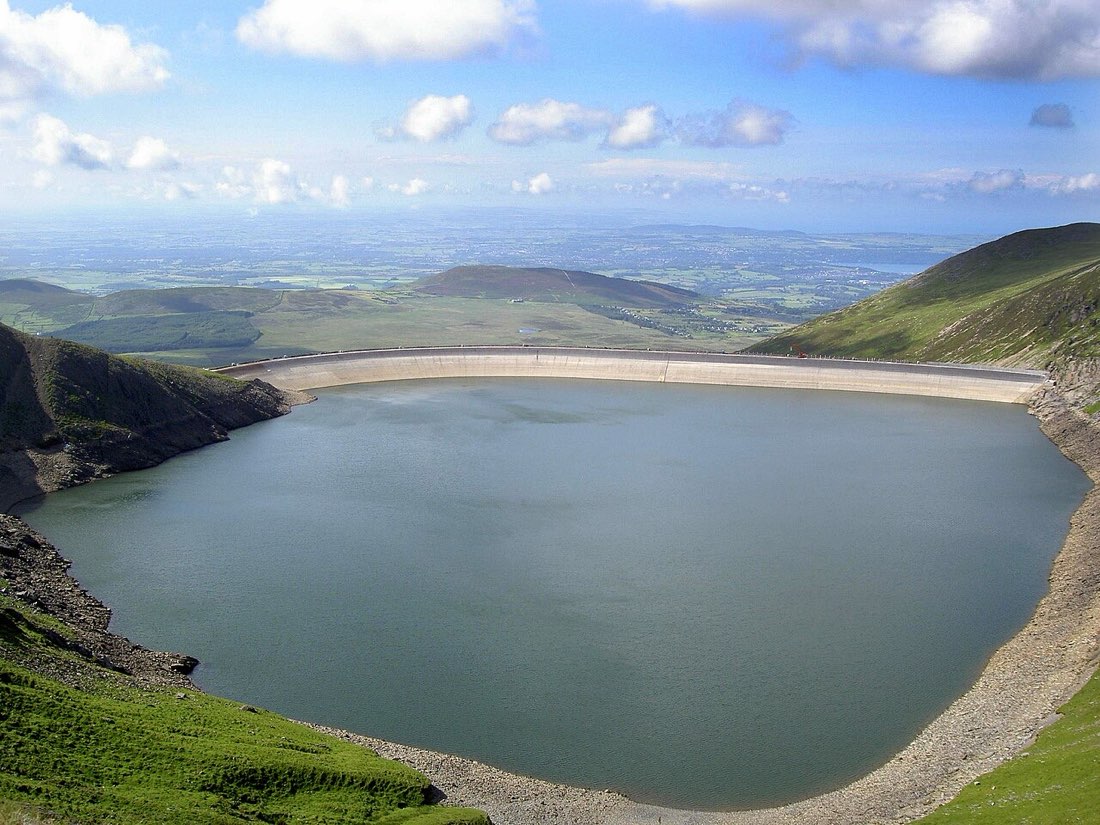
A large reservoir held by a curved dam high in the mountains
Marchlyn Mawr, the upper lake of the Dinorwig power station in Snowdonia. Photo: Ian Greig, CC BY-SA 2.0, via Wikimedia Commons

Electric Mountain

A battery made of water

At night, Dinorwig pumps water up into this lake, about 500 m above the power station. When the country suddenly needs electricity, the water rushes down through turbines.

Talk about itWhat two things would you need to know to work out how much energy the lake stores?
Lesson 3: Gravitational store

03 Gravitational field strength

What \(g\) means

On EarthGravity pulls every kilogram down with 9.8 N: \(g = 9.8\) N/kg
Where\(g\) / N/kgPull on 1 kg
Earth9.89.8 N
Moon1.61.6 N
Jupiterabout 25about 25 N
  • A newton (N) is the unit of force
  • A kilogram (kg) is the unit of mass
  • Mass is not a force: the same 1 kg is pulled by 9.8 N on Earth and 1.6 N on the Moon
  • So the same lift stores less energy on the Moon
Lesson 3: Gravitational store

03 Know and apply

Gravitational potential energy

\(E_p = m\,g\,h\)\(\text{G.P.E.} = \text{mass} \times \text{gravitational field strength} \times \text{height}\)\(E_p\) in J, \(m\) in kg, \(g\) in N/kg, \(h\) in mOn the equation sheet
Mass in kg, height in m. \(g\) is always given: 9.8 N/kg.
Example 1A 2.0 kg book is lifted onto a 1.5 m shelf.
Equation
\(E_p = m\,g\,h\)
Substitute
\(E_p = 2.0 \times 9.8 \times 1.5\)
Answer
\(E_p = 29.4\) J
Lesson 3: Gravitational store

03 Which height?

Use the height gained

Example 2A 55 kg hiker climbs from 120 m to 420 m above sea level.
Height
\(h = 420 - 120 = 300\) m
Substitute
\(E_p = 55 \times 9.8 \times 300\)
Answer
\(E_p = 161\,700\) J
Only the change in height counts.
Lesson 3: Gravitational store

03 Rearranging

Find \(h\) or \(m\)

Rearranged\(h = \dfrac{E_p}{m\,g}\qquad m = \dfrac{E_p}{g\,h}\)
Work out the bottom first: \(60 \times 9.8 = 588\). Then divide.
Example 4A crate lifted 2.0 m gains 392 J. Its mass?
Rearrange
\(m = \dfrac{E_p}{g\,h}\)
Substitute
\(m = \dfrac{392}{9.8 \times 2.0}\)
Answer
\(m = 20\) kg
Example 3A 60 kg climber gains 17 640 J. How high?
Equation
\(E_p = m\,g\,h\)
Rearrange
\(h = \dfrac{E_p}{m\,g}\)
Substitute
\(h = \dfrac{17\,640}{60 \times 9.8}\)
Answer
\(h = 30\) m
Lesson 3: Gravitational store

03 Checkpoint

Quick check

1What does \(g = 9.8\) N/kg mean?

Each kilogram is pulled down with 9.8 N

25.0 kg lifted 2.0 m?

\(5.0 \times 9.8 \times 2.0 = 98\) J

30.50 kg ball gains 24.5 J. Height?

\(\dfrac{24.5}{0.50 \times 9.8} = 5.0\) m

4Same lift on the Moon?

Less energy: \(g\) is smaller

5From 30 m to 80 m up. \(h\)?

50 m

6Height doubles. Energy?

\(\times 2\)
PRESS → TO REVEAL EACH ANSWER

04 Lesson 4: How stiff is a spring?

Stretching springs

two forcesextension\(F = ke\)two graphs

AQA spec: Physics 4.5.3Combined Science 6.5.3

WHY WE NEED \(k\)

\(k\) tells us how much energy a spring stores

Lesson 4: Stretching springs

04 Changing shape

Two forces

  • To stretch a spring and keep it still: two forces, one at each end
  • Here: the clamp pulls the top up; the load pulls the bottom down
  • Elastic deformation: goes back to its original length
  • Inelastic deformation: stays stretched
Lesson 4: Stretching springs

04 Measure the stretch

Extension, not length

Extension= stretched length − original length
  • No load: 5.0 cm long
  • With a load: 9.0 cm long
  • \(\text{Extension} = 9.0 - 5.0 =\) 4.0 cm
Lesson 4: Stretching springs

04 Know and apply

Spring constant

\(F = k\,e\)\(\text{force} = \text{spring constant} \times \text{extension}\)\(F\) in N, \(k\) in N/m, \(e\) in mOn the equation sheet
extension = stretched length − original length
Example2.0 N stretches a spring by 4.0 cm. Find \(k\).
Convert
\(e = 4.0\ \text{cm} = 0.040\ \text{m}\)
Rearrange
\(k = \dfrac{F}{e}\)
Substitute
\(k = \dfrac{2.0}{0.040}\)
Answer
\(k = 50\) N/m
Hooke's lawExtension is directly proportional to force, up to the limit of proportionality
Lesson 4: Stretching springs

04 At the bench

Masses into forces

Bench ruleEach 100 g pulls down with about 1 N
  • From Lesson 3: each kg is pulled with 9.8 N
  • So 100 g \(=\) 0.1 kg is pulled with 0.98 N \(\approx\) 1 N
  • Record the force in newtons, never grams

"I added a force of 300 g."

"I added 300 g, which pulls down with about 3 N."

Plot grams against centimetres.

Plot newtons against metres, so \(k\) comes out in N/m.

Lesson 4: Stretching springs

04 Practical

Plan the investigation

QuestionHow does the extension of a spring depend on the force pulling it?
Independentthe force: we choose it by adding masses
Dependentthe extension: we measure it
Controlthe same spring for every reading
Independent variable on the x-axis (Unit 1)
PRESS → TO REVEAL EACH ANSWER

04 Practical

Spring lab

Add 100 g at a time. Graph 1 first; swap the axes for graph 2interactive
Lesson 4: Stretching springs

04 Same results, two graphs

Which way round?

y-axisx-axisGradient means
Graph 1extension (dependent)force (independent)how stretchy: 0.04 m per N
Graph 2force (independent)extension (dependent)how stiff: \(k = 25\) N/m
Lesson 4: Stretching springs

04 When Hooke's law stops working

The limit of proportionality

  • At first: a straight line through the origin. Double the force, double the extension
  • The limit of proportionality is where the graph starts to curve
  • Beyond it, force and extension are no longer proportional
Use \(F = ke\) and \(E_e = \tfrac{1}{2}ke^2\) only up to this limit.
Force–extension graphschematic
Lesson 4: Stretching springs

04 Checkpoint

Quick check

16.0 cm long, then 9.5 cm. Extension?

3.5 cm

2200 N/m spring, \(e = 0.050\) m. Force?

\(200 \times 0.050 = 10\) N

33.0 N stretches 10 cm. \(k\)?

\(\dfrac{3.0}{0.10} = 30\) N/m

440 N/m spring, 2.0 N. Extension?

\(\dfrac{2.0}{40} = 0.050\) m, or 5.0 cm

5Stays stretched when let go?

Inelastic deformation

6Force–extension graph: gradient?

the spring constant \(k\)
PRESS → TO REVEAL EACH ANSWER

05 Lesson 5: Stretch and release

Elastic potential

\(E_e = \tfrac{1}{2}ke^2\)find \(k\) first\(2 \times\) stretch \(= 4 \times\) energy

AQA spec: Physics 4.1.1.2Combined Science 6.1.1.2

BIG QUESTION

Pull the bow back twice as far…

  • Twice the energy?
  • Or more?
Lesson 5: Elastic store
The Energy TimesLesson 5 · the case
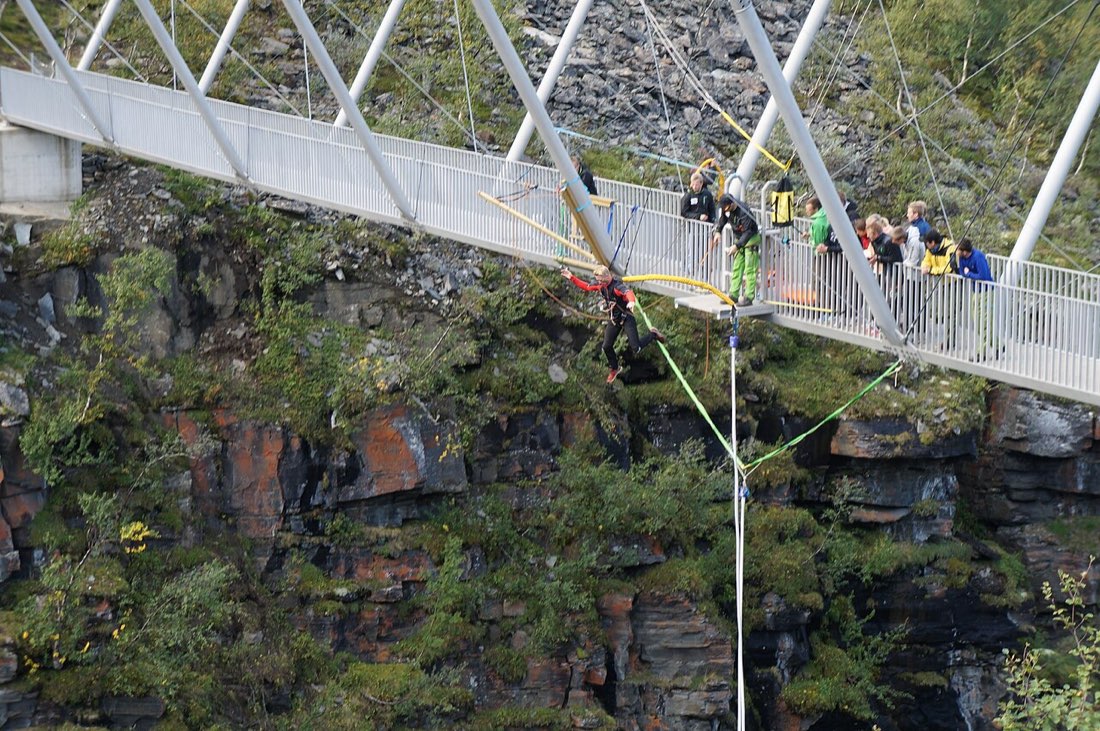
A bungee jumper hangs on a long cord below a footbridge over a rocky gorge
A bungee jump from the Gorsa bridge in Norway. Photo: Strikkhopper, CC BY-SA 4.0, via Wikimedia Commons

The cord that catches you

Stretch to stop

As the jumper falls, the cord stretches and fills its elastic potential store. The more it stretches, the harder it pulls back, until the jumper stops.

Talk about itWhat would happen with a cord that is too stiff? Too stretchy?

Lesson 5: Elastic store

05 Know and apply

Elastic potential energy

\(E_e = \tfrac{1}{2}\,k\,e^2\)\(\text{elastic potential energy} = 0.5 \times\) \(\text{spring constant} \times (\text{extension})^2\)\(E_e\) in J, \(k\) in N/m, \(e\) in mOn the equation sheet
Work done stretching a spring = energy stored, up to the limit of proportionality
Example 1\(k = 50\) N/m, stretched by 0.040 m.
Equation
\(E_e = \tfrac{1}{2}\,k\,e^2\)
Substitute
\(E_e = 0.5 \times 50 \times 0.040^2\)
Answer
\(E_e = 0.04\) J
Example 23.0 N stretches a spring by 10 cm. Energy stored?
Step 1
\(k = \dfrac{F}{e} = \dfrac{3.0}{0.10} = 30\) N/m
Step 2
\(E_e = \tfrac{1}{2}\,k\,e^2 = 0.5 \times 30 \times 0.10^2\)
Answer
\(E_e = 0.15\) J
Lesson 5: Elastic store

05 Try it

Double the stretch, \(\times 4\)

  • Stretch it 0.04 m, then 0.08 m, then 0.12 m
  • \(2 \times\) the extension → \(4 \times\) the energy
  • \(3 \times\) the extension → \(9 \times\) the energy
  • Same pattern as \(E_k\): the extension is squared
Spring, \(k = 50\) N/minteractive
Lesson 5: Elastic store

05 Checkpoint

Quick check

1\(k = 80\) N/m, \(e = 0.10\) m. \(E_e\)?

\(0.5 \times 80 \times 0.10^2 = 0.40\) J

2\(k = 400\) N/m, squashed 20 mm?

\(0.5 \times 400 \times 0.020^2 = 0.08\) J

3Extension triples. Energy?

\(\times 9\)

46.0 N stretches 0.15 m. Energy?

\(k = 40\) N/m; \(E_e = 0.45\) J

5When can't you use \(E_e = \tfrac{1}{2}ke^2\)?

Beyond the limit of proportionality

6Where does the work done go?

Into the spring's elastic potential store
PRESS → TO REVEAL EACH ANSWER

06 Lesson 6: Nothing is lost

Conservation of energy

closed systemsenergy bar chartsfalling and swingingdissipation

AQA spec: Physics 4.1.2.1Combined Science 6.1.2.1

KEY RULE

Energy cannot be created or destroyed

Lesson 6: Conservation

06 Big question

Will it hit you?

  • Release from rest at your nose. Never push.
  • It swings back to almost the same height
  • It cannot go higher: that would need more energy than it started with
  • Air resistance on: each swing a little lower
Penduluminteractive
Lesson 6: Conservation

06 Learn the wording

The principle

Conservation of energyEnergy can be transferred usefully, stored or dissipated, but cannot be created or destroyed.
A falling ball: the bars change, the total stays 20 J.
Lesson 6: Conservation

06 Calculations

Lost here, gained there

Example 1A 0.50 kg ball is dropped from 3.0 m. Ignore air resistance. \(E_k\) just before it lands?
Idea
\(E_k\) gained \(=\) \(E_p\) lost
Equation
\(E_p = m\,g\,h\)
Substitute
\(E_p = 0.50 \times 9.8 \times 3.0\)
Answer
\(E_k = 14.7\) J
Example 2A 0.25 kg ball is thrown up with 20 J of \(E_k\). Ignore air resistance. Greatest height above where it was thrown?
Idea
at the top, \(E_p = 20\) J
Rearrange
\(h = \dfrac{E_p}{m\,g}\)
Substitute
\(h = \dfrac{20}{0.25 \times 9.8}\)
Answer
\(h = 8.2\) m
Lesson 6: Conservation
The Energy TimesLesson 6 · the case
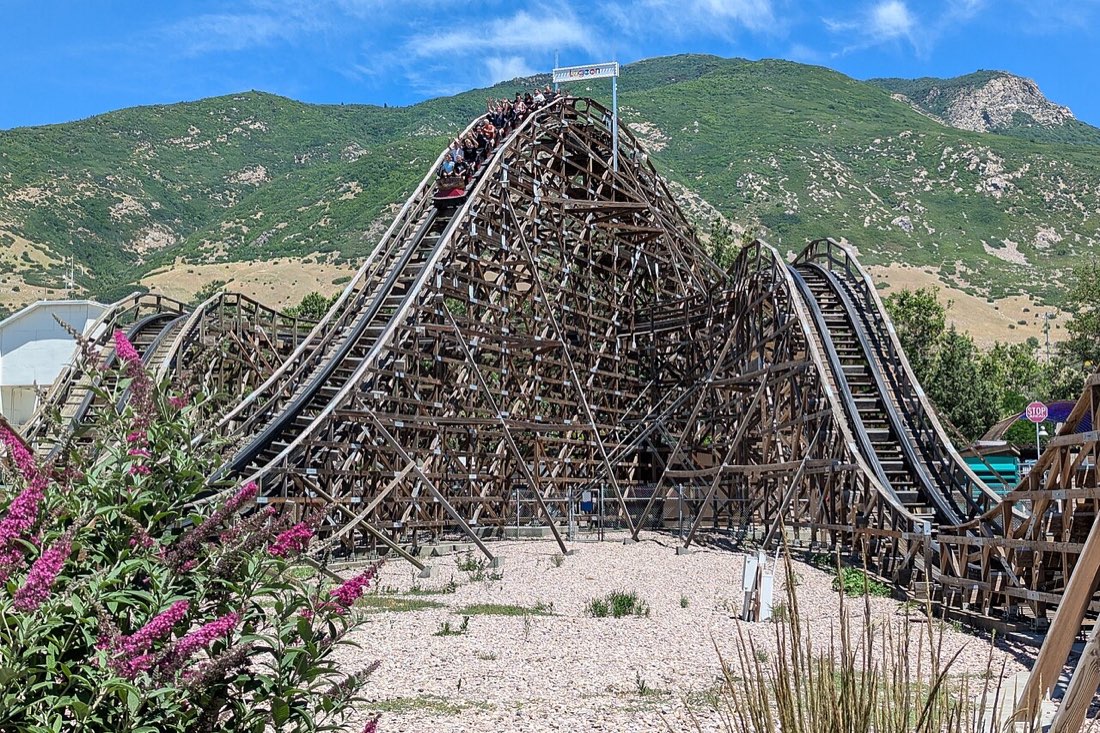
A wooden roller coaster with a tall first hill followed by smaller hills
The wooden roller coaster at Lagoon, Utah: one tall lift hill, then smaller hills. Photo: Jeremy Thompson, CC BY 2.0, via Wikimedia Commons

Ride design

Why the first hill is the highest

A chain hauls the train to the top of the first hill. After that there is no motor: the ride runs on the energy in the gravitational potential store.

Talk about itUse conservation of energy to explain the rule.

Lesson 6: Conservation

06 Practical

Does it keep its energy?

  1. Release from rest, 0.20 m above the lowest point
  2. Read the height after 1 swing (film it)
  3. Read the height after 10 swings
  4. \(E_p = m\,g\,h\) each time
0.20 kg bobHeight / m\(E_p\) / J
Released0.200.39
After 1 swing0.190.37
After 10 swings0.120.24
Lesson 6: Conservation

06 Checkpoint

Quick check

1State the principle.

Transferred, stored or dissipated; never created or destroyed

22.0 kg rock falls 5.0 m, no air resistance. \(E_k\) at the bottom?

\(2.0 \times 9.8 \times 5.0 = 98\) J

30.10 kg ball up with 4.9 J, no air resistance. Height?

\(\dfrac{4.9}{0.10 \times 9.8} = 5.0\) m

4Pendulum lower each swing. Why?

Energy dissipated to the thermal store of the air

5Top of the swing: most energy in?

gravitational potential store

6Is energy destroyed by friction?

No: it is dissipated
PRESS → TO REVEAL EACH ANSWER

07 Lesson 7: How fast?

Power

rate of energy transfer\(P = \dfrac{E}{t}\)wattshow powerful are you?

AQA spec: Physics 4.1.1.4Combined Science 6.1.1.4

BIG QUESTION

Same stairs, same bag. One runs, one walks.

  • Who transferred more energy?
  • Who was more powerful?
Lesson 7: Power

07 Watch

Same job, different power

  • Same load, same height: same energy, 29.4 J
  • A takes 2 s; B takes 6 s
  • A transfers energy faster: A is more powerful
  • Power = energy transferred per second
Two motorsinteractive
Lesson 7: Power

07 Know and apply

Calculating power

\(P = \dfrac{E}{t}\)\(\text{power} = \text{energy transferred} \div \text{time}\)\(P\) in W, \(E\) in J, \(t\) in sOn the equation sheet
1 watt= 1 joule per second. 1 kW \(=\) 1000 W.
Rearranged\(E = P\,t \qquad t = \dfrac{E}{P}\)
Example 1A motor transfers 600 J in 4.0 s.
Equation
\(P = \dfrac{E}{t}\)
Substitute
\(P = \dfrac{600}{4.0}\)
Answer
\(P = 150\) W
Example 2A 2.0 kW kettle runs for 2.0 minutes. Energy?
Convert
\(P = 2000\) W, \(t = 120\) s
Rearrange
\(E = P\,t\)
Substitute
\(E = 2000 \times 120\)
Answer
\(E = 240\,000\) J
Lesson 7: Power

07 Practical

How powerful are you?

Example results18 steps of 0.17 m, mass 50 kg, time 5.0 s
Height
\(h = 18 \times 0.17 = 3.06\) m
Energy
\(E_p = 50 \times 9.8 \times 3.06 = 1500\) J
Power
\(P = \dfrac{1500}{5.0}\)
Answer
\(P = 300\) W
Walk briskly. Never run. Hold the handrail. Everyone uses 50 kg.
Lesson 7: Power

07 Checkpoint

Quick check

1What is power?

The rate of energy transfer: joules per second

2600 J in 10 s?

60 W

340 W fan for 5.0 minutes?

\(40 \times 300 = 12\,000\) J

41500 W motor, 45 000 J. Time?

\(\dfrac{45\,000}{1500} = 30\) s

53.0 kW in watts?

3000 W

6More powerful motor, same job?

Same energy, less time
PRESS → TO REVEAL EACH ANSWER

08 Lesson 8: Where does it go?

Wasted energy

dissipationlubricationthermal conductivityinsulationEco House

AQA spec: Physics 4.1.2.1Combined Science 6.1.2.1

BIG QUESTION

Why does hot chocolate always go cold?

  • Where does its energy go?
  • Can we slow it down?
Lesson 8: Wasted energy

08 Every real transfer

Some is always dissipated

  • Some energy always goes to the thermal store of the surroundings
  • It is spread out: dissipated. We call it "wasted"
  • It is not destroyed. We just cannot use it again

"The energy is lost."

"The energy is dissipated to the thermal store of the surroundings."

"Insulation keeps the cold out."

"Insulation slows the energy transfer from the warm house to the cold outside."

Lesson 8: Wasted energy

08 Fight the waste

Reduce unwanted transfers

Friction

Lubricate

Oil or grease lets parts slide past each other easily, so less energy goes to the thermal store.

Air resistance

Streamline

A smooth shape means the air pushes back less, so less energy is dissipated in the air.

Conduction

Insulate

Materials with a low thermal conductivity slow the transfer through walls and roofs.

Lesson 8: Wasted energy

08 Conduction

Thermal conductivity

  • Higher thermal conductivity → energy conducted faster
  • Pins drop off copper first, glass last
  • Air, wool, foam: low conductivity, good insulators
  • A house cools more slowly with thicker walls of lower conductivity
Wax-and-pin rodsinteractive
Lesson 8: Wasted energy

08 Practical

Cooling cups

Independentwrapping material (categoric)
Dependenttemperature drop in 10 min
Controlvolume, start temperature, cup, lid, thickness
Categoric independent variable → bar chart (Unit 1)
Best insulator: smallest drop, cotton wool here
Lesson 8: Wasted energy

08 Apply it

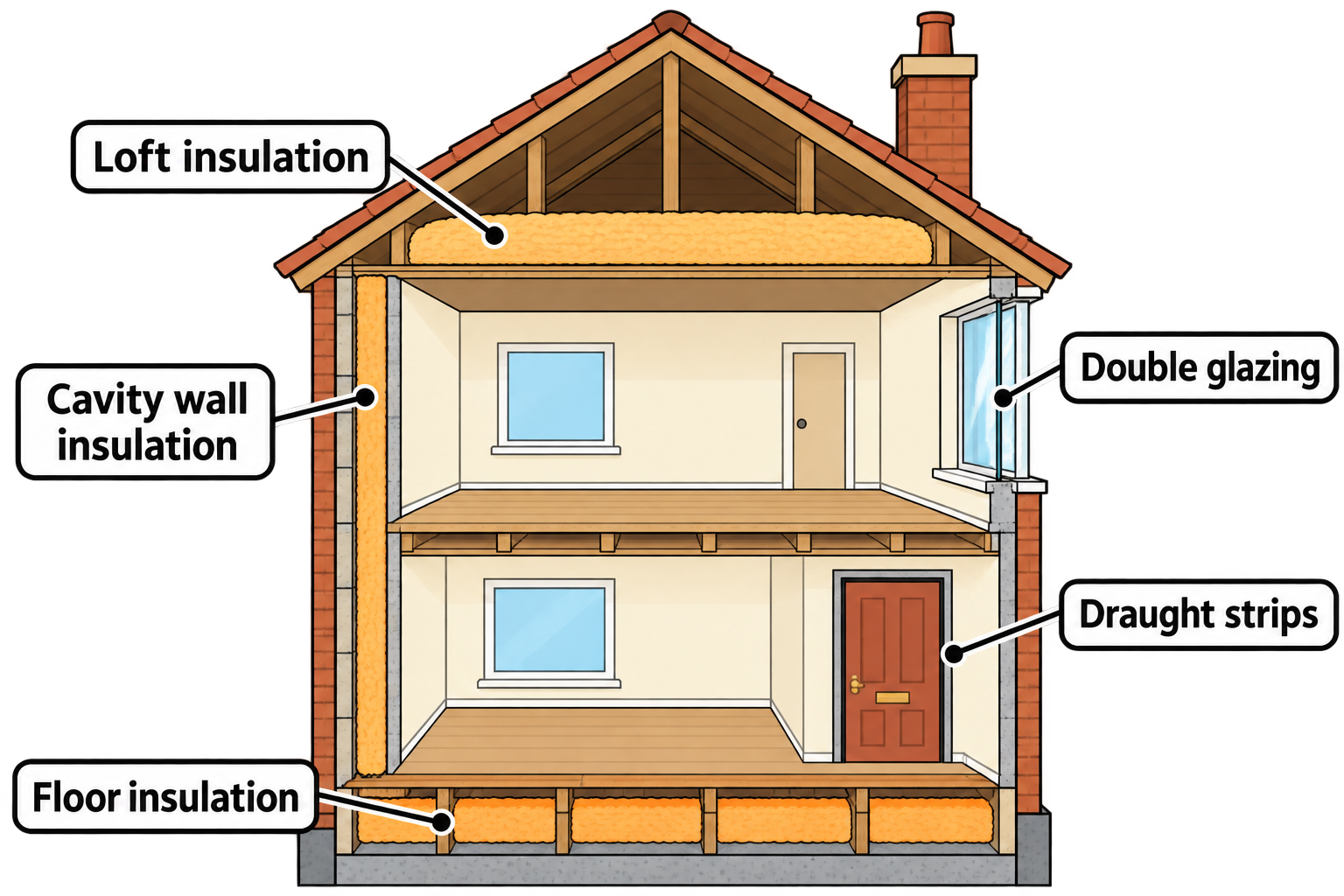
Design an Eco House

  • Loft: thick insulation
  • Walls: cavity wall insulation
  • Windows: double glazing
  • Floor: insulation under the carpet
  • Doors: draught strips
  • Explain each with thermal conductivity, thickness or gaps
Cut-away house
Cutaway house with thick loft insulation, insulation in the wall cavity and below the ground floor, double glazing and draught strips around the door.
Lesson 8: Wasted energy

08 Checkpoint

Quick check

1Where does dissipated energy end up?

Thermal store of the surroundings

2How does oil help a bike chain?

Less friction, so less energy dissipated

3Copper or glass: faster conduction?

Copper: higher thermal conductivity

4Thicker wall: cools faster or slower?

Slower

5Why do many insulators work?

They trap air, a poor conductor

6Cooling cups: best insulator? Triple only

The one with the smallest temperature drop
PRESS → TO REVEAL EACH ANSWER

09 Lesson 9: How much is useful?

Effic­iency

useful \(\div\) totaldecimal or %Sankey diagramsbouncing balls

AQA spec: Physics 4.1.2.2Combined Science 6.1.2.2

BIG QUESTION

Same light. Why does the LED cost less?

  • Filament lamp: about 10% useful
  • LED: about 40% useful
Lesson 9: Efficiency

09 Know and apply

Efficiency

\(\text{efficiency} = \dfrac{\text{useful output}}{\text{total input}}\)energy in J, or power in W. No unit.A decimal up to 1; \(\times 100\) for a percentageOn the equation sheet
Rearranged\(\text{useful} = \text{efficiency} \times \text{total}\)   \(\text{total} = \dfrac{\text{useful}}{\text{efficiency}}\)
Example 1500 J in, 400 J useful.
Equation
\(\text{efficiency} = \dfrac{\text{useful}}{\text{total}}\)
Substitute
\(\dfrac{400}{500}\)
Answer
0.80, or 80%
Example 2A 60 W lamp, 25% efficient. Useful power?
Convert
\(25\% = 0.25\)
Rearrange
\(\text{useful} = \text{efficiency} \times \text{total}\)
Answer
\(0.25 \times 60 = 15\) W
Lesson 9: Efficiency

09 Picture it

Sankey diagrams

  1. Arrow width shows the amount of energy
  2. Useful goes straight on; wasted bends away
  3. \(\text{input} = \text{useful} + \text{wasted}\): \(100 = 20 + 80\)
  4. \(\text{efficiency} = \dfrac{20}{100} = 0.20\) (20%)
A lamp
Lesson 9: Efficiency

09 Increasing efficiency

Lamp or LED?

Filament lampabout 10%
LEDabout 40%
Increase efficiency: lubricate, streamline, insulate, choose devices that waste less.
Lesson 9: Efficiency

09 Practical

How efficient is a bounce?

Same mass, same \(g\)\(E_p = m\,g\,h\)
Example resultsA 0.10 kg ball: drop 1.00 m, mean bounce 0.65 m
Input
\(E_{p1} = 0.10 \times 9.8 \times 1.00 = 0.98\,\mathrm{J}\)
Useful
\(E_{p2} = 0.10 \times 9.8 \times 0.65 = 0.637\,\mathrm{J}\)
Efficiency
\(\dfrac{E_{p2}}{E_{p1}} = \dfrac{0.637}{0.98} = 0.65\) (65%)
Drop testinteractive
Lesson 9: Efficiency

09 Checkpoint

Quick check

1300 J useful from 1200 J?

0.25 (25%)

2Efficiency of 1.4?

Impossible: more than 100%

3400 W motor, 75%. Useful power?

\(0.75 \times 400 = 300\) W

40.20 efficient, 12 J useful. Input?

\(\dfrac{12}{0.20} = 60\) J

5Unit of efficiency?

None

6Sankey: which arrow is wasted?

The one that bends away
PRESS → TO REVEAL EACH ANSWER

Summary

Equation toolkit

\(E_k = \tfrac{1}{2}mv^2\)

J, kg, m/s

calculate \(E_k\) only
\(E_p = mgh\)

J, kg, N/kg, m

\(h = \dfrac{E_p}{mg}\), \(m = \dfrac{E_p}{gh}\)
\(F = ke\)

N, N/m, m

\(k = \dfrac{F}{e}\), \(e = \dfrac{F}{k}\)
\(E_e = \tfrac{1}{2}ke^2\)

J, N/m, m

calculate \(E_e\) only
\(P = \dfrac{E}{t}\)

W, J, s

\(E = Pt\), \(t = \dfrac{E}{P}\)
\(s = vt\)

m, m/s, s

\(v = \dfrac{s}{t}\)
\(\text{eff.} = \dfrac{\text{useful output}}{\text{total input}}\)

energy or power; no unit

\(\text{useful} = \text{eff.} \times \text{total}\); \(\text{total} = \dfrac{\text{useful}}{\text{eff.}}\)
All on the AQA equation sheet. \(g = 9.8\) N/kg. Convert first: g → kg, cm → m, kJ → J, minutes → s, % → decimal.
Energy: stores and transfers

Summary

Key words

Energy storeWhere energy is held, in joules
Closed systemNo energy in or out; total constant
Gravitational field strength9.8 N on each kg
ExtensionStretched length − original length
Spring constantForce per metre of extension (N/m)
Limit of proportionalityPast it, \(F\) and \(e\) are not proportional
Conservation of energyNever created or destroyed
DissipatedSpread to the thermal store of the surroundings
PowerEnergy transferred per second (W)
Thermal conductivityHigher = faster conduction
EfficiencyUseful output \(\div\) total input
Sankey diagramArrow width shows energy
Energy: stores and transfers