
Year 10 physicsAQA GCSE Physics & Combined Science

Follow the charge.
Track the energy.

Circuits, current, p.d., resistance, power, mains
Static electricity Triple only

\(Q = I\,t\)\(E = Q\,V\)\(V = I\,R\)\(P = V\,I\)\(P = I^2\,R\)\(E = P\,t\)
ELECTRONS
− → +
ENERGY
OUT AT
EACH PART
ONE LOOP, ONE CURRENT
6 V10 ΩA0.60 A

Same current
all the way round.

\(V = I\,R\)

AQA Physics 8463: 4.2 · Combined Science 8464: 6.2

Nine missions.

01A

Build & measure

Loops, symbols, ammeter

Physics 4.2.1.1Combined 6.2.1.1

02Q

Charge on the move

Current, \(Q = I\,t\)

Physics 4.2.1.2Combined 6.2.1.2

03V

Energy per coulomb

p.d., \(E = Q\,V\), voltmeter

Physics 4.2.4.2Combined 6.2.4.2

04Ω

Resistance &
\(V = I\,R\)

Ohm’s law, RP: wire length

Physics 4.2.1.3Combined 6.2.1.3

05

Series & parallel

The rules, \(R_{\text{total}}\)

Physics 4.2.2Combined 6.2.2

06I–V

\(I\)–\(V\) characteristics

Lamp, diode, sensors, RP

Physics 4.2.1.4Combined 6.2.1.4

07P

Power & the Grid

\(P = V\,I\), \(E = P\,t\), transformers

Physics 4.2.4Combined 6.2.4

08~

Mains & safety

ac, 230 V, earth wire

Physics 4.2.3Combined 6.2.3

09±

Static Triple only

Rubbing, sparks, electric fields

Physics 4.2.5Not in Combined

Electric circuits

01 Mission 1: Wire it like a physicist

Build & measure

complete circuitscircuit symbolsammeter in series

AQA spec: Physics 4.2.1.1Combined Science 6.2.1.1

KEY RULE

No complete loop, no current

Mission 1: Build & measure

01 What a circuit needs

A complete loop

  • A source of energy: cell or battery
  • A closed loop of conducting wire
  • Wires are already full of charge
  • Close the switch → all the charge moves at once
  • A gap anywhere → no current everywhere
Mission 1: Build & measure

01 Learn to draw all of these

Circuit symbols

Cell: the longer line is the positive terminal
Battery: two or more cells joined together
Mission 1: Build & measure

01 Anyone can build it

Draw it properly

  • Pencil and ruler
  • Straight wires, right-angle corners
  • No gaps: every wire joins at both ends
  • Wire goes into each symbol
  • Label values: 6 V, 10 Ω
Mission 1: Build & measure

01 Measuring current

Ammeter in series

  • Current in amperes (A)
  • Ammeter in the same loop as the component
  • Same charge flows through both
  • Ideal ammeter: almost zero resistance
One loop \(=\) a series circuit
Mission 1: Build & measure

02 Mission 2: Measure the flow

Charge on the move

current as a rate\(Q = I\,t\)electrons vs conventional current

AQA spec: Physics 4.2.1.2Combined Science 6.2.1.2

KEY RULE

Current = charge per second

Mission 2: Charge on the move

02 Current

A rate of flow

  • Current = rate of flow of charge
  • Charge \(Q\) in coulombs (C)
  • Current I in amperes (A)
  • 1 A \(=\) 1 C passing a point each second
  • In metals: free electrons move
  • Needs a closed loop + a p.d.
Mission 2: Charge on the move

02 Know and apply

Charge flow

\(Q = I\,t\)\(\text{charge flow} = \text{current} \times \text{time}\)\(Q\) in C, \(I\) in A, \(t\) in s
Time in seconds: min \(\times 60\), h \(\times 3600\)
Example 10.40 A for 3.0 minutes
Convert
\(t = 3.0 \times 60 = 180\) s
Substitute
\(Q = 0.40 \times 180\)
Answer
\(Q = 72\) C
Example 25400 C at 1.2 A. Time in minutes?
Rearrange
\(t = Q \div I = 5400 \div 1.2\)
Answer
\(4500\ \text{s} = 75\ \text{min}\)
Mission 2: Charge on the move

02 Which way?

Two directions

  • Electrons: − terminal → + terminal
  • Conventional current: + → −
  • Circuit arrows use conventional current
  • Same current, opposite arrows
Mission 2: Charge on the move

02 Common mistake

Current is not used up

  • One loop → same current everywhere
  • Charge is conserved: it goes round
  • Components take energy, not charge

“The lamp uses up some current.”

The lamp transfers energy. Current stays the same.

Mission 2: Charge on the move

01–02 Checkpoint

Quick check

145 C flows in 30 s. Current?

\(I = 45 \div 30 = 1.5\) A

20.25 A for 2.0 min. Charge?

\(0.25 \times 120 = 30\) C

3Ammeter: series or parallel?

Series, in the same loop

4Which way do electrons flow?

− terminal → + terminal

5Ammeters before and after a lamp?

Same reading

6Switch opened. Current?

Zero everywhere: the loop is broken
PRESS → TO REVEAL EACH ANSWER

03 Mission 3: Follow the energy

Energy per coulomb

p.d. \(=\) energy per coulomb\(E = Q\,V\)voltmeter across

AQA spec: Physics 4.2.4.2Combined Science 6.2.4.2

KEY RULE

1 V \(=\) 1 J per coulomb

Mission 3: Energy per coulomb

03 Know and apply

Potential difference

  • p.d. = energy transferred per coulomb
  • Measured in volts (V)
  • 6 V across a resistor → 6 J per C
\(E = Q\,V\)\(\text{energy} = \text{charge flow} \times \text{p.d.}\)\(E\) in J, \(Q\) in C, \(V\) in V
Two steps12 V motor, 0.50 A for 40 s. Energy?
Charge
\(Q = I\,t = 0.50 \times 40 = 20\) C
Equation
\(E = Q\,V\)
Substitute
\(E = 20 \times 12\)
Answer
\(E = 240\) J
Mission 3: Energy per coulomb

03 Measuring p.d.

Voltmeter across

  • p.d. is between two points
  • Voltmeter in parallel, across the part
  • Very high resistance
  • Both leads on one wire → about 0 V

“The voltage at the resistor.”

“The p.d. across the resistor.”

Mission 3: Energy per coulomb

03 Source and load

Energy in. Energy out.

  • Source (battery): energy to the charge
  • Load (lamp, resistor): energy from the charge
  • Series: component p.d.s add up to the supply
  • 6 J supplied \(=\) 3 J \(+\) 3 J transferred
Charge is conserved and energy is conserved
Mission 3: Energy per coulomb

04 Mission 4: Control the current

Resistance & \(V = I\,R\)

\(V = I\,R\)Ohm’s lawwhy metals resistRP: length of a wire

AQA spec: Physics 4.2.1.3Combined Science 6.2.1.3

KEY RULE

More resistance, less current

Mission 4: Resistance

04 Know and apply

Resistance equation

\(V = I\,R\)\(\text{p.d.} = \text{current} \times \text{resistance}\)\(V\) in V, \(I\) in A, \(R\) in Ω
  • \(R = V \div I\) and \(I = V \div R\)
  • Same p.d., double \(R\) → half the current
  • mA \(\div 1000\) → A
Example 10.20 A through 15 Ω. p.d.?
Substitute
\(V = 0.20 \times 15\)
Answer
\(V = 3.0\) V
Example 26.0 V, 250 mA. Resistance?
Convert
\(250\ \text{mA} = 0.25\ \text{A}\)
Answer
\(R = 6.0 \div 0.25 = 24\) Ω
Mission 4: Resistance

04 Ohm’s law

Ohmic conductors

  • \(I\) directly proportional to \(V\)
  • Only at constant temperature
  • Straight line through the origin
  • Resistance stays constant
Double the p.d. → double the current
Mission 4: Resistance

04 Inside the metal

Why metals resist

  • Electrons collide with metal ions
  • Collisions oppose the current
  • Energy transferred → wire heats up
  • Hotter → ions vibrate more → more collisions
  • So \(R\) increases with temperature
Mission 4: Resistance

04 The standard circuit

Measure \(R\)

  1. Ammeter in series
  2. Voltmeter across the component
  3. Variable resistor → change I
  4. Record \(V\) and \(I\) for several pairs
  5. \(R = V \div I\), then a mean or a graph
Mission 4: Resistance

RP Resistance: Part A

Length of a wire

  • IV: length / cm
  • DV: resistance / Ω
  • Control: material, diameter, temperature
  1. 10 → 100 cm, in steps
  2. Read \(V\) and \(I\)
  3. \(R = V \div I\)
  4. Switch off between readings
Required practical: Resistance

RP Results and evaluation

\(R \propto\) length

  • Straight line through origin → \(R \propto L\)
  • Longer wire → more collisions
  • Wire heats → \(R\) rises → keep current small
  • Measure to the same contact point of the clip

“Human error.”

“The wire heated up, so \(R\) increased.”

Required practical: Resistance

03–04 Checkpoint

Quick check

15.0 C through a 12 V lamp. Energy?

\(E = 5.0 \times 12 = 60\) J

269 000 J, 300 C. p.d.?

\(V = 69\,000 \div 300 = 230\) V

3How is a voltmeter connected?

In parallel, across the component

46.0 V, 0.30 A. Resistance?

\(R = 6.0 \div 0.30 = 20\) Ω

5Wire length doubles. Resistance?

Doubles: \(R \propto L\)

6Why switch off between readings?

Stops the wire heating, so \(R\) stays constant
PRESS → TO REVEAL EACH ANSWER

05 Mission 5: Crack any network

Series & parallel

series rulesparallel rules\(R_{\text{total}} = R_1 + R_2\)

AQA spec: Physics 4.2.2Combined Science 6.2.2

KEY RULE

Parallel: same p.d., currents add

Mission 5: Series & parallel

05 One path

Series rules

  • Same current through every part
  • Supply p.d. shared between parts
  • Bigger \(R\) → bigger share of p.d.
\(R_{\text{total}} = R_1 + R_2\)total resistance in series
Mission 5: Series & parallel

05 More than one path

Parallel rules

  • Same p.d. across each branch
  • Branch currents add up to the total
  • Smaller \(R\) → bigger branch current
  • \(R_{\text{total}}\) less than the smallest resistor
Each branch gets the full supply p.d.
Mission 5: Series & parallel

RP Resistance: Part B

Another path, less \(R\)

  • Series: add a resistor → \(R_{\text{total}}\) up
  • Parallel: add a branch → more paths
  • More current at the same p.d.
  • So \(R_{\text{total}} = V \div I\) goes down
Two 10 Ω resistors
Series20 Ω
Parallel5 Ω
Mission 5: Series & parallel

05 Worked example

Find the lamp’s \(R\)

9.0 V supply, 10 Ω reads 6.0 VResistance of the lamp?
Current
\(I = 6.0 \div 10 = 0.60\) A
Lamp p.d.
\(9.0 - 6.0 = 3.0\) V
Same I
0.60 A in series
Answer
\(R = 3.0 \div 0.60 = 5.0\) Ω
Mission 5: Series & parallel

05 Checkpoint

Quick check

15 Ω and 15 Ω in series. \(R_{\text{total}}\)?

\(5 + 15 = 20\) Ω

2Series: 12 V supply, one part has 5 V?

The other has 7 V

3Branches: 0.4 A and 0.6 A. Supply current?

\(0.4 + 0.6 = 1.0\) A

4p.d. across each parallel branch?

The full supply p.d.

5Add a resistor in parallel. \(R_{\text{total}}\)?

Decreases

66.0 V, 0.20 A, \(R_1 = 12\) Ω. \(R_2\) in series?

\(30 - 12 = 18\) Ω
PRESS → TO REVEAL EACH ANSWER

06 Mission 6: A component’s fingerprint

\(I\)–\(V\) character­istics

resistor, lamp, diodethermistors and LDRsRP: \(I\)–\(V\)

AQA spec: Physics 4.2.1.4Combined Science 6.2.1.4

KEY RULE

Curved graph, changing \(R\)

Mission 6: \(I\)–\(V\) characteristics

06 Reading the graph

Current against p.d.

  • p.d. on \(x\), current on \(y\)
  • Negative values: supply reversed
  • Straight through origin → ohmic
  • Curve → \(R\) changes
Fixed resistor: same shape both ways
Mission 6: \(I\)–\(V\) characteristics

06 Non-ohmic

Lamp & diode

Filament lamp

  • More current → filament hotter
  • Hotter → \(R\) increases
  • Graph gets less steep

Diode (and LED)

  • Current in one direction only
  • Very high \(R\) in reverse
  • Forward: a diode conducts above ~0.6 V (an LED needs more)
Mission 6: \(I\)–\(V\) characteristics

06 Components that sense

Thermistor & LDR

Thermistor

  • Temperature ↑ → \(R\) ↓
  • Thermostats, fire alarms

Light-dependent resistor

  • Light intensity ↑ → \(R\) ↓
  • Streetlights, night lights
Mission 6: \(I\)–\(V\) characteristics

06 On the bench

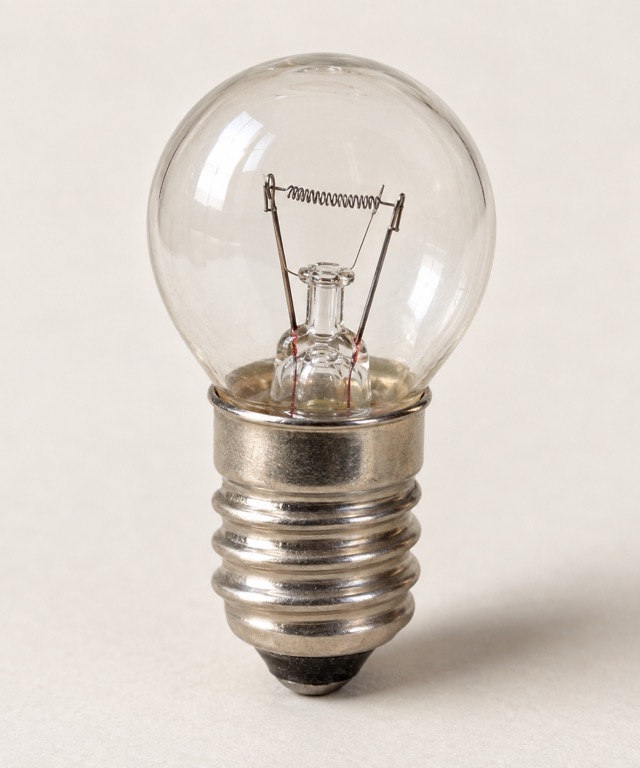
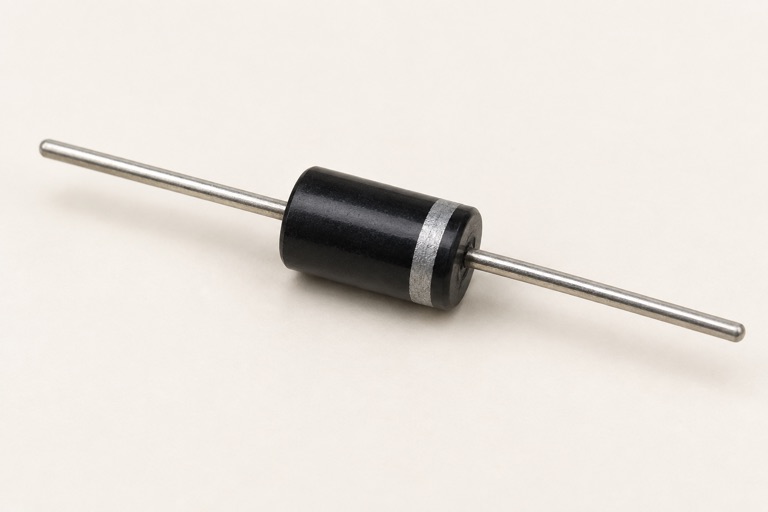
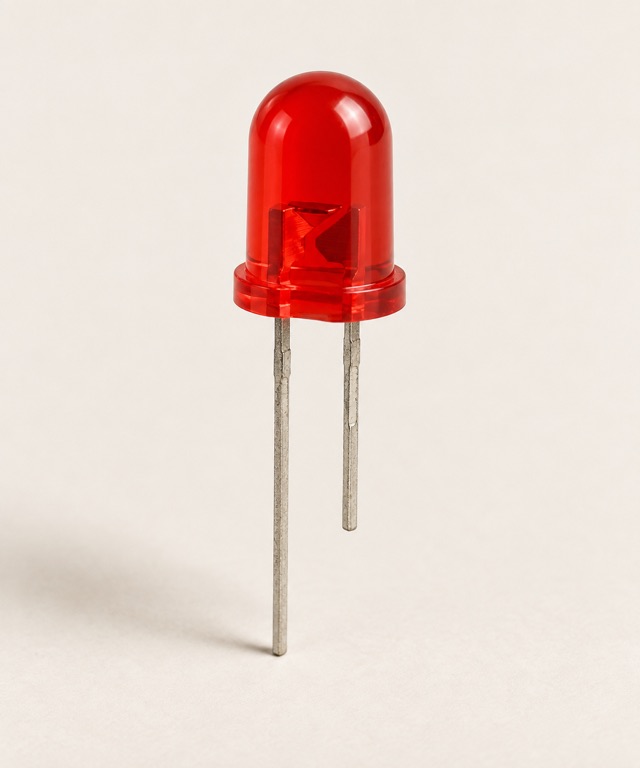
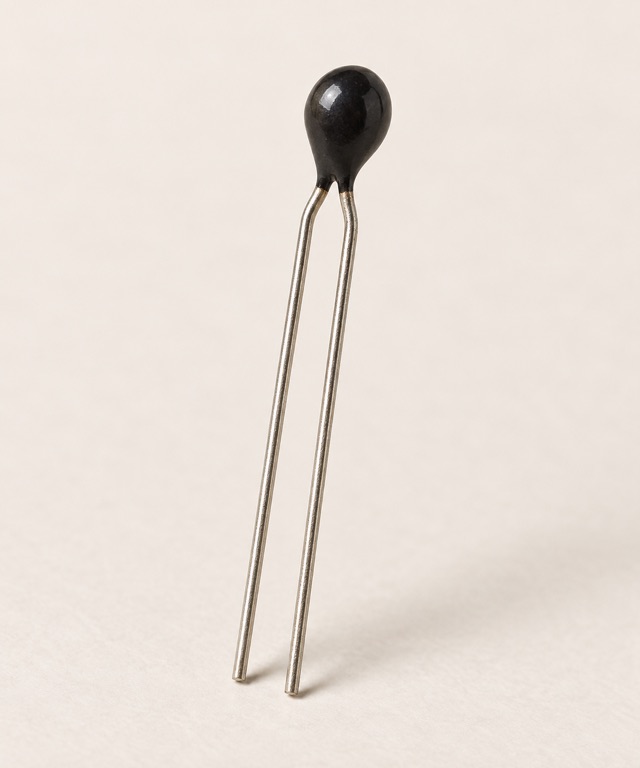
What they look like

Clear glass filament lamp with a visible coiled wire inside
Filament lampHotter → \(R\) ↑
Black cylindrical diode with a silver polarity band and two wire leads
DiodeCurrent one way only
Red light-emitting diode with a rounded plastic case and two wire leads
LEDA diode that emits light
Small black bead thermistor with two wire leads
ThermistorTemperature ↑ → \(R\) ↓
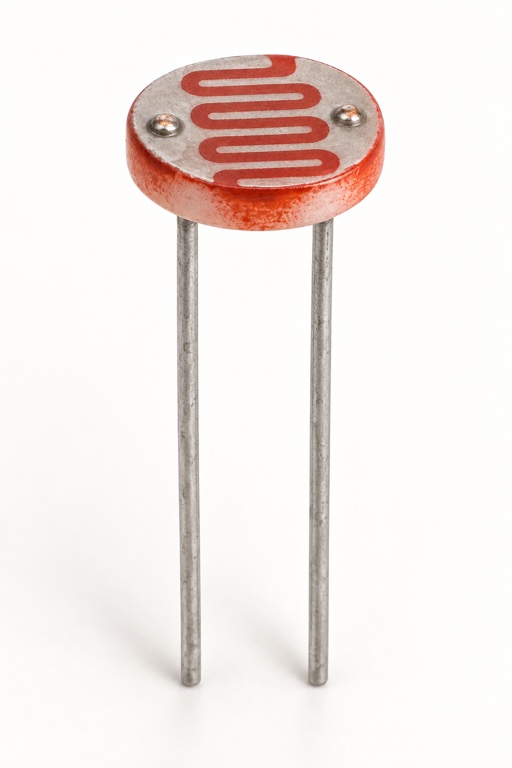
Light-dependent resistor with an upward-facing serpentine sensing surface and two leads beneath the disc
LDRLight intensity ↑ → \(R\) ↓
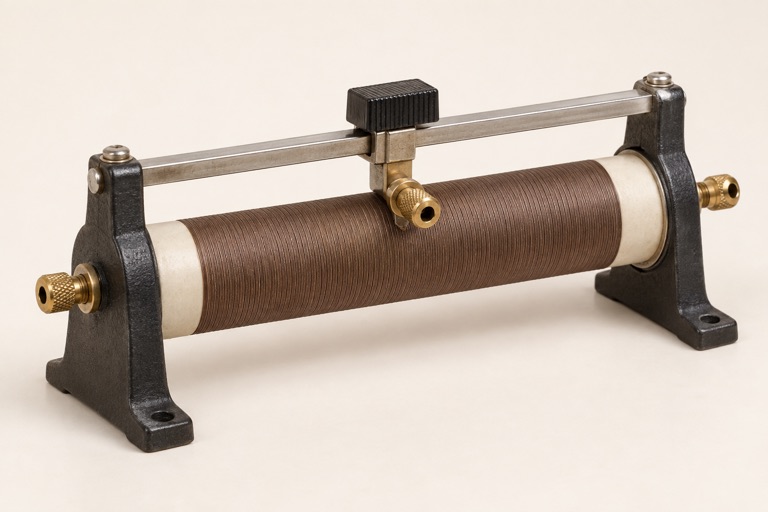
Sliding variable resistor with a wire-wound tube and an adjustable contact
Variable resistorSets \(R\) by hand
Mission 6: \(I\)–\(V\) characteristics

06 Sensor circuit

Brighter → more current

  1. Light gets brighter
  2. LDR resistance decreases
  3. Total resistance decreases
  4. \(I = V \div R\) → current increases
6.0 V supplyBright: \(6.0 \div 600 = 0.010\) A
Dark: \(6.0 \div 1500 = 0.0040\) A
Mission 6: \(I\)–\(V\) characteristics

RP \(I\)–\(V\) characteristics

Test each component

  1. Build the circuit
  2. Change the p.d. with the variable resistor
  3. Record \(V\) and \(I\) for several values
  4. Reverse the supply, then repeat
  5. Plot \(I\) against \(V\)
  6. Repeat: resistor, lamp, diode
Required practical: \(I\)–\(V\)

RP Get the negative half

Reverse & read

Required practical: \(I\)–\(V\)

06 Checkpoint

Quick check

1Straight line through the origin?

An ohmic conductor, e.g. a fixed resistor at constant temperature

2Why does the lamp graph curve?

Filament heats, so \(R\) increases

3Diode in reverse?

Very high \(R\), so almost no current

4Thermistor gets hotter. \(R\)?

Decreases

5Sensor for a streetlight?

LDR

6Why reverse the supply?

To get the negative readings
PRESS → TO REVEAL EACH ANSWER

07 Mission 7: Count the joules

Power & the National Grid

\(P = V\,I\), \(P = I^2\,R\)\(E = P\,t\)step-up, step-down

AQA spec: Physics 4.2.4Combined Science 6.2.4

KEY RULE

Power = energy per second

\(P = V\,I\)
  • 1 W \(=\) 1 J per second
  • 1 kW \(=\) 1000 W
Mission 7: Power & the Grid

07 Know and apply

Two power equations

\(P = V\,I\)\(\text{power} = \text{p.d.} \times \text{current}\)\(P\) in W, \(V\) in V, \(I\) in A
Example230 V, 4.0 A → \(P = 230 \times 4.0 =\) 920 W
\(P = I^2\,R\)\(\text{power} = \text{current}^2 \times \text{resistance}\)\(P\) in W, \(I\) in A, \(R\) in Ω
Example2.0 A, 15 Ω → \(P = 2.0^2 \times 15 =\) 60 W
Square the current first: double \(I\) → \(4 \times\) the power
Mission 7: Power & the Grid

07 Know and apply

Energy transferred

\(E = P\,t\)\(\text{energy} = \text{power} \times \text{time}\)\(E\) in J, \(P\) in W, \(t\) in s
  • Kettle → thermal store of water
  • Fan motor → kinetic energy
  • Charger → chemical store of battery
Example2.0 kW kettle for 3.0 minutes
Convert
\(P = 2000\) W, \(t = 180\) s
Equation
\(E = P\,t\)
Substitute
\(E = 2000 \times 180\)
Answer
\(E = 360\,000\) J
Mission 7: Power & the Grid

07 Power station to home

The National Grid

  • Cables + transformers
  • Step-up: p.d. up for transmission
  • High p.d. → small current
  • Small current → less heating in cables
  • Step-down: p.d. down for homes
WhyAn efficient way to transfer energy
Mission 7: Power & the Grid

07 Spot it outside

The Grid, for real

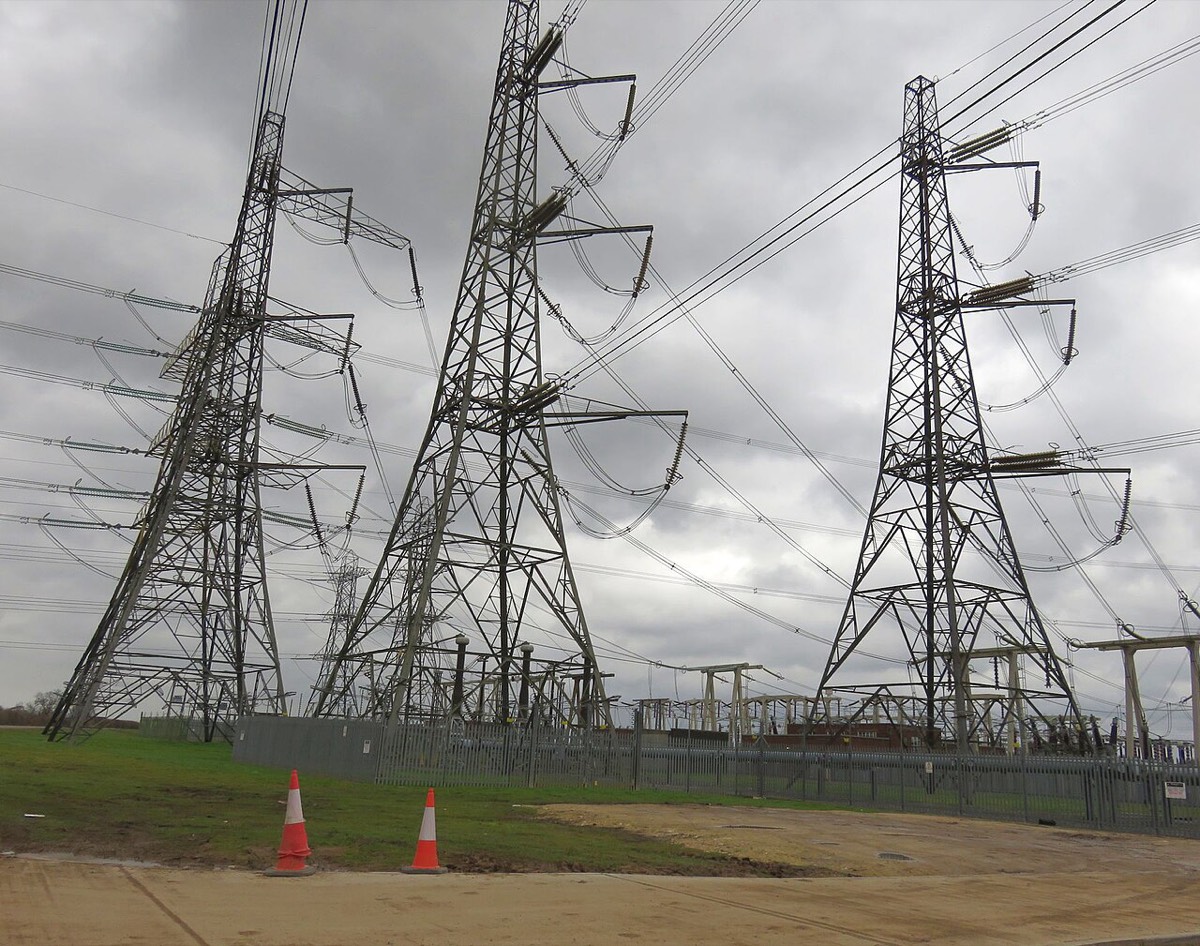
Three tall steel pylons carrying cables into a fenced substation
Pylons carry the cables at a high p.d., far above the ground. These stand at a National Grid substation in Monk Fryston. Photo: Gerald England, CC BY-SA 2.0
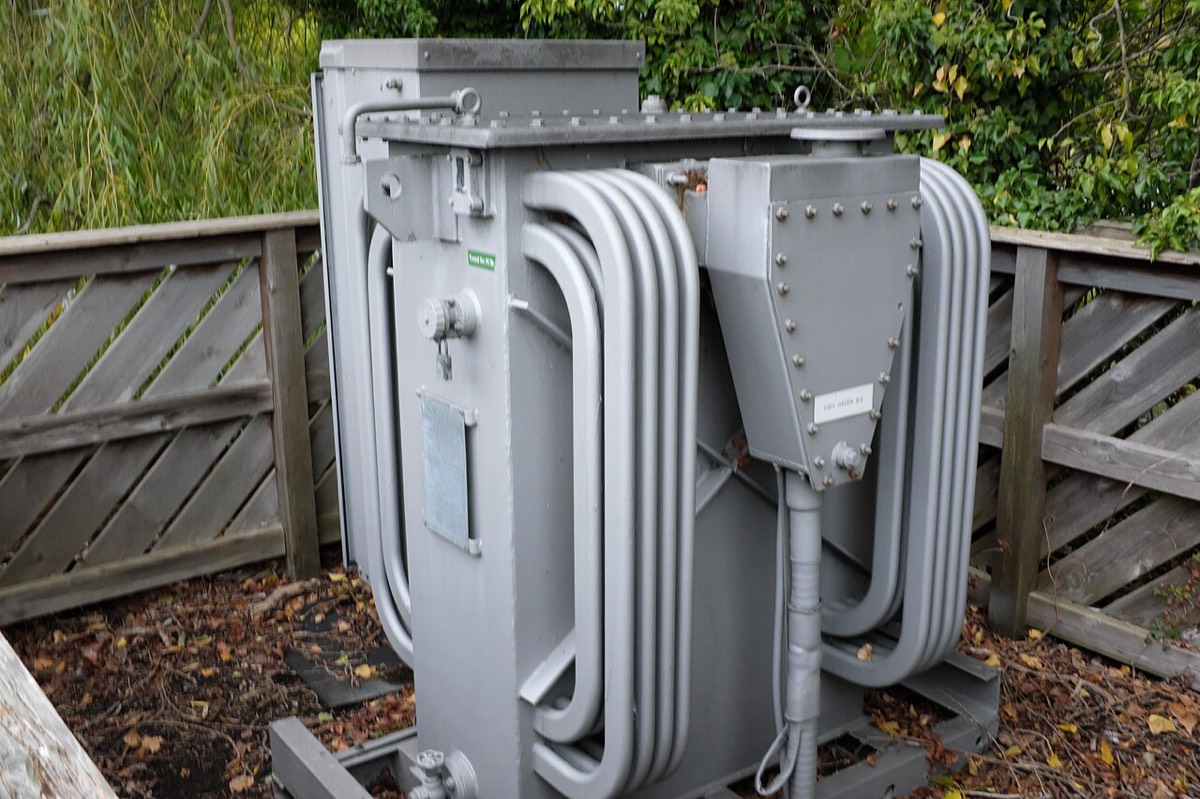
A grey metal transformer with curved cooling pipes inside a wooden fence
Transformers change the p.d.: stepped up for the cables, stepped down for homes. This one is at a local substation. Photo: Bob Harvey, CC BY-SA 2.0
Mission 7: Power & the Grid

07 Power in = power out

Transformer equation

\(V_{\mathrm{p}}\,I_{\mathrm{p}} = V_{\mathrm{s}}\,I_{\mathrm{s}}\)power in = power out\(\mathrm{p}\) = primary (input), \(\mathrm{s}\) = secondary (output)Assumes 100% efficient
Example25 kV, 1200 A in, 400 kV out. \(I_{\mathrm{s}}\)?
Rearrange
\(I_{\mathrm{s}} = V_{\mathrm{p}}\,I_{\mathrm{p}} \div V_{\mathrm{s}}\)
Substitute
\(25\,000 \times 1200 \div 400\,000\)
Answer
\(I_{\mathrm{s}} = 75\) A
p.d. stepped up \(\times 16\) → current stepped down \(\times 16\)
Mission 7: Power & the Grid

07 Checkpoint

Quick check

112 V headlamp, 5.0 A. Power?

\(P = 12 \times 5.0 = 60\) W

23.0 A through 20 Ω. Power?

\(P = 3.0^2 \times 20 = 180\) W

39.0 kW shower for 8.0 min. Energy?

\(9000 \times 480 = 4\,320\,000\) J

4Current doubles, same R. Power?

4 times bigger

5Why transmit at high p.d.?

Small current, less heating, more efficient

6Job of a step-down transformer?

Lowers the p.d. to a safer value for homes
PRESS → TO REVEAL EACH ANSWER

08 Mission 8: Stay safe at 230 V

Mains & safety

ac vs dc230 V, 50 Hzlive, neutral, earth

AQA spec: Physics 4.2.3Combined Science 6.2.3

KEY RULE

Switched off ≠ safe

Mission 8: Mains & safety

08 Two kinds of supply

dc vs ac

  • dc: one direction only (cells, batteries)
  • ac: keeps reversing direction
  • UK mains is ac
p.d.about 230 V
Frequency50 Hz
50 Hz = 50 complete cycles every second
Mission 8: Mains & safety

08 Three-core cable

Three wires, three jobs

WireColourJob
LiveBrownCarries the alternating p.d.
NeutralBlueCompletes the circuit, \(\approx 0\) V
EarthGreen + yellowSafety wire at 0 V; current only in a fault
Mission 8: Mains & safety

08 Find the three wires

Inside a UK plug

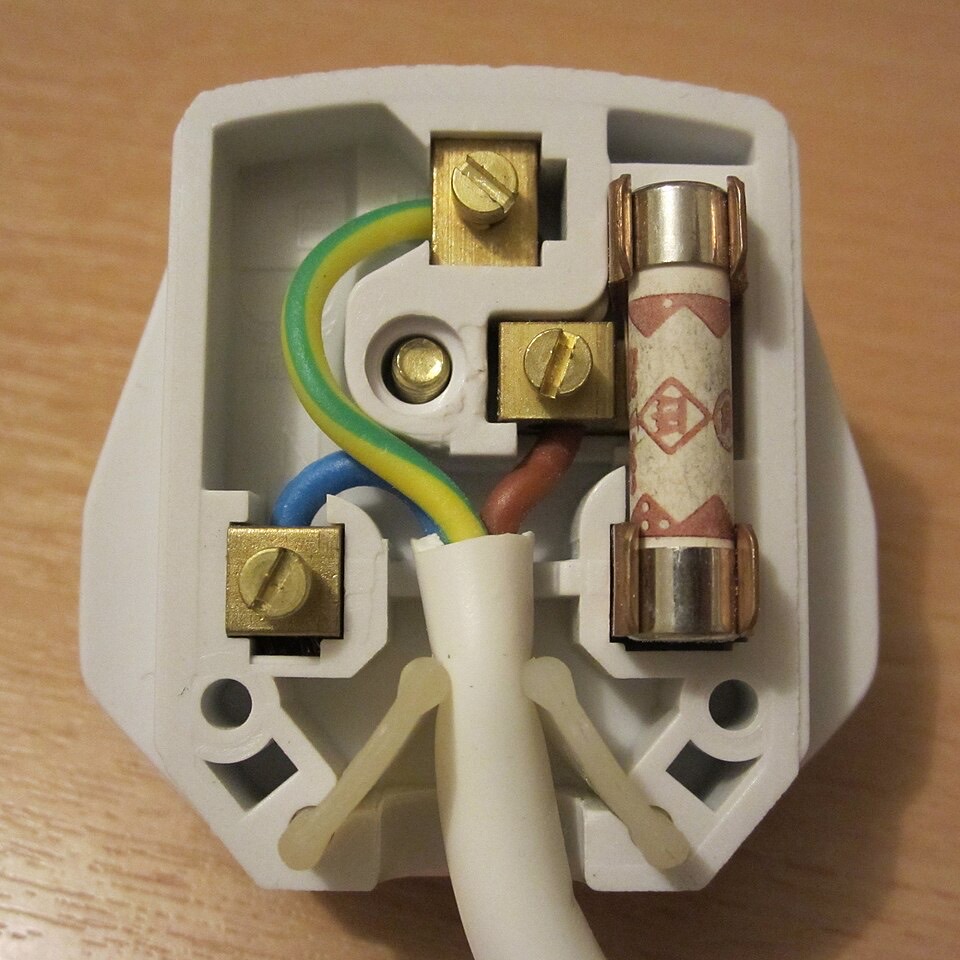
An open UK three-pin plug: a green and yellow wire runs to the top pin, a blue wire to the bottom left pin and a brown wire to a fuse on the right
Photo: Alby Reid, public domain
  • EarthGreen + yellow, to the top pin
  • NeutralBlue, to the bottom left pin
  • LiveBrown, to the fuse, then the bottom right pin
The same three wires run through the cable to the appliance.
Mission 8: Mains & safety

08 Staying safe

Why live is dangerous

  • Body at 0 V, live at 230 V
  • Touch live → current through you: shock
  • Still live with the switch off
  • Live–earth link → huge current, fire risk
  • Metal case is earthed: fault current → earth

“The earth wire is at 230 V.”

Earth is at 0 V.

Mission 8: Mains & safety

08 Checkpoint

Quick check

1UK mains supply?

ac, about 230 V, 50 Hz

2What colour is the live wire?

Brown

3p.d. between live and earth?

About 230 V

4Which wire carries current only in a fault?

Earth (green and yellow)

5Switch off. Is the live wire safe?

No, it is still at about 230 V

6Does neutral carry current normally?

Yes, it completes the circuit
PRESS → TO REVEAL EACH ANSWER

Learn to use these

Equation toolkit

\(Q = I\,t\)\(\text{charge} = \text{current} \times \text{time}\)\(Q\) in C, \(I\) in A, \(t\) in sOn the sheet
\(E = Q\,V\)\(\text{energy} = \text{charge} \times \text{p.d.}\)\(E\) in J, \(Q\) in C, \(V\) in VOn the sheet
\(V = I\,R\)\(\text{p.d.} = \text{current} \times \text{resistance}\)\(V\) in V, \(I\) in A, \(R\) in ΩOn the sheet
\(R_{\text{total}} = R_1 + R_2\)series resistanceall in Ω, series onlyLearn it
\(P = V\,I\)\(\text{power} = \text{p.d.} \times \text{current}\)\(P\) in W, \(V\) in V, \(I\) in AOn the sheet
\(P = I^2\,R\)\(\text{power} = \text{current}^2 \times \text{resistance}\)\(P\) in W, \(I\) in A, \(R\) in ΩOn the sheet
\(E = P\,t\)\(\text{energy} = \text{power} \times \text{time}\)\(E\) in J, \(P\) in W, \(t\) in sOn the sheet
\(V_{\mathrm{p}}\,I_{\mathrm{p}} = V_{\mathrm{s}}\,I_{\mathrm{s}}\)transformer: power in = power out\(\mathrm{p}\) = primary, \(\mathrm{s}\) = secondaryOn the sheet
Electric circuits

Summary

Key words

CurrentRate of flow of charge (A)
Potential differenceEnergy per coulomb (V)
ResistanceOpposes current; \(R = V \div I\) (Ω)
Ohmic conductor\(I \propto V\) at constant temperature
SeriesOne loop, same current
ParallelBranches, same p.d.
DiodeCurrent one way only
ThermistorHotter → lower resistance
LDRBrighter → lower resistance
PowerEnergy transferred per second (W)
Alternating currentKeeps reversing direction
Earth wireSafety wire at 0 V; fault current only
Electric circuits

09 Mission 9: Charge that stays put

Static electricity

charging by rubbingattract and repelelectric fields, sparks

AQA spec: Physics 4.2.5Not in Combined Science

KEY RULE

Like charges repel, unlike attract

Mission 9: Static electricity

09 Rub two insulators

Charging by rubbing

  • Friction moves electrons from one material to the other
  • Gains electrons → negative
  • Loses electrons → equally positive
  • Works for insulators: the charge cannot flow away

“Positive charges move onto the cloth.”

Only electrons move.

Mission 9: Static electricity

09 Forces between charges

Attract or repel

  • Like charges repel
  • Unlike charges attract
  • A non-contact force
  • Closer together → bigger force
Charged balloon on a wall, hair standing on end, dust on a screen
Mission 9: Static electricity
The Electric GazetteMission 9 · the story
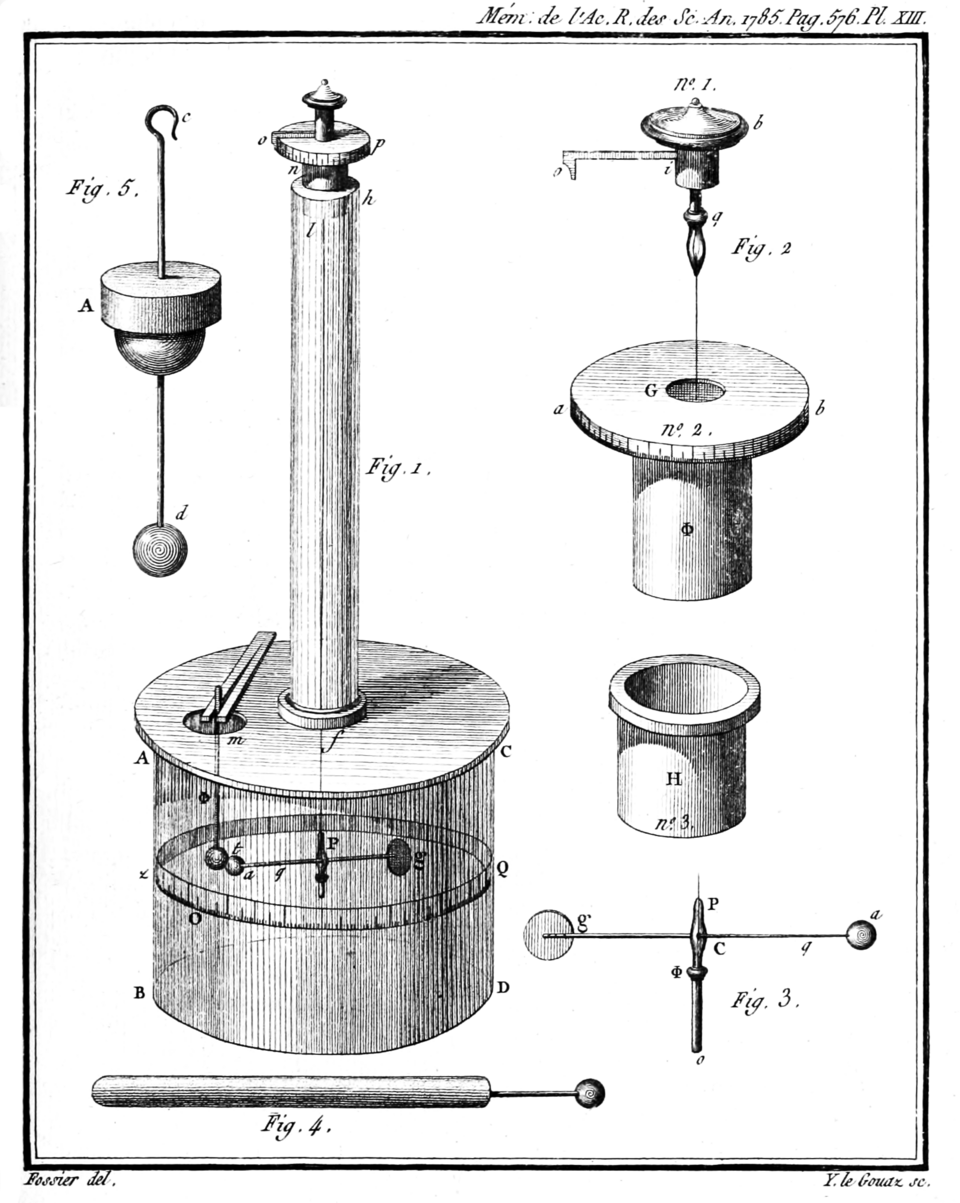
Engraved plate from 1785 showing a tall glass cylinder with a thin vertical tube on top. Inside, a light horizontal rod with a small ball at one end hangs from a fine thread, near a second fixed ball
Charles-Augustin de Coulomb’s torsion balance, from his 1785 report. Engraving: Charles-Augustin de Coulomb, 1785, public domain

Measured at last

Weighing a push you cannot see

Coulomb hung a light rod from a very thin thread, with a charged ball on one end. A second charged ball pushed it away and twisted the thread. The bigger the force, the bigger the twist.

Talk about itWhy did Coulomb need such a thin thread?

Mission 9: Static electricity

09 The space around a charge

Electric fields

  • A charged object has an electric field around it
  • Another charge in the field feels a force
  • Field is strongest close to the object
  • Lines show the force on a positive charge
Mission 9: Static electricity

09 When the charge escapes

Why sparks jump

  • Charge builds up on an insulated object
  • The p.d. to earth and the field grow
  • Strong enough to ionise the air
  • Air conducts: electrons jump as a spark
Lightning and car-door shocks are sparks. Aircraft are earthed before refuelling
Mission 9: Static electricity

09 Checkpoint

Quick check

1A rod rubbed with a cloth turns negative. What moved?

Electrons, from the cloth to the rod

2What charge does the cloth now have?

Positive, equal in size

3Two negative balloons: attract or repel?

Repel

4Where is the field around a charged sphere strongest?

Closest to the sphere

5Field lines near a negative sphere point…?

Inwards, towards the sphere

6Why does a spark jump?

Field strong enough to ionise the air
PRESS → TO REVEAL EACH ANSWER