Year 11 · AQA GCSE Physics & Combined Science
Tiny atom.!
Inside the atom, changing modelsTriple only
© 2026 PanPhy Labs. All rights reserved.
AQA Physics 8463: 4.4 · Combined Science 8464: 6.4
Four big questions.
Part 01
What is inside an atom?
Particles, size, isotopes, ions
Physics 4.4.1.1, 4.4.1.2 Combined 6.4.1.1, 6.4.1.2
Part 02
How do we know?
Plum pudding → nuclear → Bohr
Physics 4.4.1.1, 4.4.1.3 Combined 6.4.1.1, 6.4.1.3
Part 03
What do unstable nuclei do?
Alpha, beta, gamma, half-life
Physics 4.4.2 Combined 6.4.2
Part 04 Triple only
How do we use the nucleus?
Hazards, medicine, fission, fusion
Physics 4.4.3, 4.4.4 Not in Combined
Part 01
Inside the atom.
Protons, neutrons, electrons
AQA spec: Physics 4.4.1.1, 4.4.1.2 Combined Science 6.4.1.1, 6.4.1.2
Inside the atom
Three particles.
Particle Relative charge Relative mass Where?
+1 1 Nucleus 0 1 Nucleus −1 Very small Energy levels around the nucleus
Atom = neutral. Number of electrons = number of protons.
Why “relative”?
The real charges and masses are awkwardly tiny, so everything is compared with a proton, which counts as mass 1 and charge +1.
Why does only the nucleus count for mass?
An electron has about 1/2000 of the mass of a proton. Even all the electrons in a large atom add almost nothing. That is why the mass number counts protons and neutrons and ignores electrons.
Writing the electron’s mass as 0. It is very small, not zero.
Inside the atom
Mostly empty space.
Atom radius \(\approx\) \(1 \times 10^{-10}\) m
Nucleus radius \(< \dfrac{1}{10\,000}\) of the atom’s
Almost all the mass is in the nucleus
Electrons at different distances: energy levels
How empty is “mostly empty”?
Scale an atom up to a football stadium and the nucleus is a pea on the centre spot.
Using the numbers
One ten-thousandth of \(1 \times 10^{-10}\) m is \(1 \times 10^{-14}\) m . Dividing by \(10\,000\) lowers the power of ten by 4, from \(-10\) to \(-14\).
Why can you not push your hand through a table? The electrons on the outside of your atoms repel the electrons on the outside of the table’s.
Inside the atom
Reading the symbol.
Atomic number = number of protonsMass number = protons + neutronsNeutrons = mass no. − atomic no.
Protons decide the element
Try: \({}^{23}_{11}\mathrm{Na}\) → 11 p, 12 n, 11 e
Work through another one
Chlorine with 35 on top and 17 below. Protons: 17. Neutrons: \(35 - 17 = 18\). Electrons in a neutral atom: 17.
Why do the protons decide the element?
The number of protons sets how many electrons the neutral atom holds, and that sets how it behaves chemically. Change the protons and it is a different element. Change the neutrons and it is the same element with a different mass.
Inside the atom
Isotopes.
Same element: same protons
Different numbers of neutronsSo different mass numbers
Some are unstable : carbon-14
ISOTOPES OF CARBON NOT TO SCALE
Why are they the same element?
All three have 6 protons and 6 electrons, so they react in exactly the same way. Only the mass of the nucleus differs.
Why are some unstable?
A nucleus needs a suitable balance of protons and neutrons. Carbon-14 has too many neutrons for its 6 protons, so sooner or later it decays.
Living things stop taking in carbon-14 when they die. Measuring how much is left tells archaeologists how old a bone is.
Inside the atom
Atoms and ions.
Atom: electrons = protons
So no overall charge
Lose outer electron(s) → positive ion
The nucleus does not change
Why is it electrons that move, and never protons?
The outer electrons are far from the nucleus and weakly held. Protons are locked inside the nucleus. So an atom can only become charged by losing or gaining electrons.
Losing an electron gives a positive ion
Lithium has 3 protons and 3 electrons: +3 and −3 make zero. Take one electron away: +3 and −2 make +1. The atom has not gained anything positive. It has lost something negative.
Gaining an electron gives a negative ion
Fluorine has 9 protons and 9 electrons. Add one electron: +9 and −10 make −1.
Mixing up ions and isotopes. An ion has a different number of electrons . An isotope has a different number of neutrons .
Part 02
How the model changed.
New evidence → new model
AQA spec: Physics 4.4.1.1, 4.4.1.3 Combined Science 6.4.1.1, 6.4.1.3
Changing models
A model that kept changing.
Before 1897 Solid spheres Tiny spheres that cannot be divided
1904 Plum pudding After the electron was discovered
1911 Nuclear model From alpha scattering
1913 Bohr model Electrons in energy levels
The same thing happens at every step
A model explains the evidence of its day. An experiment gives a result it cannot explain. A new model is built that explains both the old evidence and the new.
Each model keeps what still works
The nuclear model kept the electrons and moved the positive charge to the centre. Bohr kept the nucleus and organised the electrons. The earlier scientists were not foolish; each model was the best explanation of what was then known.
The story · Cambridge, 1897
Background story · the exam tests the models, not these details
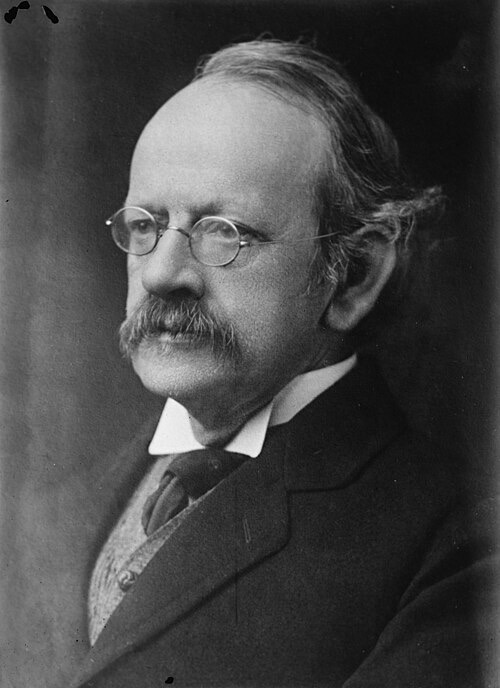
Thomson finds the electron.
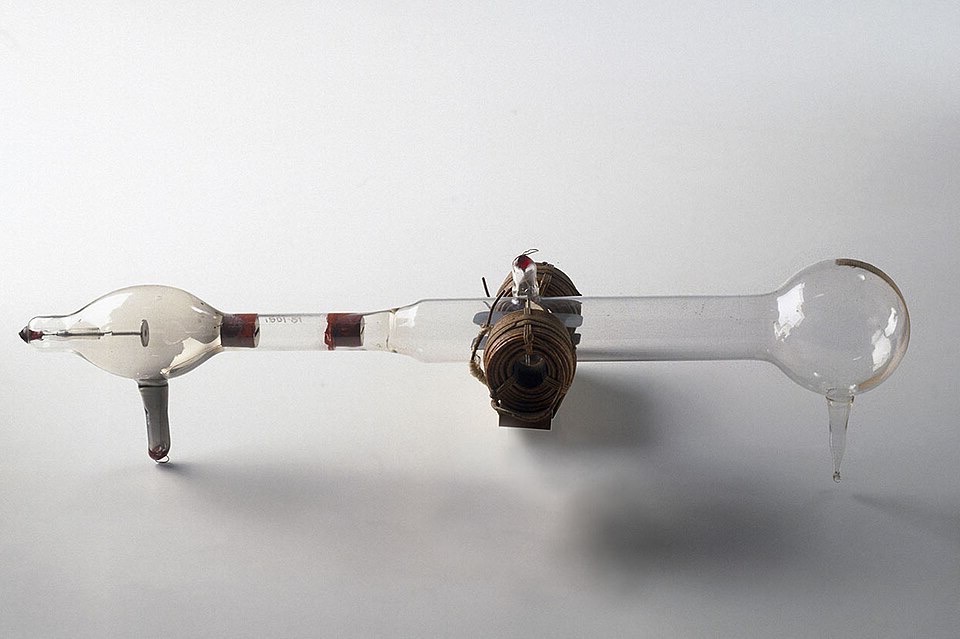
J. J. Thomson The cathode ray tube he used in 1897, now in the Science Museum, London (photo mirrored)
Glowing rays crossed the tube. Nobody knew what they were
Magnets and electric fields bent the rays: they were negative particles
Every metal he tried gave the same particles
So they must be inside every atom : the electron
Atoms can be divided . The solid sphere model had to go.
Portrait: Bain News Service, Library of Congress , public domain. Tube: Science Museum London , CC BY-SA 2.0 .
Thomson (1904)
The plum pudding model.
Electron discovered → atoms can be divided
A ball of positive charge
Negative electrons embedded in itNo nucleus
Try it: Atomic Models sim ↗
PLUM PUDDING MODEL NOT TO SCALE
− Electron+ Positive charge (spread)
Why did Thomson suggest this?
He had shown that atoms contain negative electrons. Atoms are neutral, so there had to be positive charge to balance them. Nobody knew where it was, so he took the simplest idea: spread through the whole atom.
What it predicted
With charge and mass spread thinly, nothing is concentrated enough to push a fast particle off course. The next experiment tested exactly that.
The story · Manchester, 1909
Background story · the exam tests the models, not these details
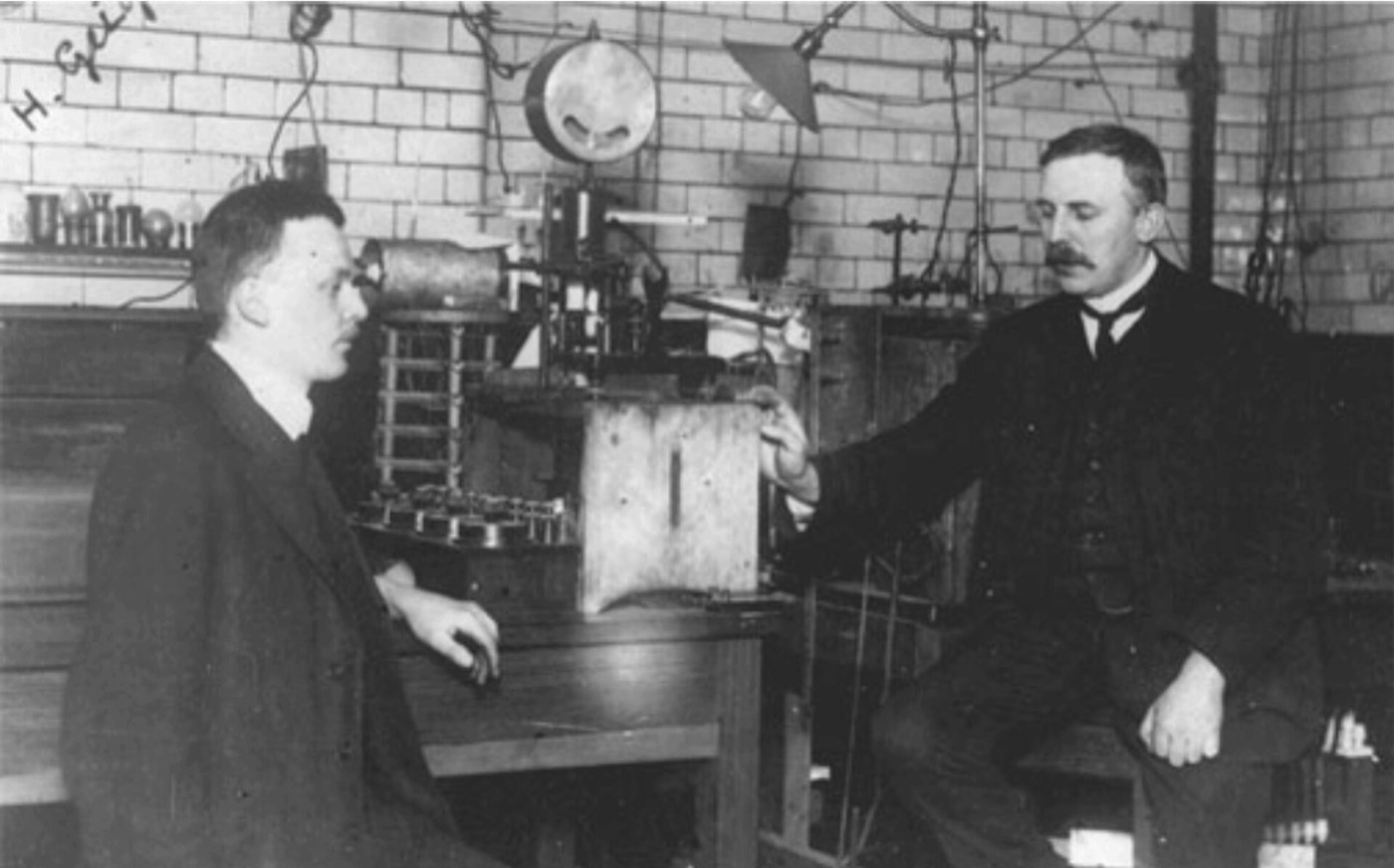
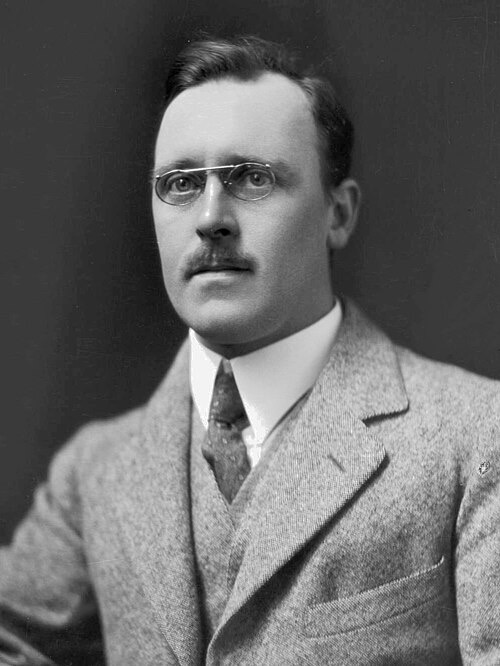
A professor, his assistant and a student.
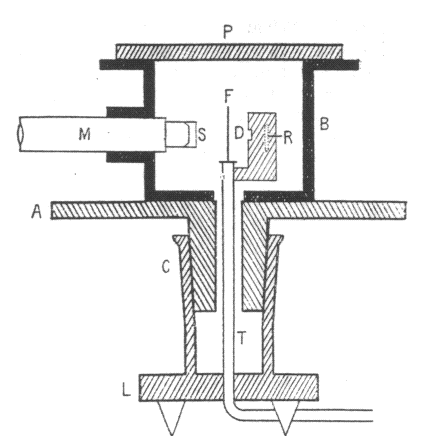
Hans Geiger (left) and Ernest Rutherford in the laboratoryErnest Marsden , pictured in 1921Their apparatus, from the 1913 paper: source R , foil F , screen S , microscope M
Each alpha particle made a tiny flash on a screen. Geiger counted flashes through a microscope, for hours in a darkened lab
Rutherford asked Marsden, a 20-year-old student , to look for alpha particles bouncing back . Nobody expected any
In an early test with a platinum plate, about 1 in 8000 bounced back. The plum pudding model could not explain it
Photos: unknown photographer and S P Andrew Ltd , public domain. Diagram: Geiger and Marsden, 1913 , public domain.
Rutherford, Geiger & Marsden (1909–1911)
The alpha scattering experiment.
Fire alpha particles (+) at thin gold foil
Count them at all angles
Plum pudding predicts: all pass through
Only tiny deflections expected
ALPHA SCATTERING NOT TO SCALE
Why alpha particles?
They are positive, fast and heavy. Positive charge inside the atom would push on them, and how far they were pushed would show how that charge is arranged.
Why gold?
It can be beaten into an extremely thin foil, so an alpha particle is unlikely to be pushed off course more than once.
Why count at every angle, even back towards the source?
Nobody expected anything there. Checking anyway led to the discovery.
Evidence → conclusion
What they saw. What it means.
OBSERVATION CONCLUSION
Most went straight through
→ Atom is mostly empty space
Some were deflected
→ Centre is positively charged
A very few bounced back
→ Mass concentrated in a tiny centre
Why do the few that bounced back tell us the most?
To turn a fast, heavy alpha particle right round takes a large force from something much more massive than it. And because it happened so rarely, that something must be a very small target, seldom hit head-on.
Rutherford said it was as surprising as firing a shell at tissue paper and having it come back and hit you.
Each mark needs an observation joined to its conclusion with “so” or “because”.
Rutherford (1911)
The nuclear model.
A tiny, dense nucleus at the centre
The nucleus is positive
Almost all the mass is in it
Electrons outside the nucleusReplaced the plum pudding model
NUCLEAR MODEL NOT TO SCALE
− Electron+ Nucleus (positive)
Check that the new model explains all three results
Straight through
most alpha particles pass through empty space.
Deflected
one passing near the positive nucleus is repelled.
Bounced back
one heading straight at the nucleus is repelled so strongly that it reverses. The nucleus is tiny, so this is rare.
The plum pudding model could explain only the first.
Compare
Plum pudding vs nuclear.
Positive charge Spread through the atom In a tiny nucleus Mass Spread through the atom Concentrated in the nucleus Empty space? No Mostly empty space Electrons Embedded in the positive ball Outside the nucleus
Each row is tied to a piece of evidence
“Mostly empty space” comes from the alpha particles that went straight through. “Positive charge in a tiny nucleus” from those that were deflected. “Mass concentrated in the nucleus” from the few that bounced back.
To compare, say how the same feature differs in the two models. “Whereas” helps: “the positive charge is spread through the atom, whereas in the nuclear model it is in a tiny nucleus”. If asked for a similarity: both contain electrons and are neutral overall.
The story · Copenhagen, 1913
Background story · the exam tests the models, not these details
Bohr fixes the nuclear model.
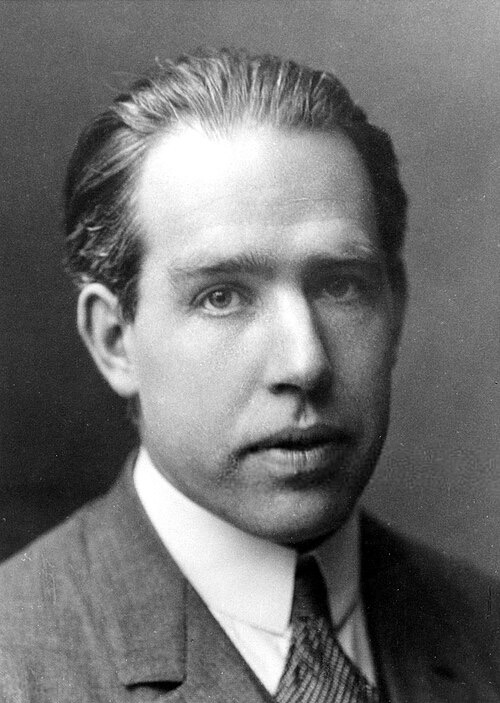
Niels Bohr , pictured about 1922, the year he won the Nobel Prize
1912: Bohr, a 26-year-old from Denmark, works in Rutherford’s laboratory
He sees a problem. An orbiting electron should lose energy and spiral into the nucleus. Atoms would collapse
1913: his answer. Electrons can only orbit at certain distances
The test: his calculations matched the colours of light given out by hydrogen
He kept Rutherford’s nucleus and changed only what the evidence demanded.
Photo: AB Lagrelius & Westphal , public domain.
Bohr (1913)
The Bohr model.
Bohr adapted the nuclear model
Electrons orbit at specific distances
These are energy levels
His calculations agreed with experiments
Carbon: 2 electrons in \(n = 1\), 4 in \(n = 2\)
BOHR MODEL: CARBON-12 NOT TO SCALE
− Electron+ Proton0 Neutron
Bohr’s idea
electrons can only be at certain fixed distances from the nucleus, like the rungs of a ladder. You can stand on a rung, not between rungs.
Why was it accepted?
His calculations agreed with the results of experiments. That is the answer the exam wants: theory and observation matched.
The problem he solved: in the nuclear model, a circling electron should lose energy and spiral into the nucleus. The experiments: hot hydrogen gives out light of a few exact colours, and Bohr’s numbers for those colours matched the measurements.
Bohr (1913)
What Bohr didn’t know.
Bohr’s nucleus: a tiny positive centre
Protons : identified later (1919)Neutrons : discovered in 1932 Evidence from James Chadwick
Our Bohr diagrams add protons and neutrons: a modern version.
CARBON: THEN AND NOW NOT TO SCALE
+ Positive nucleus+ Proton0 Neutron− Electron
Why does this slide matter?
The Bohr diagrams you draw show protons and neutrons. Bohr could not have drawn that: in 1913 the nucleus was just a small positive lump.
How were protons found?
The charge on any nucleus turned out to be a whole number of equal units, which pointed to identical positive particles inside it.
Why did neutrons take until 1932?
They have no charge, so the methods for detecting charged particles missed them.
Energy levels
Electrons can change level.
Absorb EM radiation → move further out Emit EM radiation → move closer in
HYDROGEN ATOM NOT TO SCALE
− Electron+ Proton~ EM radiation
Think of the ladder
Climbing to a higher rung takes energy; stepping down gives it back. An electron that absorbs electromagnetic radiation moves up a level. One that drops down gives out the difference as electromagnetic radiation.
Why does “further out” mean “more energy”?
The electron is attracted to the nucleus, so pulling it away takes energy, like lifting something off the ground.
The colours of fireworks come from electrons dropping back down. Each element has its own levels, so each gives its own colours.
The story · Cambridge, 1932
Background story · the exam tests the models, not these details
Chadwick finds the neutron.
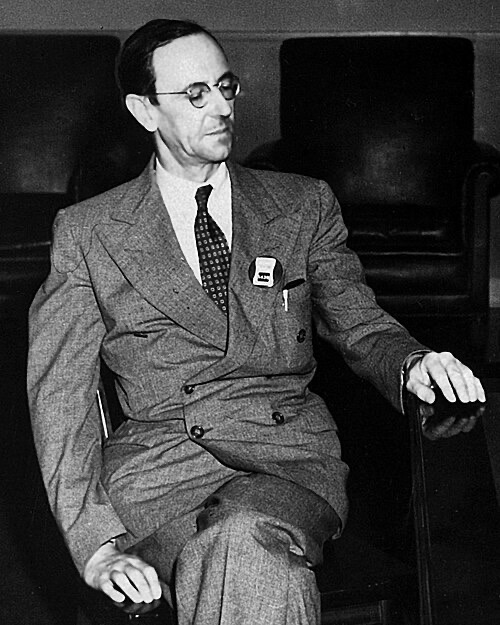
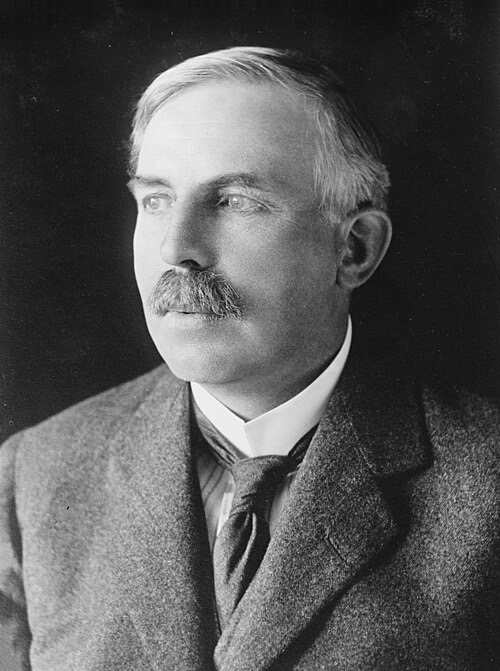
James Chadwick , pictured about 1945Ernest Rutherford , his teacher and then his boss
Chadwick was Rutherford’s student in Manchester, then his deputy in Cambridge
The masses did not add up: a helium nucleus has the charge of 2 protons but the mass of 4
They suspected a particle with mass and no charge , and hunted it for years
1932: Chadwick found the evidence. 1935: Nobel Prize
Photos: Los Alamos National Laboratory (reuse terms ); Bain Collection, Library of Congress , public domain.
Filling in the nucleus
Protons, then neutrons.
Later experiments: positive charge is in small particles: protons
Each proton: the same positive charge
James Chadwick (1932): evidence for neutrons About 20 years after the nucleus was accepted
CARBON-12 NUCLEUS NOT TO SCALE
+ Proton0 Neutron
Why did anyone suspect another particle?
The masses did not add up. A helium nucleus has the charge of 2 protons but the mass of 4. Something with mass and no charge had to be in there.
What the neutron explains
Mass number, and isotopes: atoms of one element can have different masses because they have different numbers of neutrons.
Working scientifically
Why models change.
A model must explain the evidence
It makes predictions we can test
New evidence can change or replace it
Results are published and peer reviewed
The atom is the standard example
The plum pudding model predicted that alpha particles would pass almost straight through gold foil. Some bounced back. The model could not explain that, so it was replaced by one that could.
Is the current model “proved”?
No model is. It is accepted because it explains all the evidence so far, and stays accepted until evidence turns up that it cannot explain.
Quick check
Atoms and models.
01 What is in the nucleus?
Protons and neutrons
02 How many neutrons in \({}^{37}_{17}\mathrm{Cl}\) ?
\(37 - 17 = 20\)
03 Why did most alpha particles pass straight through?
The atom is mostly empty space
04 Why did a very few bounce back?
Tiny, dense, positive nucleus
05 An electron absorbs EM radiation. What happens?
Moves to a higher energy level (further out)
06 Who gave evidence for the neutron?
James Chadwick
Part 03
Nuclear radiation.
Alpha, beta, gamma, half-life
AQA spec: Physics 4.4.2 Combined Science 6.4.2
Unstable nuclei
Radioactive decay.
Unstable nuclei give out radiation
They become more stable
Decay is random
Activity : decays per second, in becquerel (Bq) Count rate : decays a detector records per second
DECAY AND DETECTION NOT TO SCALE
α Alphaβ Betaγ Gamman Neutron
What does “random” really mean?
Nothing you do to the sample, heating, cooling or squashing it, makes a particular nucleus decay sooner. Each has the same chance of decaying in the next second as any other of its kind.
Why is count rate less than activity?
Radiation leaves the source in all directions and the detector sits on one side, so most of it misses.
Move the detector further away and the count rate falls. The activity has not changed.
\(\alpha\) : Americium-241
Alpha decay.
2 protons + 2 neutrons Same as a helium nucleus
Mass number − 4
Atomic number − 2 → new element
\({}^{241}_{\phantom{0}95}\mathrm{Am}\) → \({}^{237}_{\phantom{0}93}\mathrm{Np}\) + \({}^{4}_{2}\mathrm{He}\)
TOP: \(241 = 237 + 4\) ✓ , BOTTOM: \(95 = 93 + 2\) ✓
ALPHA DECAY SIMPLIFIED, NOT TO SCALE
+ Proton0 Neutronα Alpha particle
See where the numbers come from
An alpha particle carries away 2 protons and 2 neutrons. Four particles gone, so the mass number falls by 4. Two were protons, so the atomic number falls by 2.
Why do the checks work?
No protons or neutrons are created or destroyed. They are shared between the new nucleus and the alpha particle. So the top numbers on the right add up to the top number on the left, and the bottom numbers do the same.
\(\beta^-\) : Carbon-14
Beta decay.
A neutron → proton + electron
The fast electron leaves the nucleus
Mass number unchanged
Atomic number + 1 → new element
\({}^{14}_{\phantom{0}6}\mathrm{C}\) → \({}^{14}_{\phantom{0}7}\mathrm{N}\) + \({}^{\phantom{0}0}_{-1}\mathrm{e}\)
TOP: \(14 = 14 + 0\) ✓ , BOTTOM: \(6 = 7 + (-1)\) ✓
BETA DECAY NOT TO SCALE
+ Proton0 Neutronβ Beta particle (electron)
Where does the electron come from?
There are no electrons in a nucleus. A neutron changes into a proton, and an electron is created at that moment and thrown out.
Why the −1?
The bottom number tracks charge. A neutron (0) becomes a proton (+1) and an electron (−1), which still add up to 0.
Saying the beta particle is one of the atom’s orbiting electrons. Those are still there afterwards.
\(\gamma\) : Technetium-99m
Gamma emission.
EM radiation from the nucleusThe nucleus loses energy only
Mass number unchanged
Atomic number unchanged
\({}^{99\mathrm{m}}_{\phantom{0}43}\mathrm{Tc}\) → \({}^{99}_{43}\mathrm{Tc}\) + \(\gamma\)
SAME PROTONS, SAME NEUTRONS, LESS ENERGY ✓
GAMMA EMISSION SIMPLIFIED, NOT TO SCALE
+ Proton0 Neutronγ Gamma ray
Compare with electrons
An electron dropping to a lower energy level gives out electromagnetic radiation. A nucleus can do the same kind of thing: settle into a lower-energy arrangement and give out the difference. The energy is far larger, so the radiation is gamma, not light.
When does it happen?
Often straight after an alpha or beta decay, when the new nucleus has energy to spare.
Nuclear equations
What changes?
Emitted Symbol Mass number Atomic number
Alpha \({}^{4}_{2}\mathrm{He}\) \(-4\) \(-2\) Beta \({}^{\phantom{0}0}_{-1}\mathrm{e}\) No change \(+1\) Gamma \(\gamma\) No change No change Neutron \({}^{1}_{0}\mathrm{n}\) \(-1\) No change
Complete: \({}^{226}_{\phantom{0}88}\mathrm{Ra}\) → \({}^{222}_{\phantom{0}86}\mathrm{Rn}\) + ?
Top \(226 - 222 =\) 4 Bottom \(88 - 86 =\) 2 \({}^{4}_{2}\mathrm{He}\) alpha
The two rules are two things that do not change
The top row counts protons plus neutrons, and that total stays the same. The bottom row counts charge, which is conserved.
Finding a missing nucleus
Uranium-238 (atomic number 92) emits an alpha particle: top \(238 - 4 = 234\), bottom \(92 - 2 = 90\). The new nucleus has mass number 234 and atomic number 90. You do not need to name the element.
Making the atomic number go down in beta decay. It goes up: a neutron has become a proton.
Compare
Alpha, beta, gamma.
\(\alpha\) Alpha\(\beta\) Beta\(\gamma\) Gamma
What is it? Helium nucleus Fast electron EM wave Charge +2 −1 0 Ionising Strongly Moderately Weakly Range in air A few cm About 1 m Very far Stopped by Paper or skin A few mm of aluminium Thick lead or concrete (reduced)
You can work the table out from what each one is
Alpha is big with a charge of +2. It pulls electrons off almost every atom it passes, and each ionisation costs it energy, so it runs out within centimetres.
Beta is a tiny, fast electron. It ionises fewer atoms, loses energy more slowly and gets further.
Gamma has no charge or mass. It passes most atoms without affecting them, so it goes a very long way.
Penetration
What stops each one?
PENETRATION TEST NOT TO SCALE
Why does paper stop alpha when lead struggles with gamma?
Stopping radiation means taking its energy away. Alpha gives its energy to every atom it meets, so a thin sheet is enough. Gamma hardly interacts, so it takes a lot of dense material to absorb even some.
Identifying a source
Put absorbers in front of a detector one at a time. Count rate drops with paper: alpha. Only with aluminium: beta. Only with thick lead: gamma.
Uses
Choosing the right source.
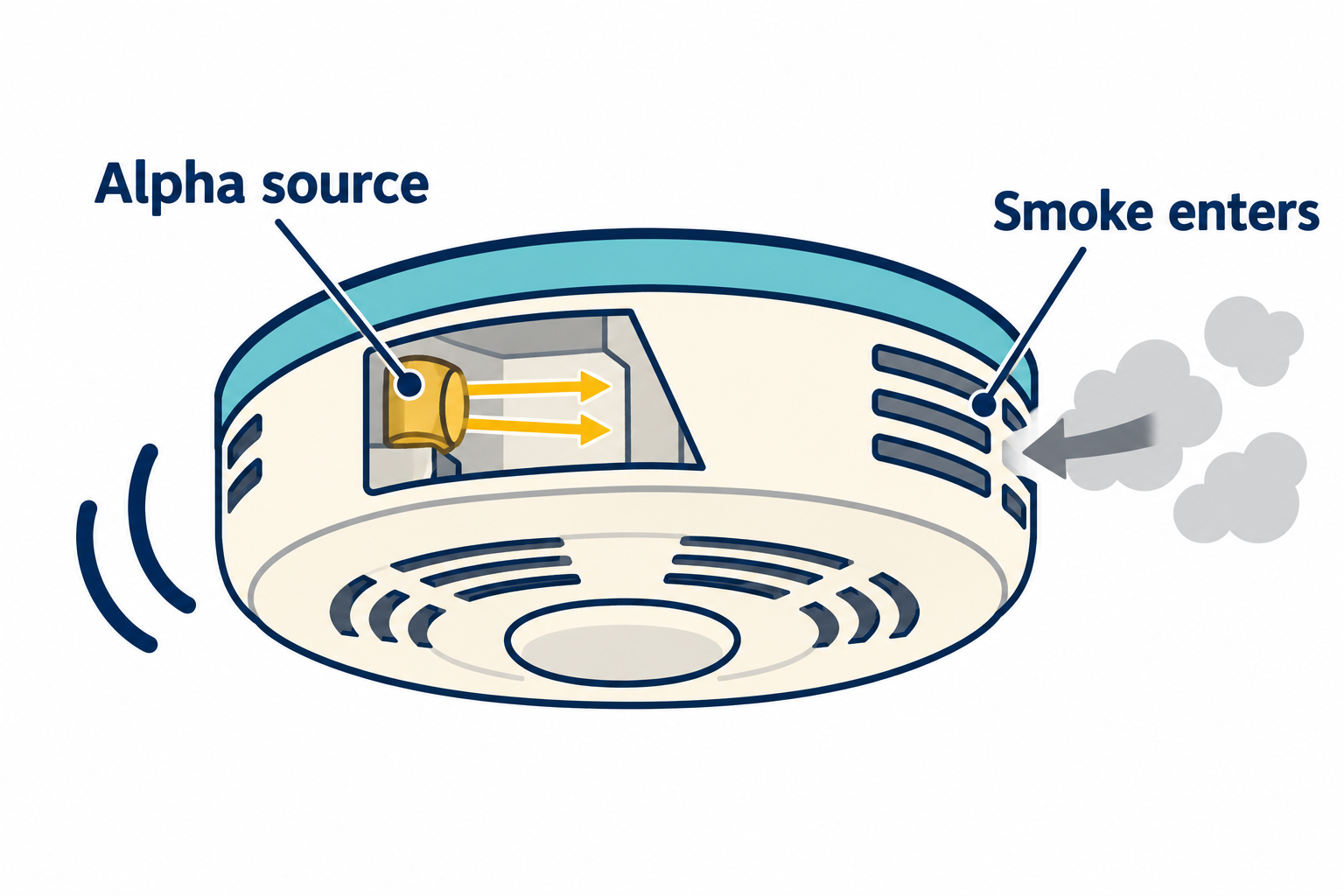
Alpha
Smoke alarm Ionises air; smoke reduces current; long half-life
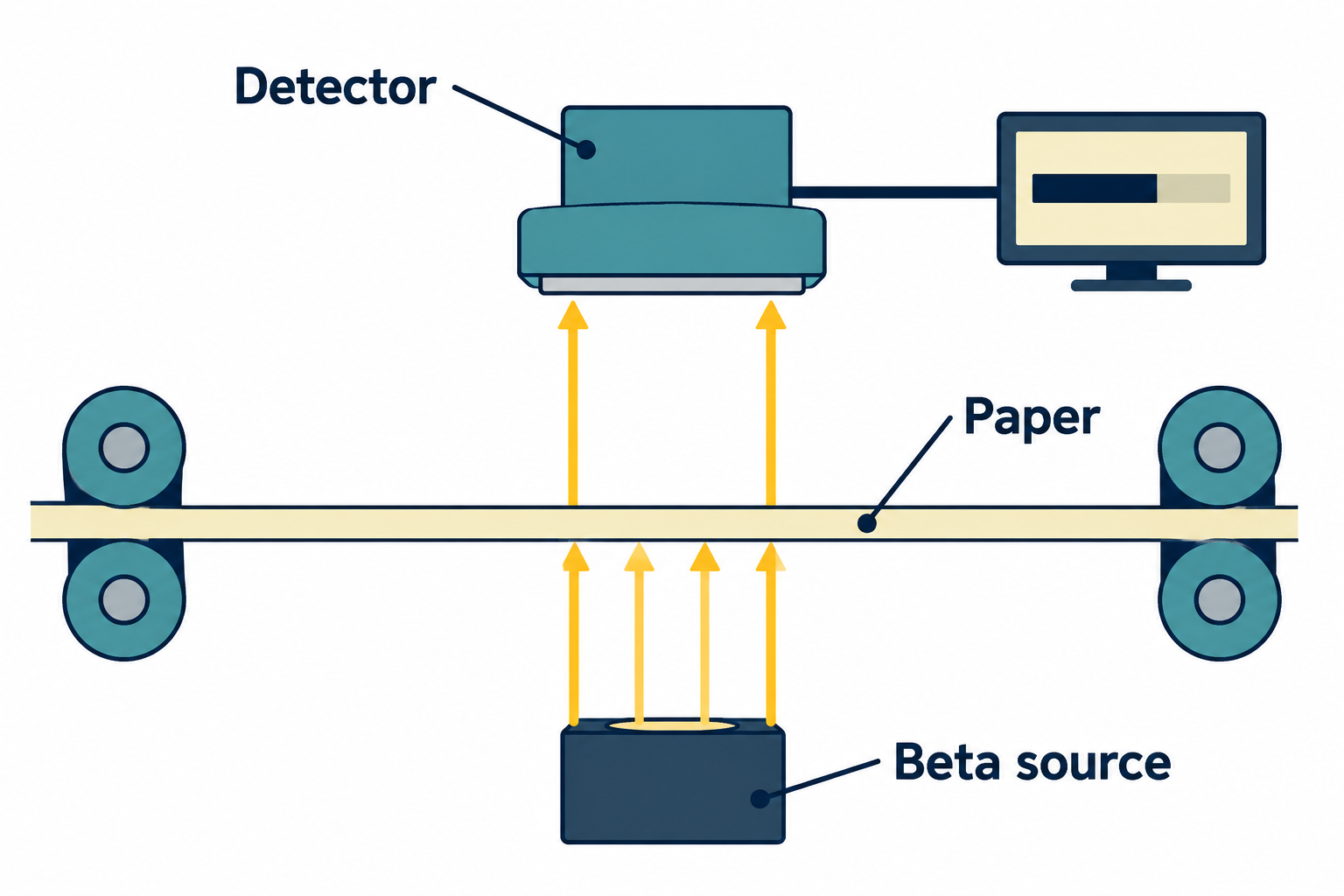
Beta
Thickness gauge Partly absorbed by paper; count rate shows thickness
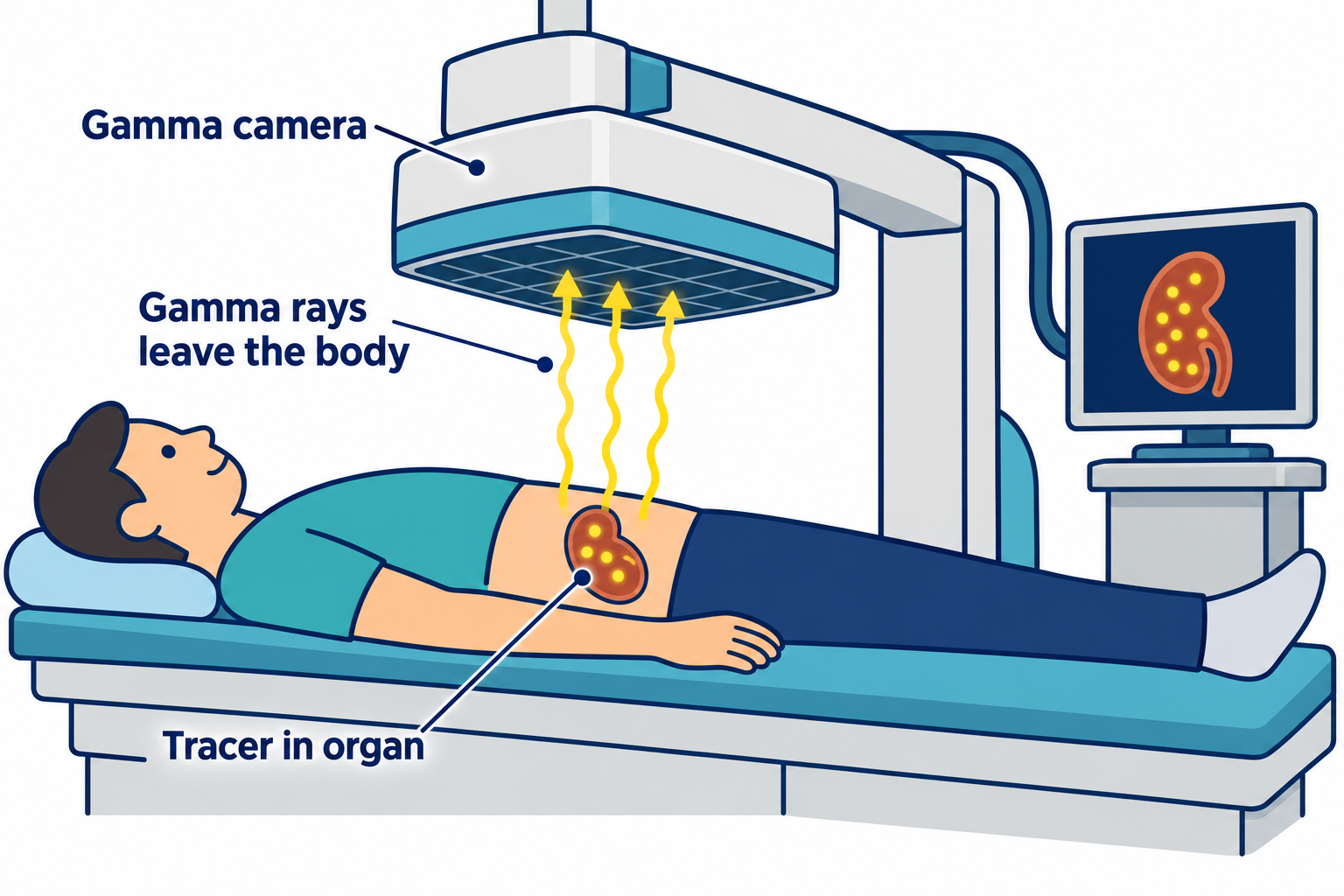
Gamma
Medical tracer Triple only Passes out of the body, weakly ionising, short half-life
Choose by: penetration , ionising power , half-life
Ask why the other two types would fail
Smoke alarm
beta and gamma would pass through smoke as if it were not there, and out through the case into the room.
Thickness gauge
alpha would be stopped by any paper; gamma would pass through almost unchanged, however thick the paper.
Tracer
alpha and beta would be absorbed inside the body, doing damage and never reaching the detector.
Half-life
Half-life.
Time for the number of unstable nuclei to halve
Or: time for the count rate (activity) to halve
Same time for every halving
Iodine-131: half-life \(\approx\) 8 days
Why does it halve, and not fall by the same amount each time?
Every unstable nucleus has the same chance of decaying in the next second. So a fixed fraction of whatever is left decays in a given time, and half always takes the same time to go.
Why not a “full life”?
Halving never reaches zero: a half, a quarter, an eighth. There is no definite moment when the last nucleus goes.
“After two half-lives it has all gone.” A quarter is left.
Half-life
Using half-life.
From a graph
Find the half-life
Read the start value
Halve it
Read across, then down
400 → 200 at 8 days
Count the halvings
\(T_{\frac{1}{2}} = 8\) days
\(24 \div 8 =\) 3 half-lives
400 → 200 → 100 → 50
As a ratio
Net decline
Left after \(n\) half-lives: \(\left(\dfrac{1}{2}\right)^{n}\)
3 half-lives: \(\dfrac{1}{8}\) left
Net decline: ⅞
Every question is the same three numbers
a start value, an end value and a number of half-lives. Given two, find the third.
Working backwards
A count rate falls from 80 to 10 in 6 hours. Count the halvings: 80 → 40 → 20 → 10 is three. Three half-lives take 6 hours, so one takes 2 hours.
Dividing by the number of half-lives. Three half-lives is \(\div 2\) three times, which is \(\div 8\), not \(\div 3\).
Random, but predictable
Random decay.
Can’t predict which nucleus or when
Large samples → predictable half-life
Small samples → counts vary
64 NUCLEI
How can something random be predictable?
Think of dice. You cannot say what one will show. Throw six thousand and close to a thousand will show a six. A sample has far more nuclei than that, so the time for half to decay comes out the same every time.
Why do small samples vary?
Throw six dice and you might get no sixes, or three. A weak source jumps about in the same way, which is why count rates are measured over a longer time.
Staying safe
Contamination vs irradiation.
Irradiation Contamination
Exposed to radiation
Does not become radioactive
Radioactive material on or in it
Keeps emitting until removed or decayed
Gloves and tongs Keep your distance Short exposure Lead-lined storage Dosimeter badge
A way to picture it
Irradiation is like standing in front of a heater. Walk away and it stops, and you have not become a heater. Contamination is like glitter on your clothes. You carry it with you until it is cleaned off.
Why each precaution works
Gloves and tongs keep radioactive material off your skin: they prevent contamination. Distance, a short exposure and lead-lined storage cut the radiation that reaches you: they reduce irradiation.
The story · Paris, from 1898
Background story · the exam tests the models, not these details
Still radioactive after a century.
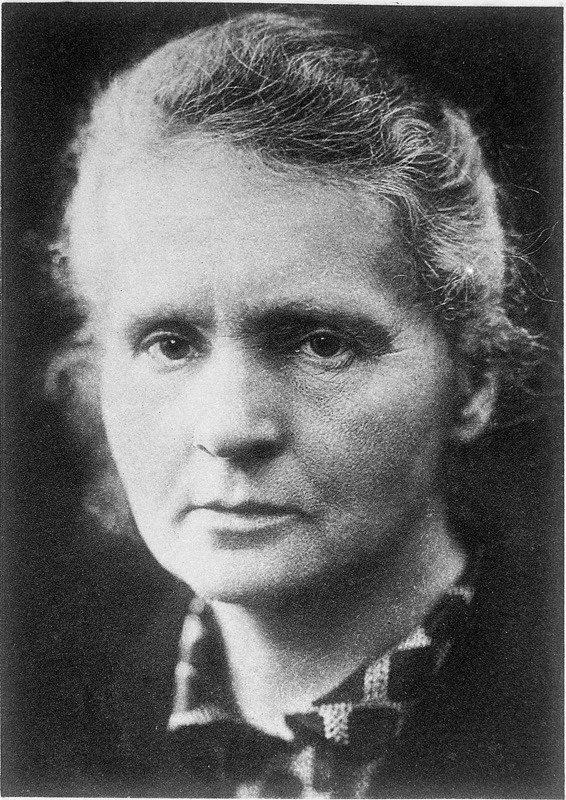
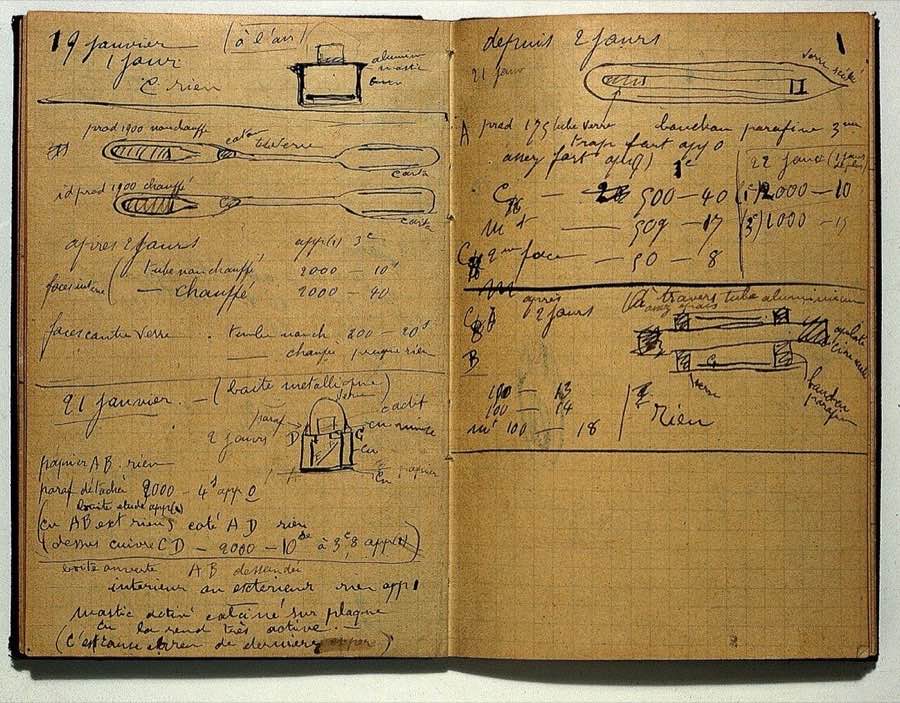
Marie Curie , pictured about 1920One of her laboratory notebooks , now in London. Tests found radium on it
She and her husband Pierre discovered polonium and radium
Nobody knew the danger. She kept tubes of radioactive material in her pocket
Radioactive atoms got onto her things. Her notebooks are still contaminated
Her papers in Paris need special protection , and readers follow strict safety rules
Radium-226 has a half-life of about 1600 years : they will stay radioactive for well over 1000 more.
Portrait: Henri Manuel, Wellcome Collection , CC BY 4.0 (cropped). Notebook: Wellcome Collection , CC BY 4.0 .
Quick check
Nuclear radiation.
01 Complete: \({}^{210}_{\phantom{0}84}\mathrm{Po}\) → \({}^{206}_{\phantom{0}82}\mathrm{Pb}\) + ?
\({}^{4}_{2}\mathrm{He}\) (alpha)
02 Beta decay: change in atomic number?
+1: a neutron becomes a proton
03 Which radiation is most ionising?
Alpha
04 What stops beta radiation?
A few mm of aluminium
05 Half-life 6 hours. Fraction left after 18 hours?
3 half-lives → \(\dfrac{1}{8}\)
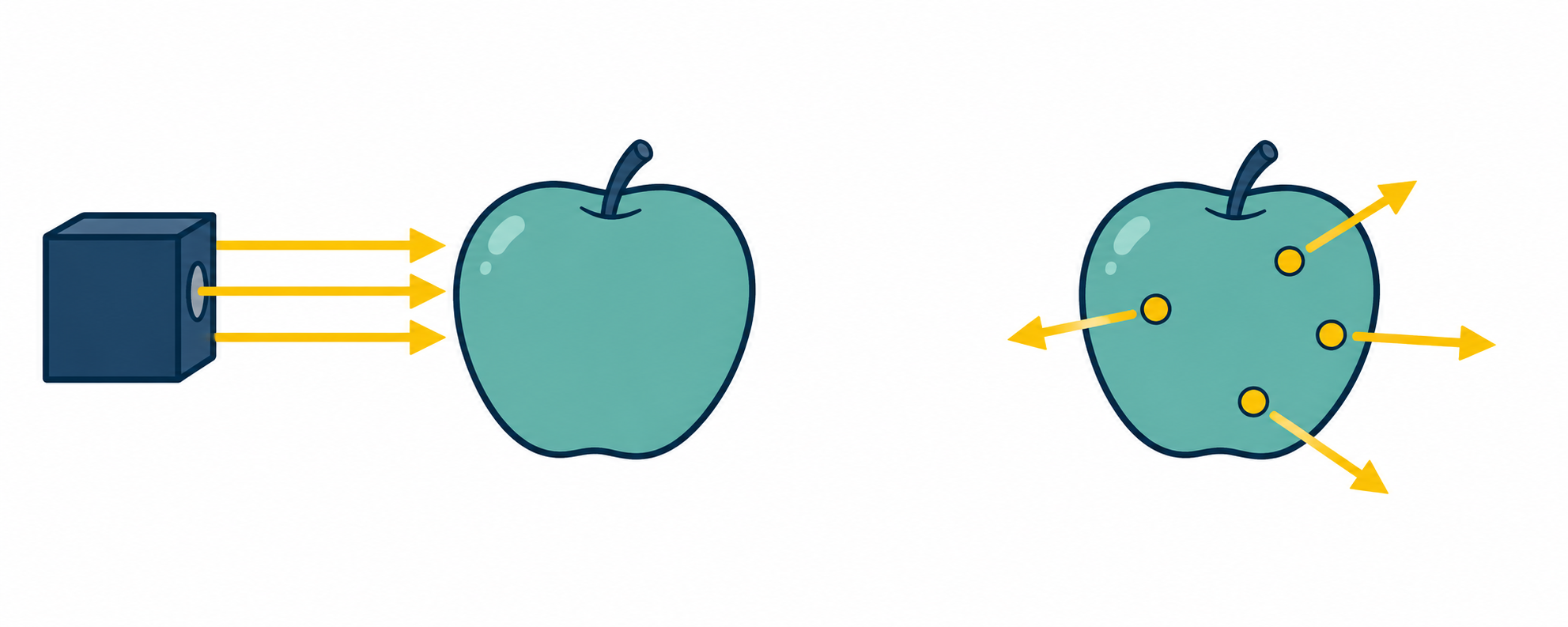
06 Does irradiated food become radioactive?
No: its nuclei do not become unstable
Summary
Key words.
Nucleus Protons + neutrons Tiny Most of the mass
Isotopes Same protons Different neutrons
Ion Atom that has lost or gained electrons Positive or negative charge
Energy level Fixed distance for electrons
Alpha Helium nucleus A − 4 Z − 2
Beta Fast electron Same A Z + 1
Gamma EM radiation No change to A or Z
Activity Decays per second Becquerel (Bq)
Half-life Time for nuclei or count rate to halve
Random Can’t predict which nucleus Or when it decays
Irradiation Exposed to radiation Does not become radioactive
Contamination Radioactive atoms on or in an object
Part 04
Using the nucleus.
Background radiation, hazards, medicine
AQA spec: Physics 4.4.3, 4.4.4 Not in Combined Science
Hazards
Background radiation.
Always around us
Natural: rocks , cosmic rays
Subtract from count ratesMan-made: tests , accidents
Corrected = measured − background
WHERE IT COMES FROM NOT TO SCALE
Why do rocks give off radiation?
Rocks such as granite contain traces of uranium. As it decays, one of the atoms it produces is radon, a radioactive gas. Radon seeps out of the ground and can build up indoors, where people breathe it in. It is the largest single part of the UK’s background radiation.
Why correct a count rate?
A detector cannot tell which counts came from your source. Measure the count rate with the source taken away and subtract it from every reading. Otherwise a source that has almost gone looks as if it never quite reaches zero.
Medical X-rays and scans add to the dose people receive, but for most people they are a smaller part than natural sources.
Hazards
Same world, different dose.
Who Higher dose, because…
Someone living on granite More radon from the rocks Aircrew More cosmic rays at high altitude Radiographers, nuclear workers They work near radioactive sources
Radiation dose measures the risk of harm. It is in sieverts (Sv) : \(1\ \text{Sv} = 1000\ \text{mSv}\)
Why a dose and not just a count rate?
Harm depends on how much energy the body absorbs and on the type of radiation. The same energy from alpha inside the body does far more damage than from gamma. The sievert takes both into account, so doses from different sources can be added and compared.
Why do aircrew get more?
The atmosphere absorbs most cosmic rays. At 10 km up there is much less air above you to stop them.
Hazards
Half-life changes the hazard.
Half-lives range from fractions of a second to billions of years
For the same number of nuclei:
Short : very active, but the activity falls quicklyLong : less active, but a hazard for a very long time
Nuclear waste must be stored safely for thousands of years
Why is a short half-life very active?
If the nuclei decay in hours rather than years, the same number of nuclei must give out their radiation in a much shorter time. More decays every second means a higher activity, so it is more dangerous to be near at first.
Why is a long half-life still a problem?
Plutonium-239 has a half-life of about 24 000 years. Ten half-lives, the time for its activity to fall to about a thousandth, is about 240 000 years. Its waste has to stay sealed away from water and people for all of that time.
“A long half-life is safer.” Lower activity, yes, but for far longer.
Uses
Radiation in medicine.
Exploring internal organs
Tracer Gamma emitter swallowed or injected; a camera outside detects it. Short half-life
Destroying unwanted tissue
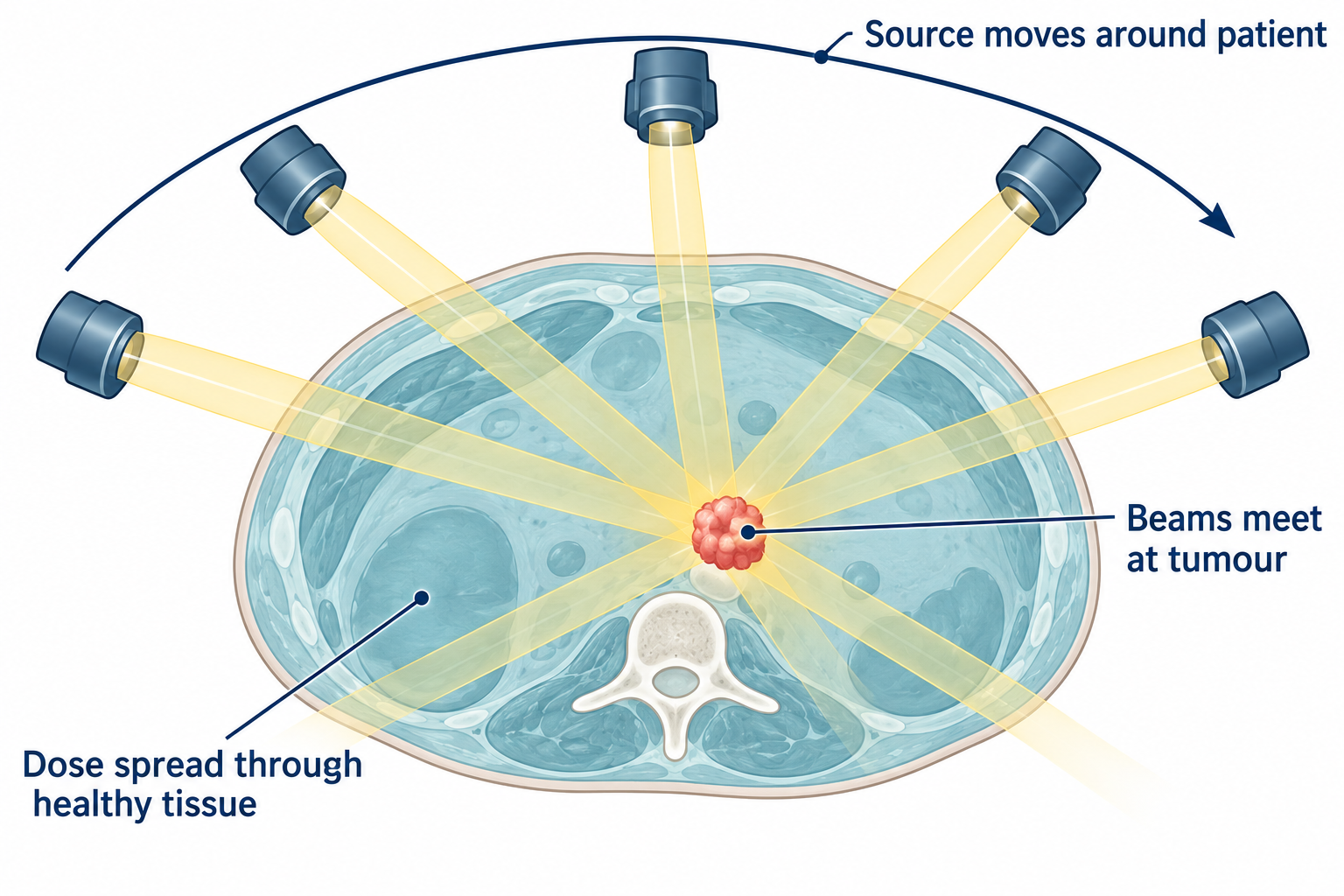
Radiotherapy Gamma beams from several directions cross at the tumour and kill its cells
Benefit must outweigh the risk of harm to healthy cells
Why a short half-life for a tracer?
It must stay active long enough to take the images, a few hours, then die away so the patient is not irradiated for days. Technetium-99m, with a half-life of 6 hours, is the usual choice.
Why several beams in radiotherapy?
Each beam alone is weak enough to do little harm to the tissue it passes through. Only at the tumour, where they all cross, do the doses add up to enough to kill cells. The beams are moved around the patient to spread the dose to healthy tissue even more thinly.
Radiotherapy can also use a small sealed source placed inside or next to the tumour, so the radiation reaches little else.
Uses
Is the scan worth it?
The data
Bone scan dose: 3 mSv
UK background: about 2.7 mSv a year
Without the scan, a fracture may be missed
Compare: about one year’s background dose
Risk: small extra chance of harm to cells
Benefit: the right diagnosis and treatment
Conclusion: benefit outweighs the risk
Perceived risk against measured risk
People often fear radiation more than risks they are used to, such as driving. Exam questions give you data so that you judge the size of the risk from the numbers, not from how it feels.
A good evaluation does three things
It compares the dose with something familiar, such as background radiation. It names the risk and the benefit. It ends with a judgement that follows from them. A dose of 300 mSv, a hundred times larger, would need a much bigger benefit.
Fission
Nuclear fission.
A large, unstable nucleus splits : uranium or plutonium
Usually it must first absorb a neutron
Two smaller nuclei, about the same size
Two or three neutrons and gamma rays Energy released: all products have kinetic energy
FISSION OF URANIUM-235 NOT TO SCALE
+ Proton0 Neutronγ Gamma ray
Check it balances
\({}^{1}_{0}\mathrm{n} + {}^{235}_{\phantom{0}92}\mathrm{U} \to {}^{141}_{\phantom{0}56}\mathrm{Ba} + {}^{92}_{36}\mathrm{Kr} + 3\,{}^{1}_{0}\mathrm{n}\). Top: \(1 + 235 = 141 + 92 + 3 = 236\). Bottom: \(92 = 56 + 36\). The same nucleons are shared out, as in alpha and beta decay.
Why add a neutron and not a proton?
A neutron has no charge, so the positive nucleus does not repel it. It can drift in and be absorbed, which makes the nucleus so unstable that it splits.
Where does the energy go?
The two new nuclei and the neutrons fly apart at high speed. In a reactor they collide with the material around them and heat it, and that heat boils water to drive turbines.
Calling fission a kind of radioactive decay that happens by itself. Spontaneous fission is rare; almost all of it is started by a neutron.
The story · Berlin and Sweden, 1938
Background story · the exam tests fission, not these details
The nucleus that split.
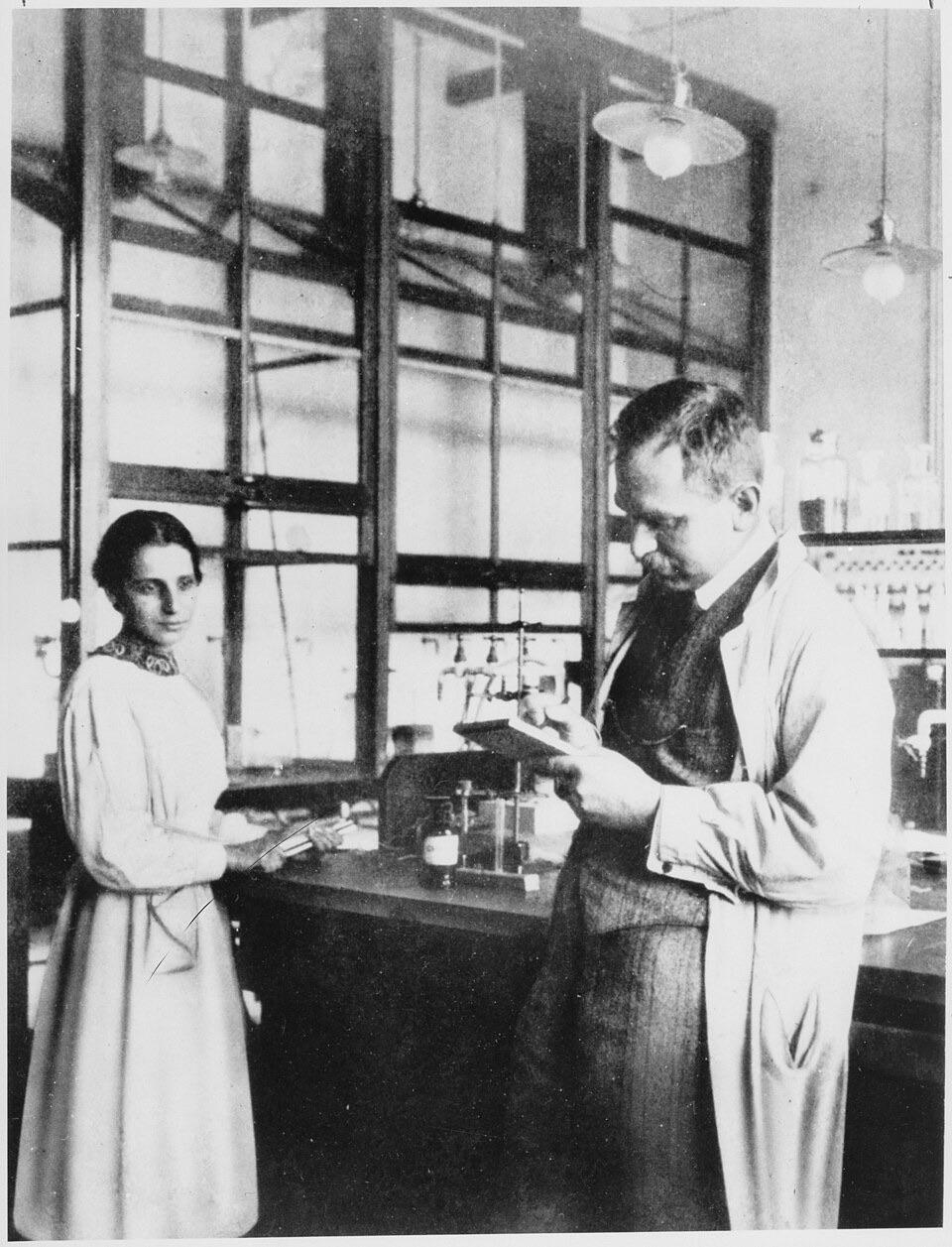
Lise Meitner and Otto Hahn in their laboratory, 1913
In Berlin, Otto Hahn fired neutrons at uranium and found barium , an element about half its size
His colleague of thirty years, Lise Meitner , had fled Nazi Germany that summer
At Christmas in Sweden, she and her nephew Otto Frisch worked it out: the uranium nucleus had split in two
Frisch named it fission , after the way a living cell divides
The Nobel Prize for the discovery went to Hahn alone.
Photograph: unknown photographer, 1913 , public domain.
Fission
Chain reaction.
Each fission gives out 2 or 3 neutrons
Each neutron can split another nucleus
The number of fissions multiplies at every step
EACH FISSION STARTS MORE NOT TO SCALE
0 Neutron
Two go on each time: after 10 steps, \(2^{10} \approx 1000\) fissions
Drawing one
Start with one neutron hitting one nucleus. Show it split into two smaller nuclei and two or three neutrons. Draw each new neutron hitting another nucleus, which splits in the same way. Two generations are enough to show the idea.
Why so fast?
Each step takes a tiny fraction of a second, so the multiplying happens almost at once. About eighty steps of doubling would split every nucleus in a kilogram of uranium-235. That is why the chain must be controlled, or it releases its energy as an explosion.
Not every neutron causes a fission: some escape, like the faint ones in the diagram, and some are absorbed. A chain reaction keeps going only if, on average, at least one neutron from each fission splits another nucleus.
Fission
Reactor or bomb?
IN A NUCLEAR REACTOR NOT TO SCALE
Reactor: controlled. On average, one neutron from each fission causes another fission, so energy is released at a steady rate
Weapon: uncontrolled. On average, more than one neutron from each fission causes another fission, so the energy is released in an explosion
How the control rods work
They are made of a material, such as boron, that absorbs neutrons without splitting. Lowering them further absorbs more neutrons and slows the reaction; raising them speeds it up. Dropping them in fully stops it.
Why a reactor cannot explode like a bomb
A weapon packs nearly pure uranium-235 or plutonium-239 together so that almost every neutron hits another nucleus. Reactor fuel is mostly uranium-238, which does not split easily, so the chain cannot run away in the same way.
A moderator, such as water or graphite, slows the neutrons down, because slow neutrons are absorbed by uranium-235 more easily.
The story · Chicago, 2 December 1942
Background story · the exam tests the reactor, not these details
A reactor under a stadium.
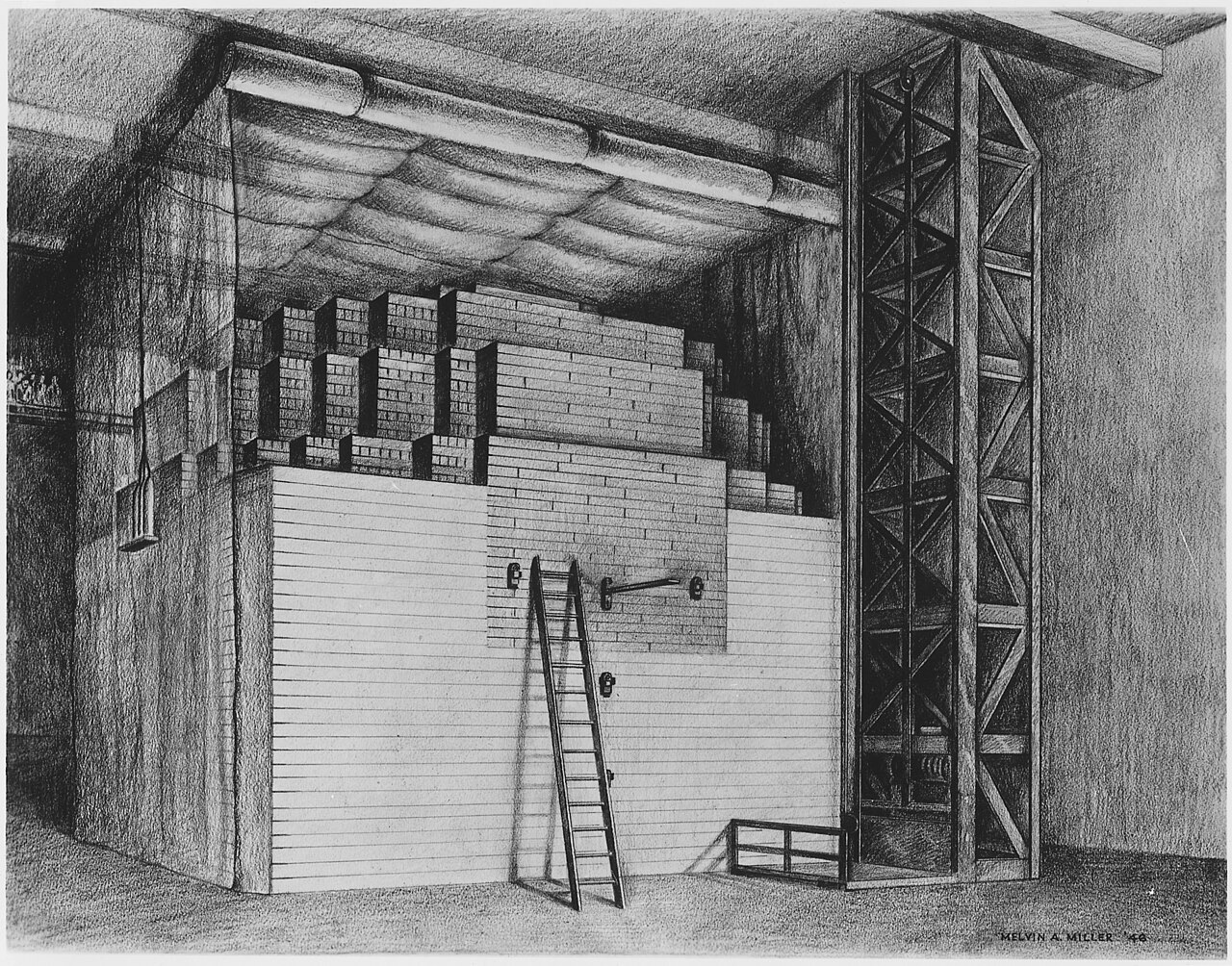
Chicago Pile-1 , drawn by Melvin A. Miller
Under the seats of a university sports ground, Enrico Fermi’s team built a pile of graphite blocks with uranium between them
Wooden strips covered in cadmium were the control rods : they absorbed neutrons
As the rods were pulled out, the count rate climbed. At 3:25 pm the chain reaction kept itself going
Its power was about half a watt : less than a torch bulb
The world’s first controlled chain reaction, with no shielding at all.
Drawing: Melvin A. Miller, Argonne National Laboratory , public domain.
Fusion
Nuclear fusion.
Two light nuclei join to make a heavier nucleus
Some of the mass is converted into energy , released as radiation
How the Sun and other stars release energy
\({}^{2}_{1}\mathrm{H}\) + \({}^{3}_{1}\mathrm{H}\) → \({}^{4}_{2}\mathrm{He}\) + \({}^{1}_{0}\mathrm{n}\)
TOP: \(2 + 3 = 4 + 1\) ✓ , BOTTOM: \(1 + 1 = 2 + 0\) ✓
FUSION OF HYDROGEN NOT TO SCALE
+ Proton0 Neutron
If the numbers balance, where does the energy come from?
The equation counts nucleons, not mass. The helium nucleus and the neutron together have slightly less mass than the two hydrogen nuclei. That missing mass has become energy.
Why is fusion so hard to do on Earth?
Both nuclei are positive and repel each other strongly. They only get close enough to join if they collide extremely fast, which needs temperatures of many millions of degrees, as in the core of the Sun.
Mixing up the two words. Fission: one nucleus splits (think “fissure”, a crack). Fusion: two nuclei fuse together.
Compare
Fission vs fusion.
Fission Fusion
What happens One heavy nucleus splits Two light nuclei join Nuclei used Uranium, plutonium Hydrogen Started by Absorbing a neutron Very high temperature Where Nuclear power stations The Sun and other stars
Both release energy
Quick check
Using the nucleus.
01 Two natural sources of background radiation?
Rocks (radon gas) and cosmic rays
02 Why do aircrew get a higher dose?
More cosmic rays at high altitude
03 Why does a tracer need a short half-life?
Lasts for the scan, then soon decays away
04 What must a uranium nucleus absorb before fission?
A neutron
05 What do control rods do?
Absorb neutrons to control the chain reaction
06 Fusion joins two light nuclei. Where does the energy come from?
Some of the mass is converted into energy
Summary
Key words: Part 4.
Background radiation Around us all the time Natural and man-made
Radon Radioactive gas From rocks
Radiation dose Risk of harm Sievert (Sv)
Tracer Gamma emitter in the body Short half-life
Radiotherapy Kills unwanted cells Gamma beams
Fission Heavy nucleus splits After absorbing a neutron
Chain reaction Neutrons cause more fissions
Control rod Absorbs neutrons Controls the reaction
Fusion Two light nuclei join Mass → energy